6074816-UIM-A-0421
Johnson Controls Ducted Systems 5
PRECAUTIONS DURING BRAZING OF LINES
All outdoor unit and evaporator coil connections are copper-to-copper
and must be brazed with a phosphorous-copper alloy material such as
Silfos-5 or equivalent. Do not use soft solder. The outdoor units have
reusable service valves on both the liquid and vapor connections. The
total system refrigerant charge is retained within the outdoor unit during
shipping and installation. The reusable service valves are provided to
evacuate and charge per this instruction.
Serious service problems can be avoided by taking adequate precau-
tions to assure an internally clean and dry system.
PRECAUTIONS DURING BRAZING SERVICE VALVE
Precautions must be taken to prevent heat damage to service valve by
wrapping a wet rag around it as shown in Figure 5. Protect all painted
surfaces, insulation, and the plastic base during brazing. After brazing,
cool the joint with a wet rag.
Open the valve by removing the service valve cap, fully inserting a hex
wrench into the stem, and backing out counterclockwise until the valve
stem just touches the chamfered retaining wall.
Connect the refrigerant lines using the following procedure:
1. Remove the cap and Schrader core from both the liquid and vapor
service valve service ports at the outdoor unit. Connect low pres-
sure nitrogen to the liquid line service port.
2. Braze the liquid line to the liquid valve at the outdoor unit. Be sure
to wrap the valve body with a wet rag. Allow the nitrogen to con-
tinue flowing.
3. Carefully remove the plugs from the indoor coil liquid and vapor
connections at the indoor coil.
4. Braze the liquid line to the indoor coil liquid connection. Nitrogen
must be flowing through the indoor coil.
5. Slide the grommet away from the vapor connection at the indoor
coil. Braze the vapor line to the evaporator vapor connection. After
the connection has cooled, slide the grommet back into original
position.
6. Protect the vapor valve with a wet rag and braze the vapor line con-
nection to the outdoor unit. The nitrogen flow must be exiting the
system from the vapor service port connection. After this connec-
tion cools, remove the nitrogen source from the liquid fitting service
port.
7. Replace the Schrader core in the liquid and vapor valves.
8. Go to SECTION IV for TXV installation.
9. Leak test all refrigerant piping connections, including the service
port flare caps, to be sure they are leak tight. Do not over-tighten
(between 40 in. lb and 60 in. lb maximum).
10. Evacuate the vapor line, indoor coil, and liquid line to 500 microns
or less.
11. Replace cap on service ports. Do not remove the flare caps from
the service ports except when necessary for servicing the system.
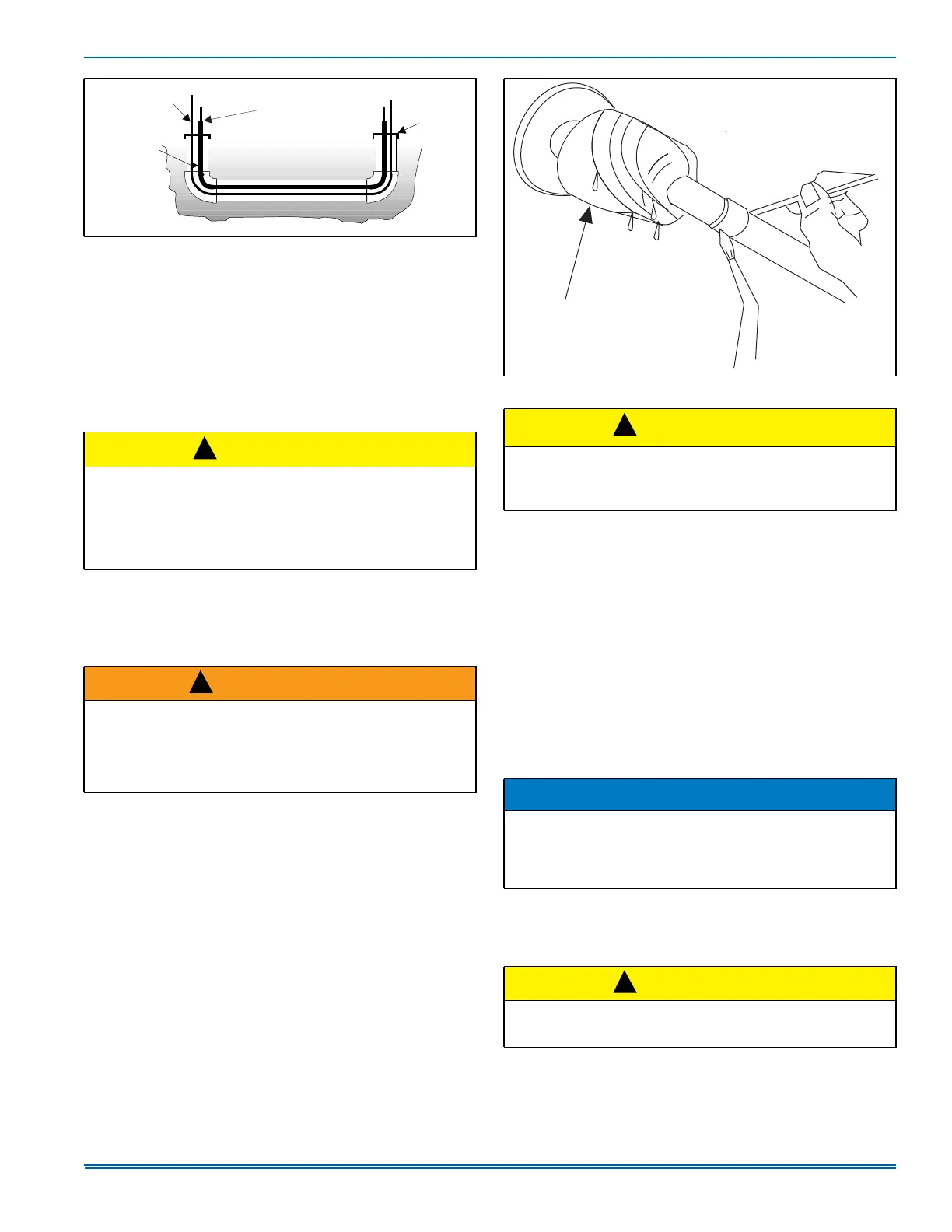
Figure 4: Underground Installation
CAUTION
Dry nitrogen must always be supplied through the tubing while it is
being brazed, because the temperature required is high enough to
cause oxidation of the copper unless an inert atmosphere is provided.
The flow of dry nitrogen must continue until the joint has cooled.
Always use a pressure regulator and safety valve to insure that only
low pressure dry nitrogen is introduced into the tubing. Only a small
flow is necessary to displace air and prevent oxidation.
WARNING
This is not a backseating valve. The service access port has a valve
core. Opening or closing valve does not close service access port.
If the valve stem is backed out past the chamfered retaining wall, the
O-ring can be damaged causing leakage or system pressure could
force the valve stem out of the valve body possibly causing personal
injury.
TO IND
OOR C
OI
L
TO
O
UT
DO
OR
U
NI
T
LI
QU
ID
LIN
E
CA
P
PVC
CO
ND
U
IT
IN
SU
LA
TE
D
VAPOR LINE
A0152-001
!
!
Figure 5: Heat Protection
CAUTION
Do not install any coil in a furnace which is to be operated during the
heating season without attaching the refrigerant lines to the coil. The
coil is under pressure which must be released to prevent excessive
pressure build-up and possible coil damage.
NOTICE
Line set and indoor coil can be pressurized to 250 psig with dry nitro-
gen and leak tested with a bubble type leak detector. Then release
the nitrogen charge.
Do not use the system refrigerant in the outdoor unit to purge or leak
test.
CAUTION
Do not connect manifold gauges unless trouble is suspected. Approx-
imately 3/4 oz of refrigerant is lost each time a standard manifold
gauge is connected.
$
:(75$*6
:UDSZHWUDJV
DURXQGVHUYLFHYDOYH
RUUHIULJHUDQWOLQHV
SULRUWREUD]LQJ
!
!



 To Next Page