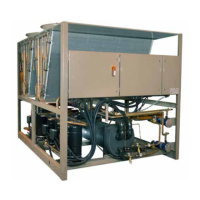
YLHA SELECTION EXAMPLE
A YLHA heat pump operating at a 35°C ambient temperature should chill water from 13°C to 7°C, with
a 112 kW cooling capacity.
A 110 kW heating capacity is required in 5 °C design ambient temperature and a hot water outlet
temperature of 40 °C.
The fouling factor is 0.044 m
2
°C/kW, with the unit operating at sea level (no corrections). With a quick
glance of capacity Tables 3 and 5, we see that a YLHA 120 heat pump gives the approximate required
capacities of:
• Cooling capacity = 114 kW
• Total unit absorbed power = 43.2 kW
• Cold water temperature = 13 °C to 7 °C (Temp. diff. of 6 °C)
• Hot and cold water flow = 16 340/h
• Heating capacity = 110.1 kW
• Total unit absorbed power in heat mode = 35.8 kW
• Hot water outlet temperature = 40 °C
Hot water temp. dif‐
ferential
=
110.1 x 860
= 5.8 °C
16 340
Thus, hot water return temperature is = 34.2°C
All values are within operating limits:
• Available pressure in hydraulic circuit of a unit with pack:
• From Table 6 we infer that the YLCA 120, with a 16 340 l/h flow, has an available pressure of 289
kPa.
• Pressure drop in hydraulic circuit of a unit without pack:
– From the table we infer that the YLCA 120, with a 16 340 l/h flow, has an available pressure of 21
kPa.
• Pressure drop in filter.
– From Table
Pressure drop in filters, see on page 16
, 2 1/2" filter, we infer that with a 16 340 l/h
flow rate, said filter has a pressure drop of 2.2 kPa.
1.4.1 Selection guide with glycol (cooling units only)
Necessary information
The following information is needed to select a YLCA cooling unit:
1. Cooling capacity needed
2. Design cold water/glycol inlet and outlet temperatures.
3. Design water/glycol flow rate.
4. Design inlet temperature of air to the condenser. Normally, this will be the design ambient temperature
of summer air, unless influenced by the situation or other factors.
5. Altitude above sea level.
6. Design fouling factor of the evaporator.
N O T E
Points 1, 2 and 3 should be related by means of the following formulae:
Capacity (kW) =
Temp. diff. (°C) x Flow rate (litres/sec.)
Glycol factor
Temp. diff. (°C) = Liquid inlet Liquid Inlet ‑ Liquid Outlet Temp.
1
Quick installation guide
1.4 Selection guide (YLCA/YLHA)
6



 To Next Page
 Loading...