BUTTONHOLES
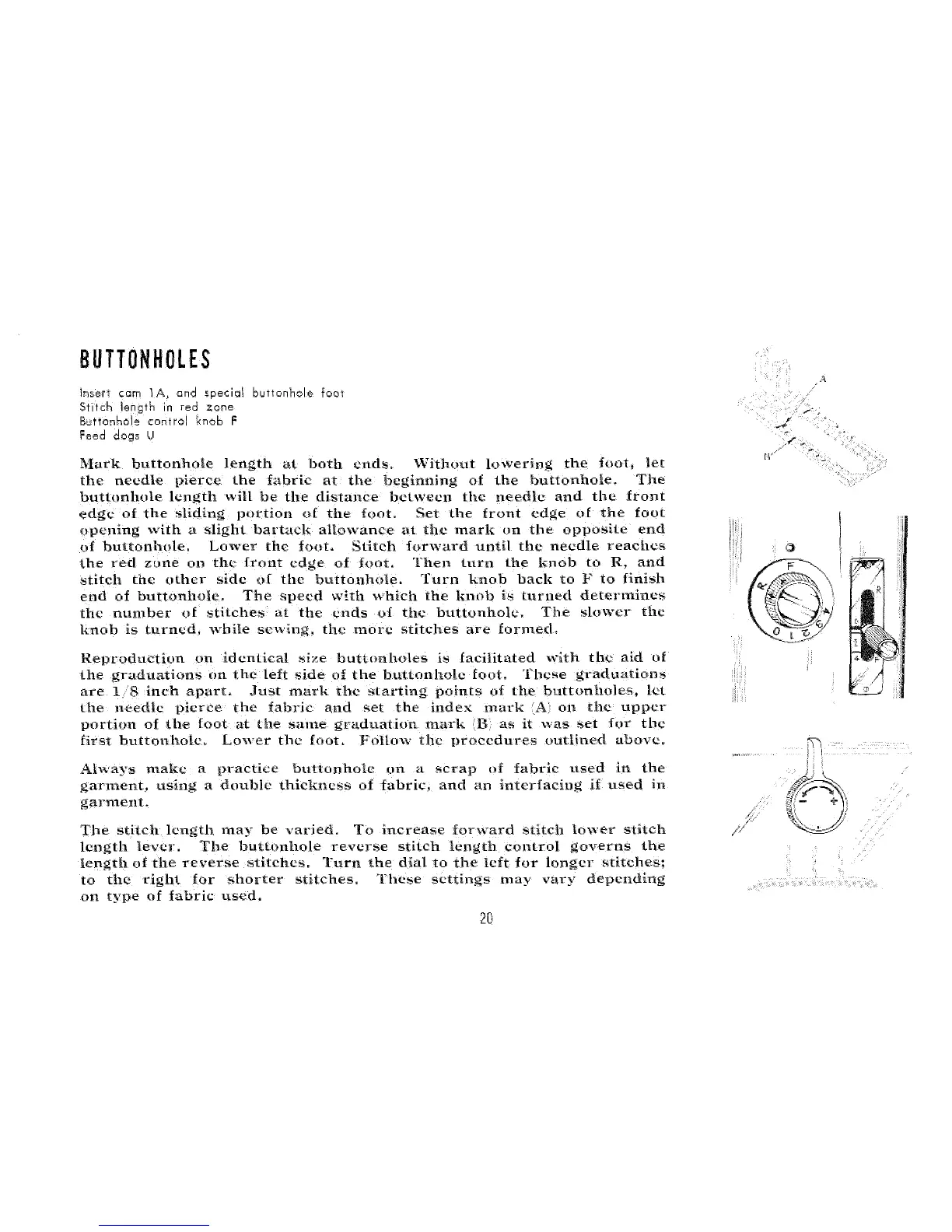
lr_ser_; _am IA ano _3ecic
Stitch lenGTn _ rea zone
Buttonhole control Knoa =
Feec _cJgs
buttonhole foot
Mark buttonhole length al_ both ends+ Without lowerisg the foot. let
the; needle pierce the fabric at the beginning of the buttonhole. The
Buttonhole length will be the distance betweell the needle and the front
edge o| the siidlng portion _i the four, Set the front edge of the foot
,,pening with a slight bartack allowance at the mark on the opposite end
Oi buLtonhole, Lower the foot, Stitch furward until the needle reaches
the red zone on the front edge of too_, Then turn the knob 1o R. and
stitch the other side of the buttonhole. Turn knob back [o F to finish
end of buttonhole. The speed _v;.th which the knob is fumed determines
the nnntber of stitches at the ends ot the buttonhole, The slower the
knob is turned, while sewing, the more stitches are formed,
Reproduction on identical size bt,_onholes is facilitated with the aid oi
the graduations on the left side oi the bt_ttonhole foot. These graduationn
are 1 8 inch apart. Just mark the starting points ot the buttonholes, let
the needle pierce the fabric and set the index nlark A on the upper
portion of the foot at the same graduation mark B as it was set for the
[irsi buttonholc_ Lower the foot. Follow the procedures ,,utlined above.
Always make a practice buttonhole on a scrap oi fabric used in the
garment, using a double thickness of fabric, and an interfacing if used in
al'lTielll;.
The stitch length may be varied. To increase forward stitch lower stitch
length Lever. The buttonhole reverse stitch length control governs the
length of the reverse stitches. Turn the dial to the icft for longer stitches:
to the right for shorter stitches. These settings may vary depending
on type of fabric used.
20
<
ii!
w ¸ _ _-
ii •
/i ¸ Ji _
/ %, _,



 To Next Page