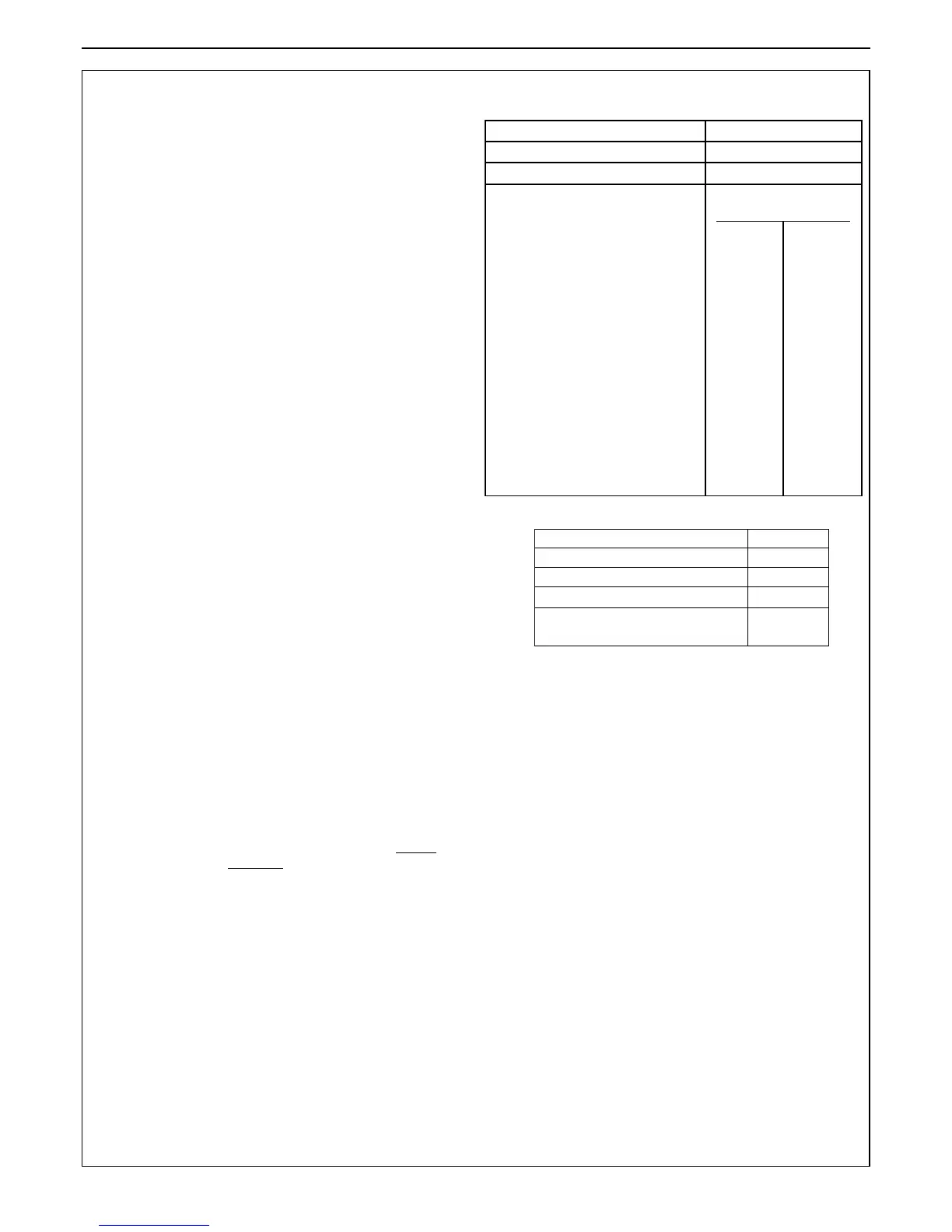
Safety valve setting bar 3.0
Vessel charge pressure bar 0.5 to 0.75
System pre-charge pressure bar None 1.0
System volume
(litres)
Expansion vessel
volume (litres)
25 1.6 1.8
50 3.1 3.7
75 4.7 5.5
100 6.3 7.4
125 7.8 9.2
150 9.4 11.0
175 10.9 12.9
190 11.9 14.0
200 12.5 14.7
250 15.6 18.4
300 18.8 22.1
For other system volumes
multiply by the factor access 0.063 0.074
Water Flow Rate and Pressure Loss
Max CH Output kW 24.2
Water ow rate l/min 17.3
(gal/min) (3.8)
Temperature Differential
o
C 20
Head available for m.w.g. 3.4
system (ft.w.g.) (11.1)
1.14 SYSTEM REQUIREMENTS - Central Heating
Notes
a. The method of lling, relling, topping up or ushing sealed
primary hot water circuits from the mains via a temporary hose
connection is only allowed if acceptable to the local water
authority.
b. Antifreeze uid, corrosion and scale inhibitor uids suitable for
use with boilers having aluminium heat exchangers may be used
in the central heating system.
General
1. The installation must comply with all relevant national and local
regulations.
2. The installation should be designed to work with flow
temperatures of up to 84
o
C.
3. All components of the system must be suitable for a working
pressure of 3 bar and a maximum design temperature of 110
o
C. Extra care should be taken in making all connections so
that the risk of leakage is minimised.
The following components are incorporated within the appliance:
a. Circulating pump.
b.
Safety valve, with a non-adjustable preset lift pressure of 3 bar.
c. Pressure gauge, covering a range of 0 to 4 bar.
d. An 8-litre expansion vessel, with an initial charge pressure
of 0.75 bar.
4. ‘Make-up’ Water. Provision must be made for replacing water
loss from the system, either :
a. From a manually lled ‘make-up’ vessel with a readily visible
water level. The vessel should be mounted at least 150mm
above the highest point of the system and be connected
through a non-return valve to the system, tted at least
150mm below the ‘make-up’ vessel on the return side of
the radiators. or
b. Where access to a ‘make-up’ vessel would be difcult, by
pre-pressurisation of the system.
The maximum cold water capacity of the system should
not exceed 143 litres, if not pressurized. However, if
the system is to be pressurized, the efciency of the
expansion vessel will be reduced and a larger vessel
(or smaller system volume) may be necessary. If the
capacity of the vessel is not considered sufcient for this,
or for any other reason, an additional vessel MUST be
installed on the RETURN to the boiler.
Guidance on vessel sizing is given in Table opposite.
5. Filling
The system may be lled by the following method:
Where the mains pressure is excessive a pressure reducing
valve must be used to facilitate lling.
a. Thoroughly ush out the whole system with cold water.
b. Fill and vent the system until the pressure gauge
registers 1bar and examine for leaks. Refer to Section
2.15 for lling detail.
c. Check the operation of the safety valve by raising the
water pressure until the valve lifts. This should occur
within 0.3bar of the preset lift pressure.
d. Release water from the system until the
minimum system design pressure is reached;
1.0 bar if the system is to be pre-pressurised.
DOMESTIC HOT WATER
1. The domestic hot water service must be in accordance with
BS 5546 and BS 6700.
2. Refer to Table 1 for minimum and maximum working
pressures. In areas of low mains water pressures the
domestic hot water regulator may be removed from
the DHW ow turbine cartridge. Refer to Section 3.25.
The boiler will require the ow rate to be set to obtain a
temperature rise of 35
o
C at the tap furthest from the boiler.
3. The boiler is suitable for connection to most types of
washing machine and dishwasher appliances.
4. When connecting to suitable showers, ensure that:
a. The cold inlet to the boiler is tted with an approved
anti-vacuum or syphon non-return valve.
b.
Hot and cold water supplies to the shower are of equal
pressure.
5. Hard Water Areas
Where the water hardness exceeds 200mg/litre, it is
recommended that a proprietary scale reducing device is
tted into the boiler cold supply within the requirements of
the local water company.
IMPORTANT
Provision MUST be made to accommodate the expansion of
DHW contained within the appliance, if a non-return valve is tted
to the DHW inlet, or a water meter with a non-return valve is
installed.
Cold water rising main and pipework in exposed areas need to
be suitably lagged to prevent freezing.


 To Next Page