KMS MD35 manual
Version 4.16 39
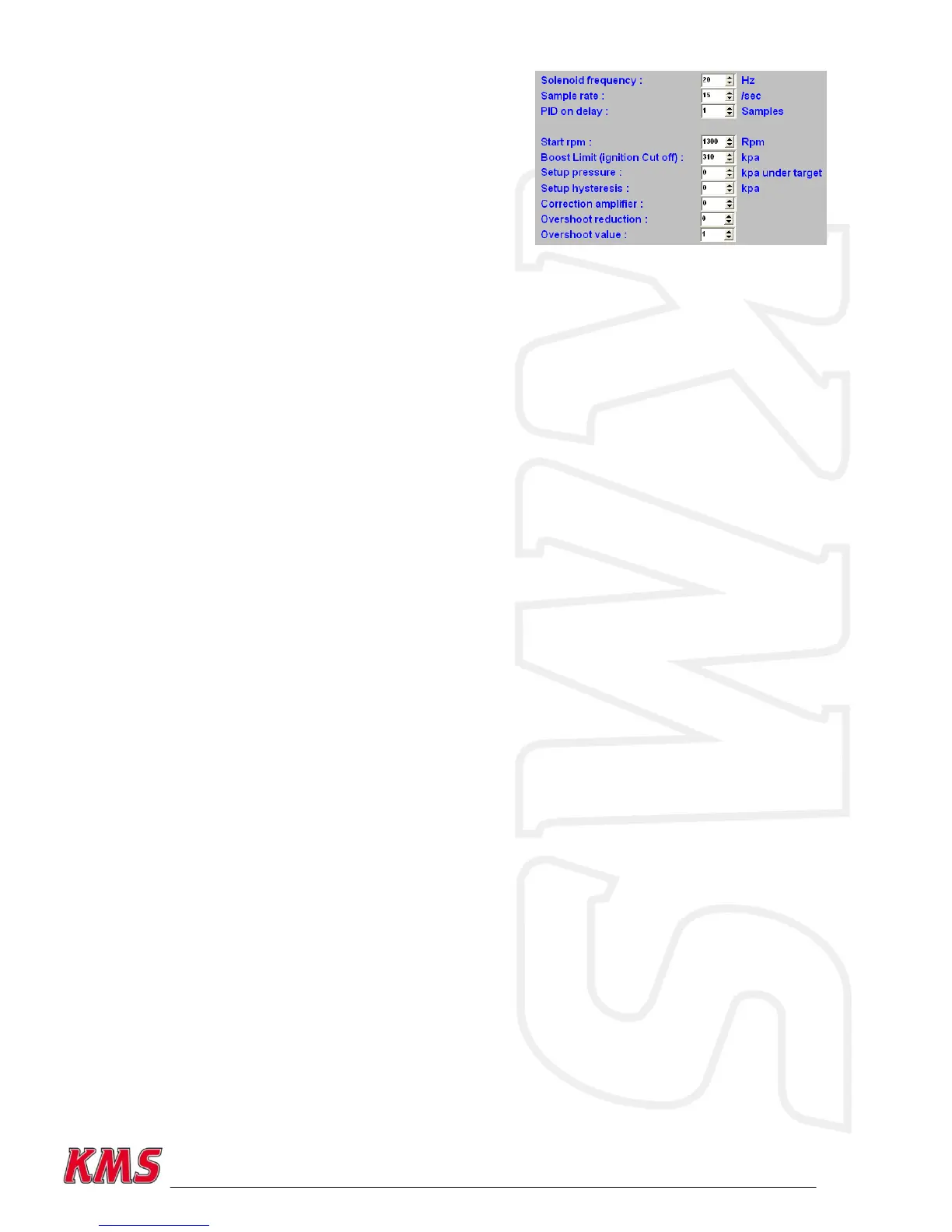
3.2.4.1.9.1 Parameters Boost Control
Solenoid frequency:
Each control valve has a specific frequency at which it
operates best. This frequency can be entered here
between 16 and 40 Hz.
Sample rate:
Specifies the number of measurements per seconds for detecting boost pressure. In case of control
instability, you need to input a lower value. If the control system responds too slowly, a higher
value has to be entered.
PID on delay:
As described before, the PID boost control activates at full throttle. When the throttle is fully open
but the boost pressure target hasn‟t been reached, the PID control will adjust the solenoid position
in order to reach the boost pressure target. However this may cause the boost pressure to build up
so fast, that it will overshoot the target pressure.
The PID on delay can be used to delay the start of the PID control after fully opening the throttle.
This way the boost pressure can build up before the PID control will adjust the solenoid and thus
preventing an overshoot of the boost target pressure. The number of samples entered and the
sample rate determine the duration of the PID on delay.
Start RPM:
Here you can enter the rpm at which the control may activate. This helps avoid unnecessary
operation of the solenoid valve at low revs.
Boost Limit (ignition cut off):
In case the boost pressure exceeds the target value (risk of engine damage), you can specify a limit
with this parameter. When the boost pressure reaches this limit, ignition and injection will be
interrupted.
Setup pressure:
To allow the turbo system to respond as quickly as possible but not overshooting the target, it is
important that the PID control only activates above a certain boost pressure (the boost pressure
should reach first a stable pressure with the fixed PWM value). Therefore the setup pressure (in
kPa) should be kept slightly lower than the target boost pressure (recommended: 20 – 40 kPa below
target pressure). From this setup pressure the PID starts to control the boost up to the target.
So it is important that boost pressure will reach setup pressure with the fixed PWM values,
otherwise PID control wil not activate!
Setup hysteresis:
Once the setup target pressure has been reached and the pressure consequently decreases, it is
advisable not to switch off the control at once, but to allow for a certain pressure reduction prior to
switching off.


 To Next Page