Ignition on / off
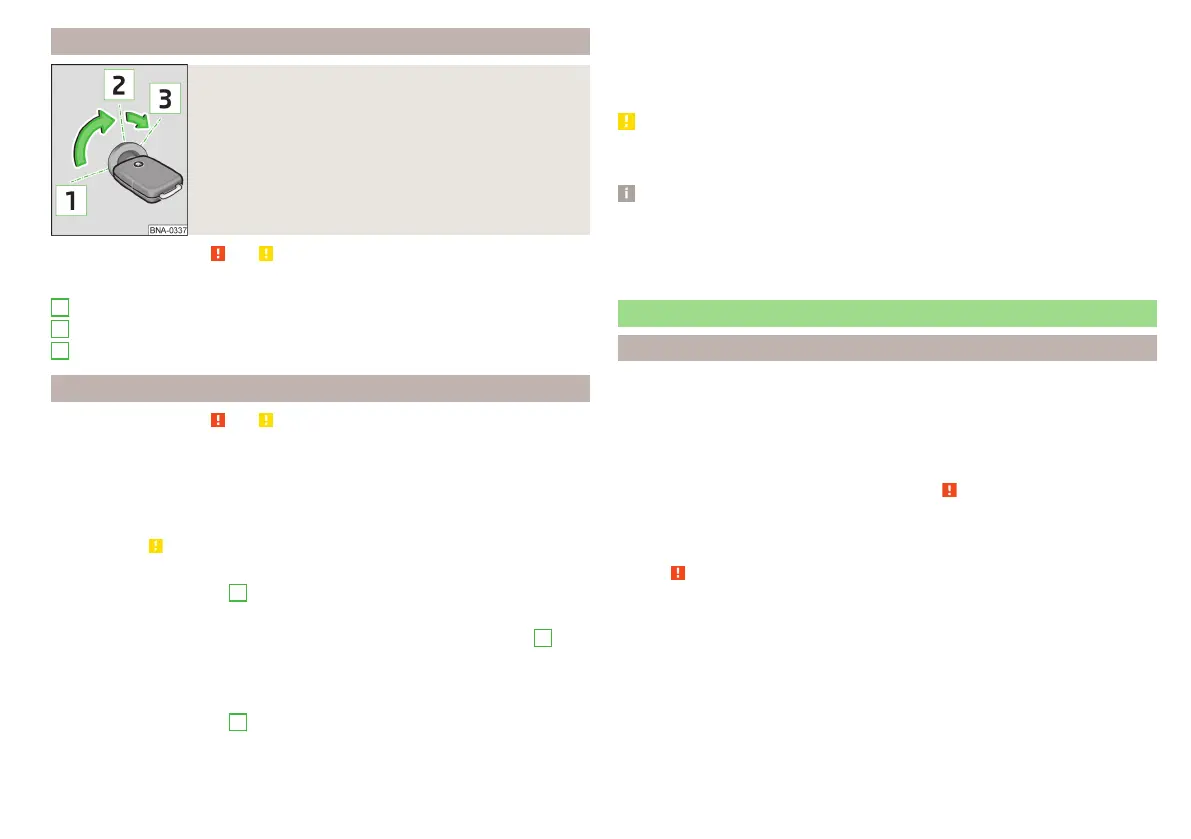
Fig. 61
Positions of the vehicle key in the ignition lock
Read and observe and on page 54 first.
Positions of the vehicle key in the ignition lock » fig. 61
Ignition switched off, engine switched off
Ignition switched on
Starting the engine
Starting engine / Stopping
Read and observe and on page 54 first.
Before starting the engine
›
Firmly apply the handbrake.
›
For vehicles with manual gearboxes, select neutral, depress the clutch pedal
and hold it there until the engine starts.
›
For vehicles with automatic transmission, place the selector lever in position
P or N and »
depress the brake pedal until the engine starts.
Starting engine
›
Turn the key to position
3
» fig. 61 on page 55, the start-up process will be-
gin. Then release the key, the engine will start automatically.
If the engine does not start within 10 seconds, turn the key to position
1
. Re-
peat the start-up process after 30 s.
Switching off the engine
›
Stop the vehicle.
›
Turn the key to position
1
» fig. 61 on page 55.
For vehicles with automatic transmission, the ignition key can only be removed
if the selector lever is in position P.
1
2
3
Do not switch the engine off immediately at the end of your journey if the en-
gine has been working at high revs over a prolonged period, but leave it to run
at an idling speed for about 1 minute. This prevents any possible accumulation
of heat when the engine is switched off.
CAUTION
When the outdoor temperature is below -10 ° C, the selector lever when start-
ing must always be in P mode.
Notice
■
The engine running noises may louder at first be louder for a short time after
starting the cold engine.
■
After switching off the ignition, the radiator fan may (also intermittently)
continue to operate for approx. 10 minutes.
Brakes and parking
Introduction
The wear of the brake pads is dependent on the operating conditions and driv-
ing style. In difficult conditions (e.g. urban, sporty driving), the condition of the
brakes should be checked between service intervals by a specialist garage.
The performance of the brakes can be delayed if the brakes are damp, iced up
in winter or if covered in a layer of salt. The brakes should be cleaned and
dried by applying the brakes many times over »
.
Corrosion on the brake discs and dirt on the brake pads can occur if the vehi-
cle has been parked for a long period and if you do not make much use of the
braking system. The brakes must be cleaned by applying the brakes several
times » .
Before negotiating a long or steep gradient, reduce speed and shift down a
gear. As a result, the braking effect of the engine will be used, reducing the
load on the brakes. If, nevertheless, there is a need for additional braking, it
should be carried out at intervals.
New brake pads must first be “run in” because these do not initially have the
best possible braking effect. Drive especially carefully for the first 200 km or
so.
55
Starting-off and Driving



 To Next Page