WARNING
The following instructions must be observed, otherwise there is risk of in-
jury.
■
Ensure the vehicle cannot unexpectedly roll away.
■
Always ensure the base plate of the lifting jack cannot slip.
■
Place a wide and stable base material under the jack if on a loose surfa-
ces (e.g. gravel).
■
Place an anti-slip base material (e.g. a rubber mat) under the jack if on a
smooth surface (e.g. cobblestones).
■
Always raise the vehicle with the doors closed.
■
Never position any body parts (e.g. arms or legs) under the vehicle while
the vehicle is raised.
■
When the vehicle is raised, never start the engine.
CAUTION
It is important to ensure that the jack is correctly positioned against the bar of
the lower beam - otherwise there is a risk of damage to the vehicle.
Jump-starting
Introduction
WARNING
■
The following instructions must be followed at all times when working on
the engine compartment » page 75.
■
When handling the vehicle battery, the following warnings must be ob-
served » page 80.
■
A discharged vehicle battery may already freeze at temperatures just be-
low 0 °C. If the battery is frozen, do not carry out a jump start with the bat-
tery of another vehicle – There is a risk of explosion and injury!
■
Never jump-start vehicle batteries with an electrolyte level that is too low
– There is a risk of an explosion and caustic burns!
Jump-starting using the battery from another vehicle
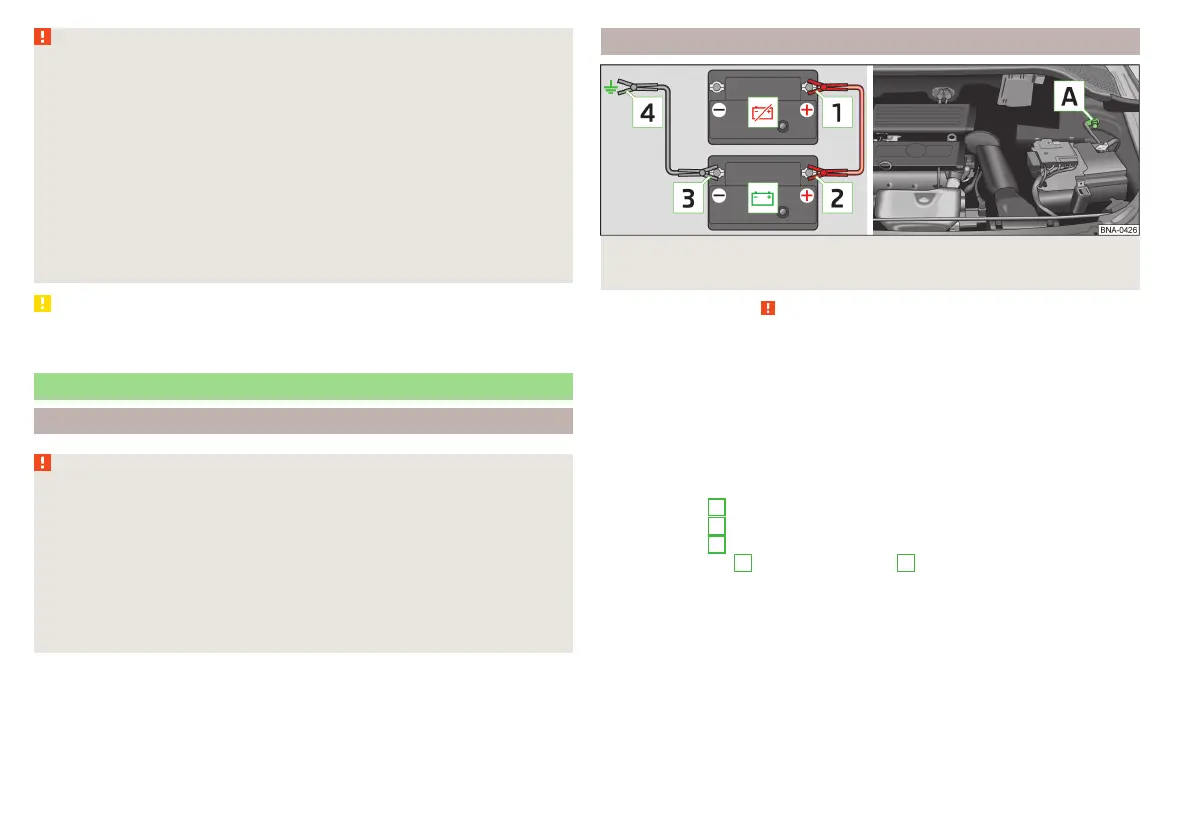
Fig. 93 Jump-starting: – flat battery, – battery providing current /
engine earthing point
Read and observe
on page 90 first.
If, because of a discharged battery, it is not possible to start the engine, the
battery of another vehicle can be used to start the engine. To do this, jump-
start cables are required which have a sufficiently large cross-section and insu-
lated terminal clamps.
The rated voltage of the two batteries must be 12 V. The capacity (Ah) of the
power-supplying battery must not be significantly lower than the capacity of
the discharged battery.
The jump-start cables must be attached in the following sequence.
›
Attach clamp
1
to the positive terminal of the discharged battery.
›
Attach clamp
2
to the positive terminal of the power-supplying battery.
›
Attach clamp
3
to the negative terminal of the power-supplying battery.
›
Attach the clamp
4
to the earthing point
A
or to a solid metal component
firmly connected to the engine block or to the engine block itself.
Starting engine
›
Start the engine on the vehicle providing the power and allow it to idle.
›
Initiate the starting process in the vehicle with the discharged battery.
›
If the engine does not start within 10 s, then cancel the starting procedure
and repeat after half a minute.
›
Disconnect the jumper cables in reverse order to connecting.
90
Do-it-yourself



 To Next Page