4 Description
17 of 48
KSB Delta Basic
1983.835/01-EN
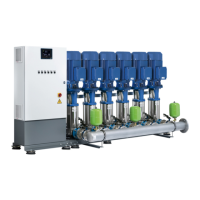
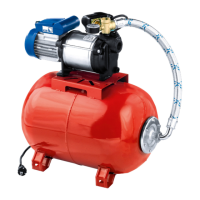
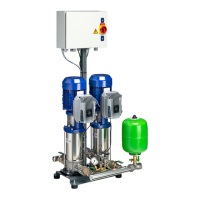
Design The fully automatic pressure booster system is equipped with one or more vertical
high-pressure pumps (2) (all of which are speed-controlled) for pumping the fluid
handled to the consumer installations in the set pressure range.
Function
Automatic mode
One or more pumps (2) are controlled and monitored by motor-mounted frequency
inverters.
As the demand increases or decreases, the pumps are started and stopped
automatically.
As soon as the demand increases again after one pump has been stopped, another
pump which has not been in operation before is started up.
The stand-by pump is also included in the alternating cycle.
2)
The standard setting is for the pressure booster system to start automatically as a
function of pressure; the actual pressure is measured by an analog pressure
measuring device (pressure transmitter).
As long as the pressure booster system is in operation, the pumps are started and
stopped as a function of demand (standard setting). In this way it is ensured that the
individual pumps operate only in line with actual demand. The use of variable speed
pumps reduces wear as well as the frequency of pump starts in parallel operation.
If a duty pump fails, the next pump is started up immediately. A fault is output,
which can be reported via volt-free contacts (e.g. to the control station).
If the demand drops towards 0, the pressure booster system slowly runs down to the
stop point and stops
As standard, one of the pumps is on stand-by. The control unit defines each of the
pumps as stand-by pump in alternation. This prevents stagnation of water in any of
the pumps.
The pressure booster system is designed with dry running protection.
If the pump has not been in operation for 24 hours, a test run is initiated.
Function
Manual mode
In manual mode, a minimum flow is required to protect the pump against
overheating.
4.6 Noise characteristics
The pressure booster system is available with different numbers and sizes of pumps.
For the noise characteristics refer to the operating manual of the pump set. To
calculate the expected total sound pressure level, add a defined value to the
individual pump set’s expected sound pressure level.
Table9: Values for calculating the total expected sound pressure level
Number of pump sets Value
dB(A)
2 + 3
3 + 4,5
4 + 6
5 + 7
6 + 7,5
Example Pressure booster system with 4 pump sets (value: + 6dB(A))
Single pump = 48dB(A)
48dB(A) + 6dB(A) = 54dB(A)
The expected total sound pressure level of 54dB(A) may develop when all 4 pump
sets are running under full-load conditions.
2) Multiple pump systems only


 To Next Page