RDL
15
5.3 Installing the pump/unit
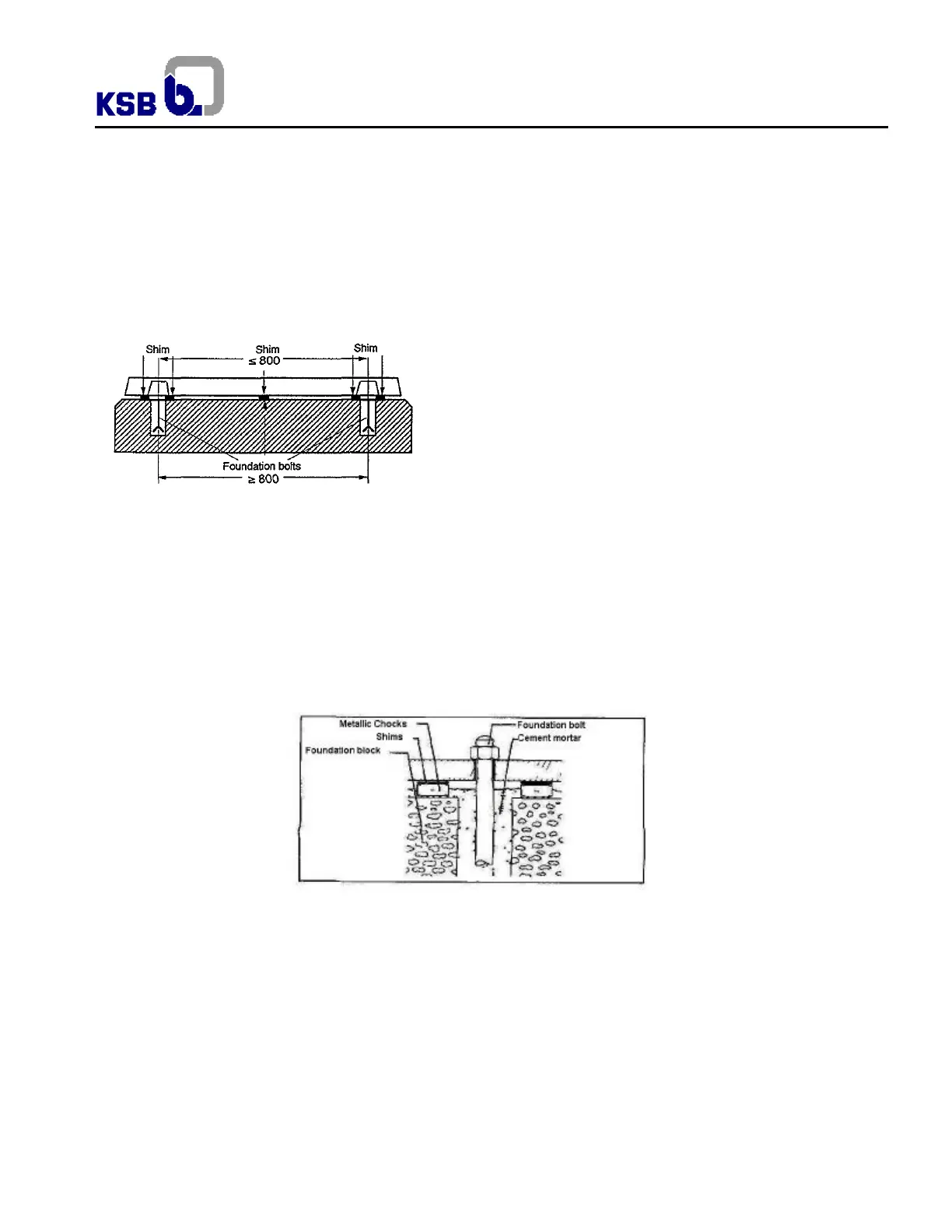
After placing the baseplate (preferably without the pump and driver) on the foundation, level it with the help of a spirit level
placed on the pump and driver pads. Permissible deviation: 0.2 mm/m. Shims should be fitted between the baseplate and the
foundation itself; they shall always be inserted to the left and right of the foundation bolts and in close proximity to these bolts.
For a bolt-to-bolt clearance of more than 800 mm, additional shims shall be inserted halfway between the adjoining holes. All
shims must lie perfectly flush.
Insert the foundation bolts and set them into the foundation using concrete. When the mortar has set, level the baseplate as
described in section 5.3.1 and tighten the foundation bolts evenly and firmly. Then grout the baseplate (see also 5.3.2) using
low shrinkage concrete with a standard particle size and a water/concrete ratio of 0.5. The flowability must be produced with
the help of a solvent. Secondary treatment of the concrete to DIN 1045 is an absolute necessity.
Fig. 11: Fitting required shims
To ensure low-noise operation, the unit can be mounted on vibration dampers (please confirm with KSB first). Expansion joints
can be fitted between pump and suction/discharge line.
5.3.1 Base Leveling
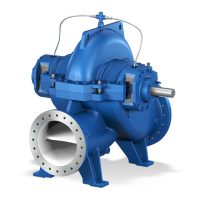
Check if the baseframe is equally leveled on its metallic shims. Place and tighten uniformly the nuts on the foundation bolts.
Using a spirit level, check the leveling of the baseframe longitudinally and transversally.
If the baseframe is unleveled, loosen the anchor bolts nuts and insert additional shims as necessary between the metallic
chocks and the baseframe, so as to correct the leveling. See Fig. 12.
Maximum leveling deviation: 0,2 mm/m.
Fig.12 – Base Leveling
5.3.2 Grouting
In order to obtain a rigidity structure and vibration free operation, the inner side of the baseframe should be filled with grout.
This grout should be prepared with specific products available in the civil construction market, non-shrinking type in order to
avoid contraction during the hardening process and also provide sufficient fluidity to fill the baseframe and prevent from cavities
formation. See Fig.13


 To Next Page