4 SAFE OPERATION
(3)
Do
not refuel the machine indoors and always
clean
up
spilled fuel or oil.
(4)
Do
not store the machine or fuel container inside
where there
is
an
open flame, such
as
in
a water
heater.
8.
Do
not change the engine governor setting or
overspeed the engine.
9.
Never
run
a machine inside a closed area.
10.
Mower blades are sharp and can cut your hands. Wrap
the
blade(s) or wear gloves, and use extra caution
when servicing them.
11.
Keep nuts and bolts, especially blade attachment
bolts, tight and keep equipment
in
good condition.
12.
Do
not smoke when working around the battery.
Keep
all sparks and flames away from battery. The
battery presents
an
explosion hazard because it gives
off hydrogen
and
oxygen
...
especially when
recharging.
13. Before "JUMP STARTING" a dead battery, read and
follow all of the instructions to help protect the
alternator from damage due to extreme load changes.
(See "JUMP STARTING"
in
"OPERATING THE
ENGINE" section.)
Batteries contain
sulfuric acid and produce explosive
gases. Follow the instructions below to prevent
personal injury.
• Wear eye
and
skin protection.
• Keep sparks
and
flame away.
• Always have adequate ventilation while charging
or using the battery.
14.
Keep first
aid
kit
and
fire extinguisher available at all
times.
15.
Disconnect the battery's negative (-) cable before
working
on
or near electric components.
16.
Do
not use or charge the refillable type battery if the
fluid
level is below the LOWER (lower limit level) mark.
Otherwise, the battery component parts may
prematurely deteriorate, which may shorten the
battery's service
life or cause
an
explosion. Check the
fluid
level regularly
and
add distilled water
as
required
so that the fluid
level
is
between the UPPER
and
LOWER levels.
17.
To
avoid sparks from
an
accidental short circuit,
always disconnect the battery's negative (-) cable first
and connect it
last.
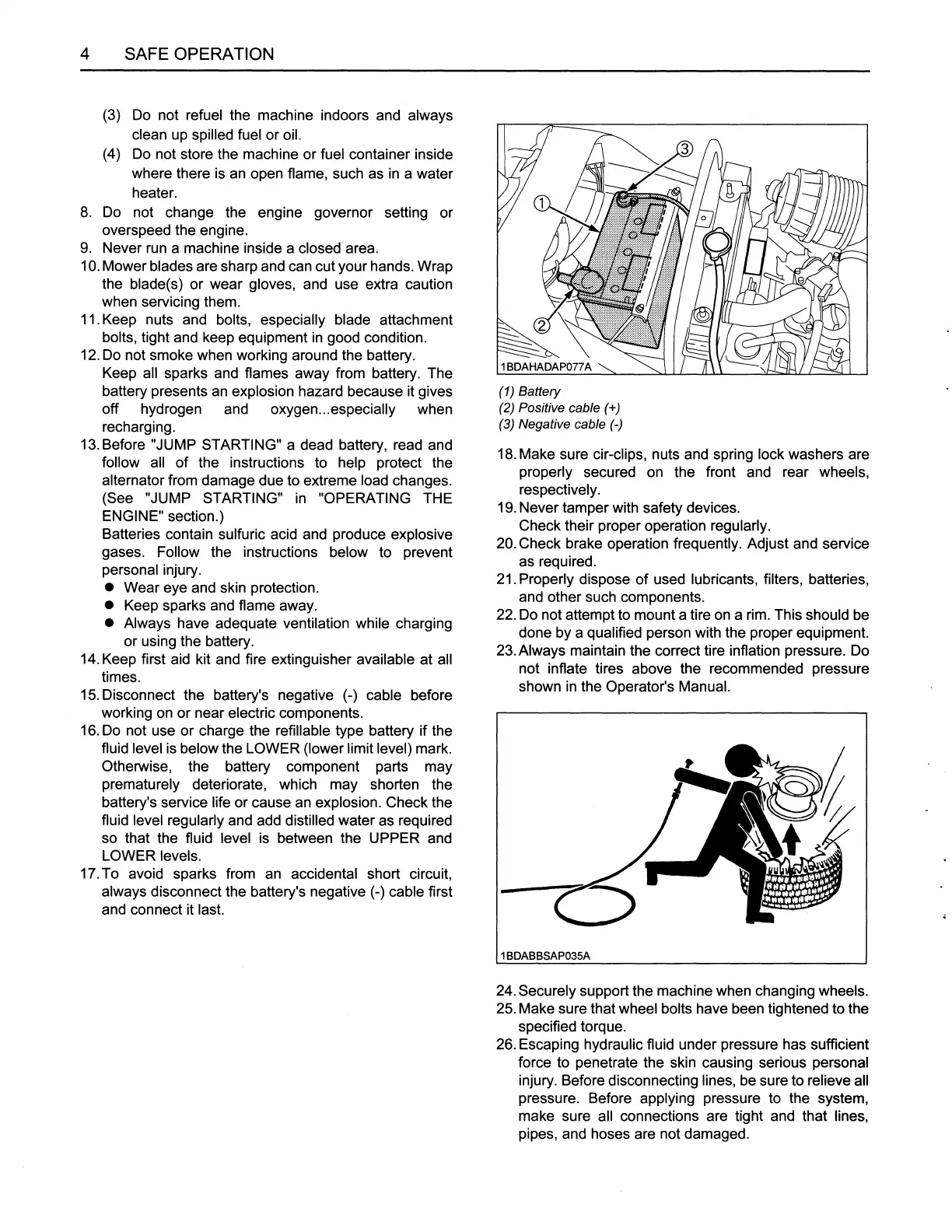
(1) Battery
(2)
Positive cable (+)
(3)
Negative cable (-)
18. Make sure cir-clips, nuts
and
spring lock washers are
properly secured
on
the front
and
rear wheels,
respectively.
19.
Never tamper with safety devices.
Check their proper operation
regularly.
20. Check brake operation frequently. Adjust and service
as required.
21.
Properly dispose of used lubricants, filters, batteries,
and other such components.
22.
Do
not attempt to mount a tire
on
a
rim.
This should
be
done by a qualified person with the proper equipment.
23.
Always maintain the correct tire inflation pressure.
Do
not inflate tires above the recommended pressure
shown
in
the Operator's Manual.
1 BDABBSAP035A
24.
Securely support the machine when changing wheels.
25.
Make sure that wheel bolts have been tightened to the
specified torque.
26. Escaping
hydraulic fluid under pressure has sufficient
force to penetrate the skin causing serious
personal
injury. Before disconnecting lines,
be
sure to relieve all
pressure. Before applying pressure to the system,
make sure
all connections are tight and that lines,
pipes,
and
hoses are not damaged.



 To Next Page