20
ENGLISH
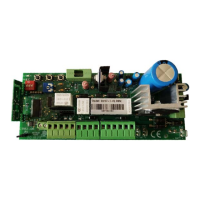
9) Definitions of Programming Keys
P1 - Allows to insert/cancel the remote control codes in the memory
P2 - Allows to set the motors’ work time
P3 - Allows to set the pause time
10) Definitions of Protection Fuses
F1 – Battery fuse (10A - Fast)
It disconnects the backup battery from the electronic card in case of short-circuit or electric current consumption anomalies.
F2 - Services resettable fuse (0,5A - Slow)
It protects the electronic unit in case of short circuits or over-currents on photo-cells or any other accessory devices connected to the card.
11) Technical features
Power supply
The electric power is supplied to the electronic card and the motors by means of an electric transformer fitted with a protection fuse. The appliance
may be connected to an optional backup battery for the automation system to work in case of absence of Mains power supply.
Battery can be 12Vdc / 7Ah or 24Vdc / 4 Ah, it depends on the power supply in use.
Radioreceiver (Rolling-code)
The electronic unit contains a two-channel radio receiver allowing remote control of the gate by means of the radio transmitter. The radio receiver
channel 1 acts as Start control and channel 2 acts as Pedestrian start. Pedestrian start control can be supplied only by remote control and It is
employed to request the opening or closure of one wing only (M2), see the chapter “Remote control codes self-learning”. The radio receiver operates
with a self-learning logic and can store up to 50 codes. Each code may be addressed on the desired channel (start or pedestrian start). The memory
contents is preserved in absence of power supply. The memory contents may be erased (total cancellation).
Work time
The motors’ work time is controlled by two independent digital timers. If any command interrupts the wing’s travel before its end, the Timer stops and
the elapsed time is stored in memory. Therefore the unit can determine, with a fair approximation, the partial working time necessary to the wing to
end its travel. If programmed in manual mode, for the automation system to work properly the work time value to be set (see the chapter “work times
setting”) must be slightly (approx. 5 sec.) above the wing’s real work time. We recommend to adjust the work time so that the wing starts to slow down
at min. 50 cm. from the end of its travel. The stop of the wing depends by the current consumed by the motor (Torque). During the normal speed
phase, when the motor's current reaches the self-learned value, due to an obstacle, the gate stops (both wings). In opening it reverses its motion for
approx. 2 sec., while during the closure phase , the gate reverses its motion for all the stroke. After the electric power is supplied to the electronic card
(at installation), or after one absence of power supply, when the Start push-button is pressed for the first time the gate performs an opening cycle.
Warning : In case of absence of power supply the position of the shutters will be lost (Timers reset).


 To Next Page