126 / Miscellaneous/Precautions and care instructions
Care instructions
• As any soiling also represents a growth medium for
microorganisms, you should take care to keep the
equipment clean.
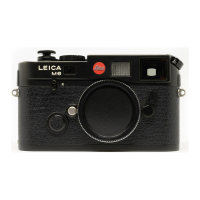
For the camera
• Only clean the LEICA M8 with a soft, dry cloth.
Stubborn dirt should first of all be covered with a
well-thinned cleaning agent and then wiped off with
a dry cloth.
• To remove stains and fingerprints, the camera and
lens should be wiped with a clean lint-free cloth.
Tougher dirt in hard to reach corners of the camera
body can be removed with a small brush. Be careful
not to damage the shutter blades, for instance with
the shaft of the brush.
• All mechanically operated bearings and sliding sur-
faces on your LEICA M8 are lubricated. Please
remember this if you will not be using the camera
for a long period of time. To prevent the lubrication
points becoming gummed up, the camera shutter
should be released a number of times every three
months. It is also recommended that you repeatedly
move and use all other controls, such as the image
field selector. The distance and aperture setting
rings on the lens should also be moved periodically.
• Take care not to scratch the sensor for the 6-bit
coding (1.11) in the bayonet fastening, or to get it
dirty. Take care also that no grains of sand or simi-
lar particles enter the fastening, where they could
scratch the bayonet. Never wet this component
when cleaning it!
For lenses
• Normally, a soft hair brush is sufficient to remove
dust from the outer lens elements. However, in case
of more stubborn dirt, they can be carefully cleaned
with a very clean, soft cloth that is completely free
of foreign matter, using circular motions from the
inside to the outside. We recommend micro-fiber
cloths (available from photographic and optical spe-
cialists) that are stored in a protective container
and can be washed at temperatures of up to 40°C
(without fabric softener, never iron!). Cloths for
cleaning glasses, which are impregnated with chem-
icals, should not be used as they can damage the
lens glass.
• Take care not to scratch the 6-bit coding (1.10) in
the bayonet fastening, or to get it dirty. Take care
also that no grains of sand or similar particles enter
the fastening, where they could scratch the bayo-
net. Never wet this component when cleaning it!
• For optimum front lens protection in unfavorable
photographic conditions (e.g. sand, salt water
spray), use transparent UVa filters. However, you
should bear in mind that, like all filters, they can
cause unwanted reflections in certain backlight
situations and with high contrasts. The generally
recommended lens hood also protects the lens
from unintentional fingerprints and the rain.


 To Next Page