39
SINGLE PASS HALF-BLIND DOVETAILS
Chapter 10Super Jig-12-18-24 User Guide
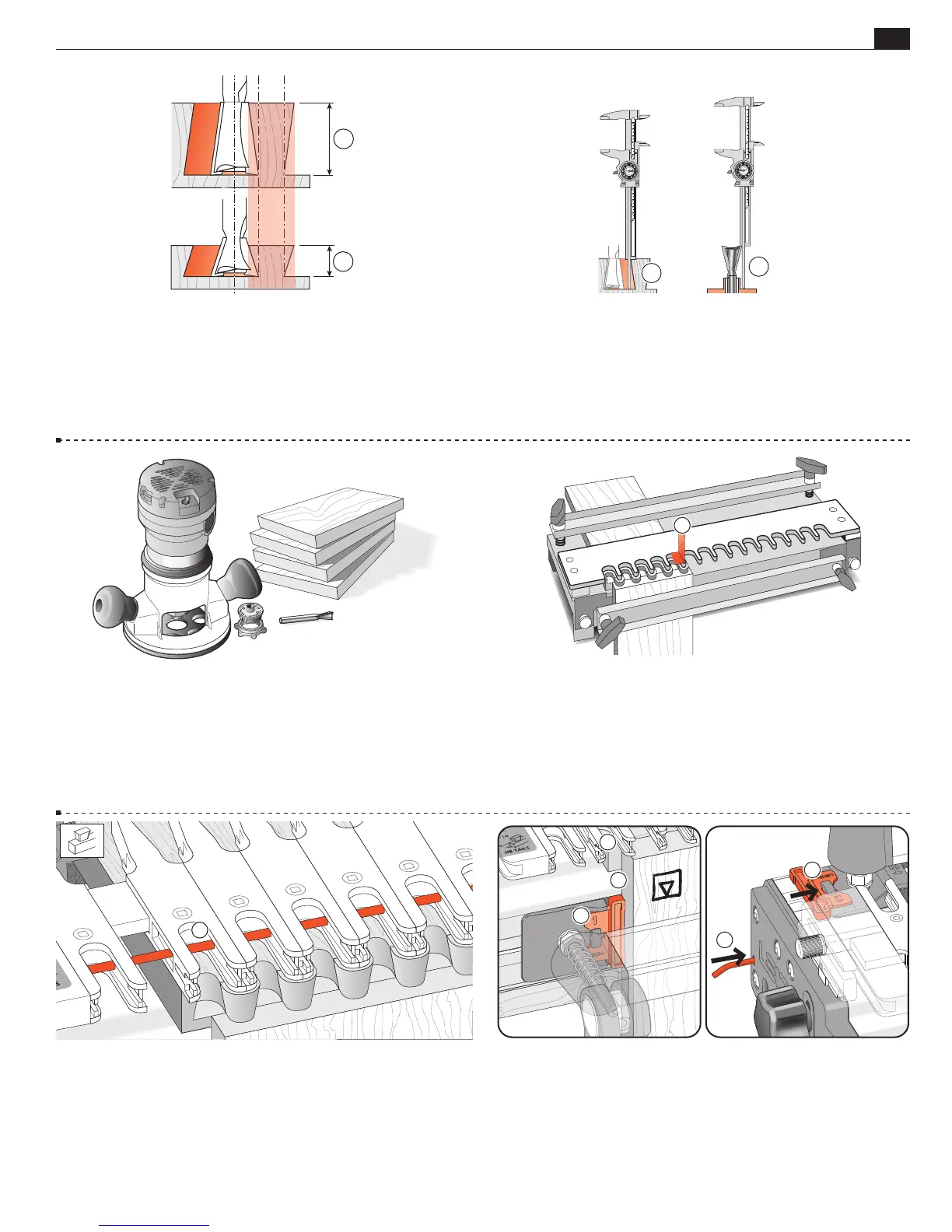
10-3 Bit Angle and Depth of Cut. Half-blind pins and tails
are routed with the same dovetail bit, the same guidebush, and
the same depth of cut. A different depth of cut requires a differ-
ent angled bit. Leigh offers five different angled dovetail bits for
a range of cut depths. A lesser angle, say 8˚, for a deeper cut
; a
greater angle, say 18˚, for a shallower cut
.
1
2
18˚
8˚
10-4 Cumulative plus/minus tolerances in routers, bits and
guidebushes, make it impossible to state exact bit depth for first-
time precision fit. All dovetail jigs require trial and error tests to
attain a fine fitting joint. The good news; we give a starting depth
for each bit. Test and measure the successful ‘Best fit’ depth of
cut
or bit projection
and record for future first-time fits.
1
2
10-5 Routing a Test Joint You need a router, the e7-Bush set
at No.10, the 80-8
1
⁄2"[12,7mm] 8˚ dovetail bit, two
3
⁄4"[19mm]
thick pin boards and two
1
⁄2" thick tail boards. The No.80-8 bit
routs at a shallower ~
1
⁄2"[13mm] depth on single pass dovetails
than on regular variably spaced joints. For this test, start with the
No.80-8 bit projecting 1"[26mm] from the router base.
10-6 This is a typical fixed template comb type jig. The comb
depth
is usually dimensioned to suit the most popular drawer
side thickness of
1
⁄2"[12,7mm].
�
10-7 Superjig features two novel innovations.
A Stop Rod inserted through the fingers
limits router travel to
allow the deep tail socket guides to function as a simple shallow
fixed comb.
1
10-8 The Spacer in the #1 position, slipped into the left-hand
front side stop
correctly offsets drawer sides
from drawer
fronts
. The Spacer stays in place for the complete procedure.
The Stop Rod stores here
➃
and the Spacer here
➄
.


 To Next Page