Asymmetric Dovetails
SUPERJIG - CHAPTER 12
~=
~=
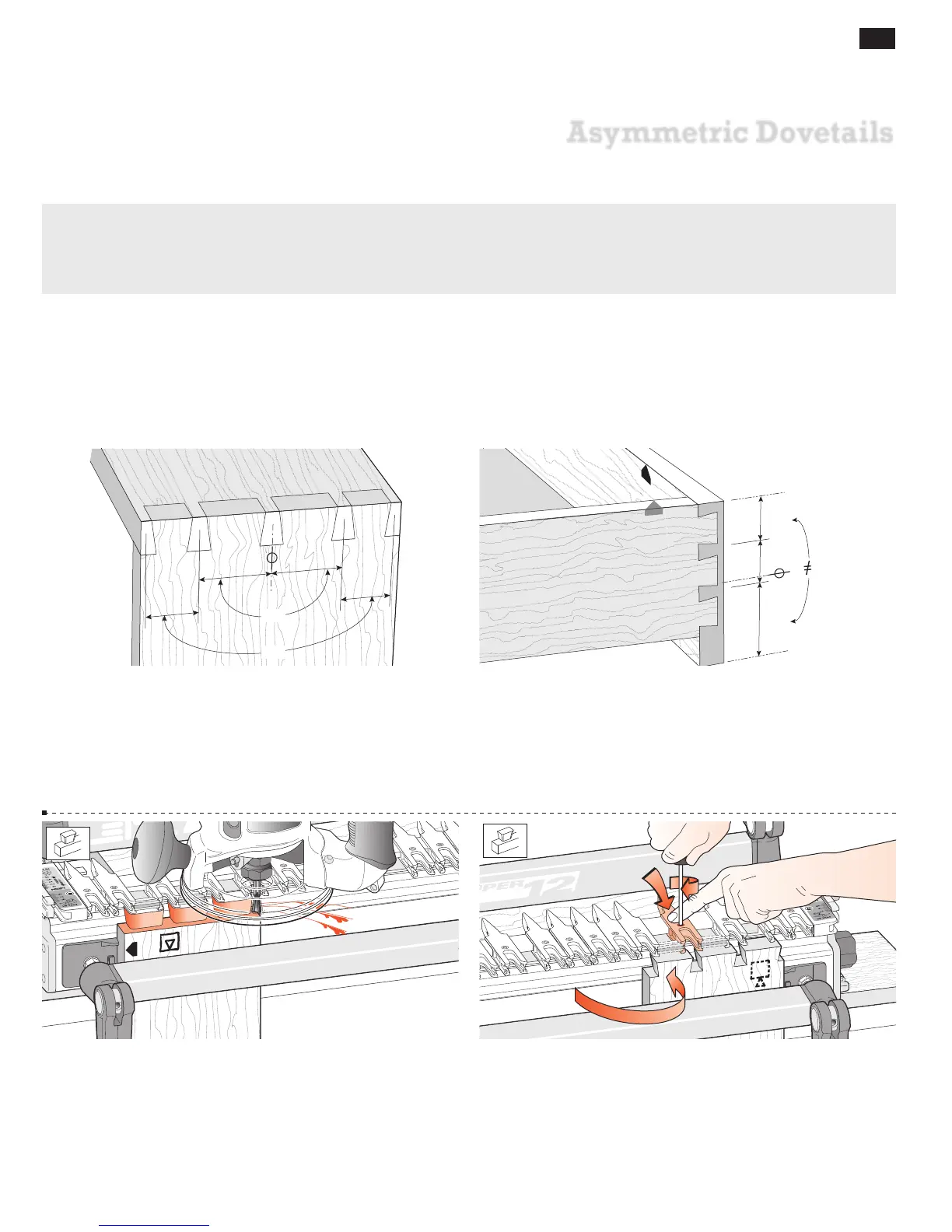
12-1 By symmetrical we mean a joint that looks or is approximately
symmetrical about its center line but is probably not, and need
not be precisely symmetrical. Using the Leigh jig, it is easy to cut
a joint that looks symmetrical; the pins will always align perfectly
with the tails cut at the same spacing. Remember, symmetry is
only required for appearance, not for joinery reasons.
12-2 An asymmetrical joint has a deliberately uneven layout of
pins and tails desired for a project design; for example, this drop-
front drawer. The half-pin at the bottom of the drawer is much
wider than the top half-pin. As the top edges of the front and sides
are flush, it makes sense to use these edges against the side stops
at each end of the jig. Here's how.
12-3 Mount the right-hand drawer sides and pins on the left end
of the jig for routing, and…
12-4 Turn one tailboard (like turning a page in a book) to the
right end of the jig. Now lay out the fingers at the right end to
match the sockets already routed. Now simply rout the left front
corner (tails and pins) on the right side of the jig.
For certain procedures, you will need to use both ends of the Leigh Superjig Jig. Asymmetrical joint layouts are one
example. On the Superjig, no joints will be truly symmetrical, but they can look symmetrical. Apparent symmetry
is desirable for aesthetic reasons, but is not required for strength. Be sure you have read and understood chapters
8 through 10 before attempting these procedures.
47


 To Next Page