To Next Page

C
Christine MunozSep 8, 2025
What causes a Water inlet temperature sensor error in my LG Heat Pump?
- IipageSep 8, 2025
The water inlet temperature sensor is either disconnected or short-circuited.

What causes a Water inlet temperature sensor error in my LG Heat Pump?
The water inlet temperature sensor is either disconnected or short-circuited.
What causes a Water inlet & outlet temperature sensor error in my LG Hydro Kit Heat Pump?
The water inlet and outlet temperature sensors are disconnected or short-circuited simultaneously.
What causes an error due to high or low inverter input voltage in my LG Heat Pump?
The inverter input voltage exceeds the unit limit and lasts for 4 seconds (173 V ~ 289 V).
What causes a Liquid side temperature sensor error in my LG Hydro Kit Heat Pump?
The liquid side temperature sensor is either disconnected or short-circuited.
What causes a Gas side temperature sensor error in my LG Heat Pump?
The gas side temperature sensor is either disconnected or short-circuited.
What causes an Indoor unit EEPROM error in my LG Hydro Kit Heat Pump?
This is due to communication issues between the microprocessor and the EEPROM, or an error due to EEPROM damage.
What causes the Inverter DC Link low voltage in my LG Hydro Kit Heat Pump?
After the inverter activation relay is ON, there is a DC voltage recharge defect.
What causes an Inverter compressor IPM defect in my LG Heat Pump?
The inverter compressor drive IPM is defective, or the inverter compressor itself is defective.
What causes the low pressure ratio error of the inverter compressor in my LG Hydro Kit?
The high pressure/low pressure ratio of the inverter compressor is maintained at below 1.8 for 3 minutes or more.
What does it mean if my LG Hydro Kit displays 'Inverter PSC/PFC Fault Error'?
This error is caused by overcurrent at the inverter input.
Explains the meaning of WARNING and CAUTION symbols used in the manual.
Covers electrical, installation, operational, and handling safety to prevent injury and damage.
Covers safe placement, ventilation, enclosed spaces, power cables, capacitors, and correct parts.
Advises on safe lifting, handling refrigerant, environmental restrictions, and proper cleaning.
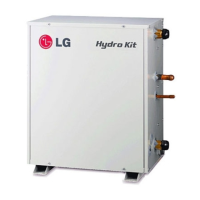
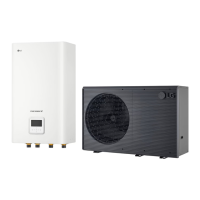
Illustrates the typical installation layout for 8HP and 4HP models, labeling key components and connections.
Details the remote controller display icons and identifies each button's function for operation.
Explains icons related to water pump, defrosting, temperature maintenance, outdoor unit, and child lock functions.
Describes icons for central controller, thermostat, slight trouble, and heavy trouble indicators.
Guides on selecting operation modes and setting target temperatures for heating and water.
Details weather-dependent heating and how to view various temperature readings.
Covers activating and deactivating the child lock feature to prevent unintended controller use.
Explains how slight, heavy, and critical errors are displayed on the remote controller, including error codes.
Provides step-by-step instructions for setting the current time on the controller, including day, AM/PM, hour, and minute.
Guides on setting simple, sleep, ON, and OFF reservations for automated operation.
Explains how to set up weekly reservations, including start/off times and provides examples.
Guides on setting a holiday reservation to automatically stop the machine working on specific days.
Defines thermostat, notes its third-party nature, and provides usage precautions for electro-mechanical types.
Lists features permitted and not permitted when using a thermostat with the remote controller.
Defines trouble, error, and emergency mode, explaining the objective of introducing trouble handling.
Classifies troubles into slight, heavy, and option types, and describes emergency operation levels and settings.
Details allowed features, duplicated troubles, and automatic restart prohibition during emergency mode.
Advises on yearly checks, inspections by technicians, and precautions when the unit is not in use.
Lists critical situations like abnormal smells, hot cords, error codes, water leaks, or switch failures requiring service.
Lists items to check annually before the season, including water analysis, strainer cleaning, flux, and environment.
Provides a step-by-step guide for chemical solvent cleaning, neutralization, and rinsing the heat exchanger.
Offers solutions for common problems like non-operation, odors, noise, steam, and display issues before requesting service.
 General
| Type | Air to Water Heat Pump |
|---|---|
| Application | Residential |
| Power Supply | 220-240V, 50Hz |
| Refrigerant | R410A |
| Noise Level | 45 dB |