Hiflex
10 All Versions
English
3 - Operating limits
All versions
HIFLEX units are provided for operating within the following working ranges (the limits concern new units
on which correct installation and maintenance have already been made):
Ambient conditions:
from 18.0C, 45% R.H. to 27.0C, 55% R.H.
To avoid the formation of too much condensate which might cause water drops entrainment, it is important
to check that the latent capacity - difference between total and sensible load at the selected conditions
doesn't exceed the value of 5.5 kW.
Air flow
The minimum and maximum values are shown in the tables of the useful available heads. However, safety
devices are provided as standard to protect the various components from any damages due to operation
outside the indicated limits.
Power tolerances
Standard voltage (V): 10%
Standard frequency (Hz): 2
Versions A and D
Outdoor conditions:
low limit = +10C (from +9C to -20C with Variex accessory installed on the condenser)
high limit determined by the size of the coupled condenser. Exceeding these limits causes the compressor
lock due to the safety pressure switch, which can be restored only by hand.
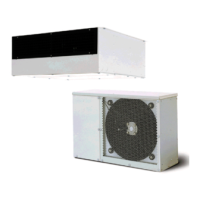
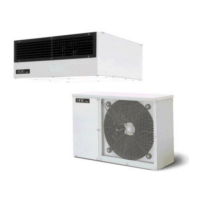
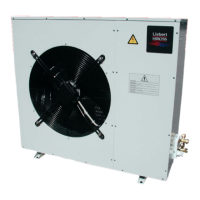
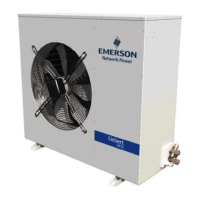
Condensing unit installation:
Maximum distance between ambient unit and external air condenser: 30 m (equivalent lentgh).
Max. geodetic height difference between condenser and unit: 3 m (if the condenser is placed underneath
the ambient unit).
Attenzione:
I ventilatori centrifughi dispongono di prevalenza pari a quella nominale di progetto. Se le perdite di
carico del condotto di espulsione sono esigue (condotto molto corto o sovradimensionato) la corren
te assorbita dal motore può superare il valore di targa del motore. In questi casi è assolutamente
necessario attenersi ad una delle seguenti istruzioni:
1) Introdurre nel circuito delle perdite di carico supplementari (inserendo nel condotto una serranda
manuale o una tagliola).
2) Ridurre il numero di giri del ventilatore ovunque sia possibile, ossia quando il ventilatore è
accoppiato mediante cinghie al motore oppure quando è dotato di motore monofase a più
velocità.
N.B.: L'operazione può considerarsi definitiva quando l'assorbimento del ventilatore sarà
prudenzialmente inferiore al valore di targa di almeno il 10%.



 To Next Page