Page 7 Chapter 2: Introduction
2. Introduction
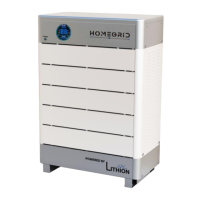
The Stack’d Series lithium iron phosphate battery is an energy storage product developed and
produced by HomeGrid. It can provide reliable power for several types of equipment and
systems. The Stack’d Series is especially suitable for home energy storage systems.
The Stack’d Series can do the following:
1. Store energy from solar arrays or wind turbines for use later when it’s dark or the wind
isn’t blowing.
2. Peak shaving: power from the battery is used to reduce the maximum power drawn from
the utility. This can result in cost savings in some jurisdictions.
3. Load shifting: power from the battery can be used to reduce the power drawn from the
utility during peak hours when rates are high. The battery is recharged during off-peak
hours when the rates are lower.
4. Demand response: in some areas the local utility will pay users to provide power to the
grid when demand is high. This is called “net metering.” Power flows from the battery
to the grid when demand is high, then the battery is recharged when demand is lower
and grid power is cheaper.
5. The battery can provide power when the local utility has experienced an outage.
The Stack’d Series has a built-in battery management system (BMS). The BMS manages and
monitors information including voltage, current and temperature from the cells inside the
battery. The BMS will balance the battery cells to maximize the energy that can be stored and
recovered.
Multiple battery stacks can be connected in parallel to expand capacity and power to meet the
requirements of longer power supporting duration and higher power consumption.
2.1. Lithium iron phosphate Battery
The lithium iron phosphate battery (LiFePO4 or LFP) is the safest of the mainstream lithium
battery types. A single LFP cell has a nominal voltage of 3.2V. A 48V LFP battery consists of
15 cells connected in series.
LFP is the chemistry of choice for very demanding applications. Some of its features are:
• Safety- LFP is the safest Li-Ion battery chemistry and does not experience thermal
runaway.
• High round trip efficiency.
• High energy density - More capacity with less weight and volume.
• High charge and discharge currents - Fast charge and discharges are possible.
• Flexible charge voltages.
The lithium iron phosphate battery is the chemistry of choice for a range of very demanding
applications.
2.2. Stack’d Series Features
• LFP modules are non-toxic, pollution-free, and environment-friendly.
• Cathode material is made from Lithium Iron Phosphate for safety, performance, and
long cycle life.
• The Battery management system (BMS) has many protection functions including over-
discharge, over-charge, over-current, and high/low temperature.


 To Next Page