8-14 CHAPTER 8: OPERATION
EXPRESS 332 S2
Lt2
Lt2
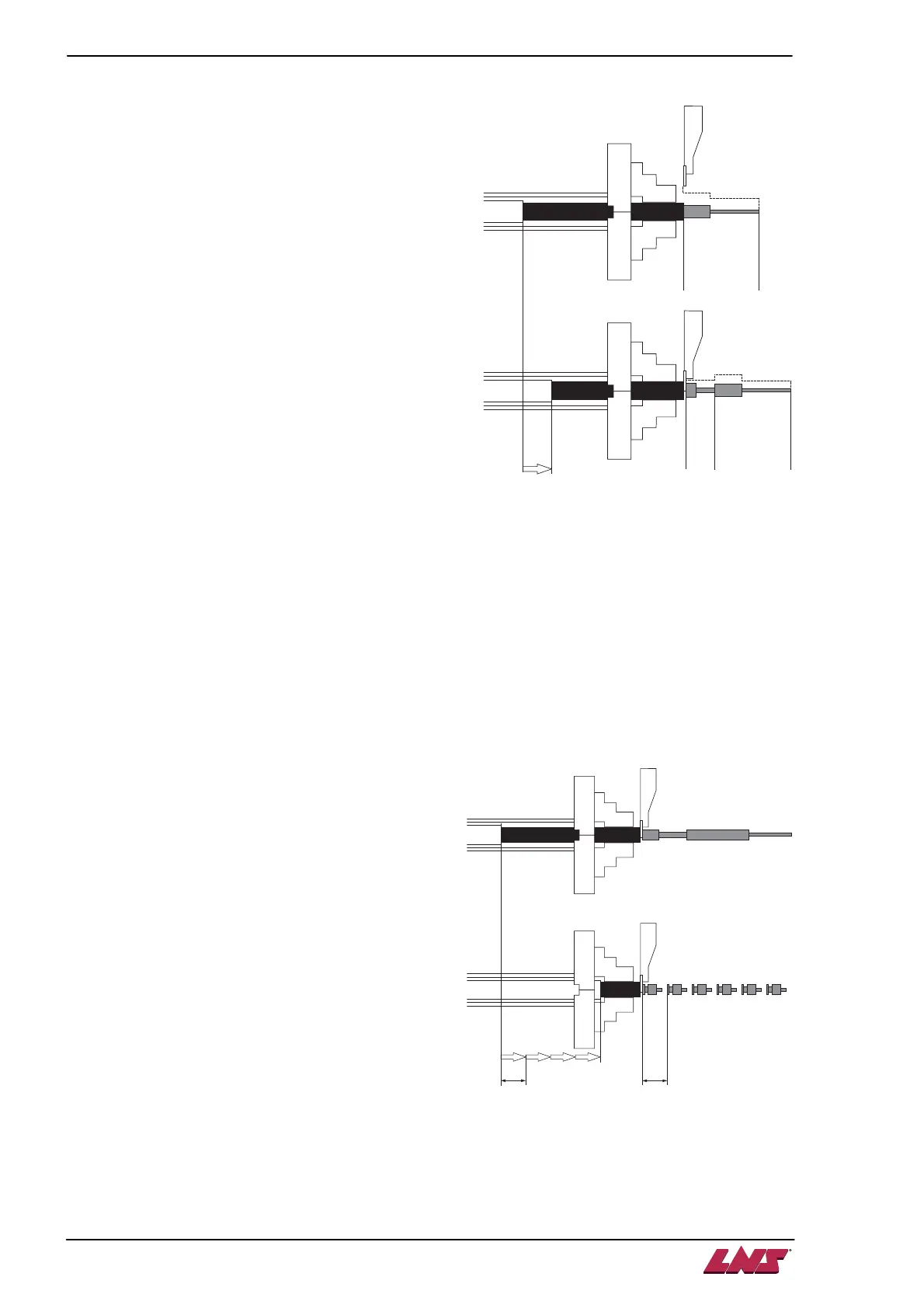
Number of clamping device openings for overall part length
When the machining of a part requires several openings of
the clamping device (for ex.: a long part, or transfer of the
part to the sub-spindle), some interface conflicts may
occur during the feeding process.
It is important for the bar feed system to be “informed” of
the number of times the clamping device must open for
the machining of a part.
The bar feed system only carries out the first positioning
for a single part. The following positioning (if any) must be
done by the turret.
Loading cycle enable (may be not visible)
This parameter defines the moment when the loading
cycle must be started.
Top-cut position (may be not visible)
During the loading cycle, the bar is automatically loaded into the spindle and automatically positioned in
the clamping device of the lathe (chuck or actuator).
This positioning corresponds to a value (Z) programmed by the operator, which is equal to the distance
between the measuring cell and the position of the material in the lathe clamping device.
With this system, the setting is the same for any bar length.
Optional auxiliary end of bar (may be not visible)
When machining remnants (A) that are rather long, a second mode of production for machining the rest of
the stock can be selected (depending on the capabilities of the lathe).
Auxiliary end of bar position (may be not visible)
Depending on the lathe and its options, the auxiliary
end of bar may be used in several ways, for example
for the opening of an external rest. The procedure is the
same as this for the end of bar setting.
2
1
1


 To Next Page