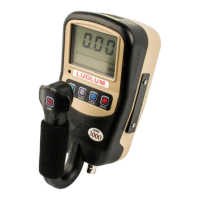
Model 3000 Survey meter User’s Manual Section 2
Ludlum Measurements, Inc. Page 2-4 April 2021
Ensure that the low-battery indicator is not present. If the low-battery
indicator is present, replace the batteries as soon as possible. Should the
instrument detect a battery voltage that is high enough to power on, but too
low to safely operate, the display will blank and the low-battery icon will
flash. Normal operation will not be available until the batteries have been
replaced. Under extreme low-battery conditions, be aware that the unit may
not even turn on or may turn itself off abruptly.
A reference reading with a check source, 1 µCi (37 kBq) of
137
Cs for
example, should be obtained at the time the instrument is received in the
field. Small check sources of radiation are available from Ludlum
Measurements. While exempt from many regulations because of their small
size, these sources are large enough to produce a response on this
instrument. If this procedure is done routinely with the same radiation
source, instrument malfunction may be detected when anomalous readings
are observed. If at any time the instrument fails to read within 20% of the
reference reading when using the same check source, it should be sent to a
calibration facility for recalibration and/or repair.
Example log reading:
Check Source # Rate Units
Once this procedure has been completed, the instrument is ready for use.
Sigma Audio
The Ludlum Model 3000 has the standard "click" audio that is widely used
by radiation instruments. However, it also has a Sigma Audio mode that can
be enabled to change the audio sound. This mode is useful for scintillation
detectors because their high count rate makes the "click" audio less useful.
In the sigma audio mode, the instrument measures the background
radiation alarm for eight seconds on power-up, and then automatically sets a
low threshold rate above the background rate. Then the instrument will
produce a beep any time that the instrument "sees" more than this
threshold value. The user doesn't need to watch the display to find a small
increase over background; the user can just listen for multiple beeps. Thus,
the unit has an audio alarm that, on power-up, adjusts to just above the
current background level, and provides a sensitive audio indication to the
user. Note that this audio alarm can also work in conjunction with the fixed
alarm, i.e. the user can have both a floating audio alarm (resulting in audio
beeps) based on the background level, and a fixed tone audio and a steady
ALARM icon when a predetermined fixed alarm level is exceeded.

 To Next Page
 Loading...