Sound DNA
20
Replicating Genes: Morph
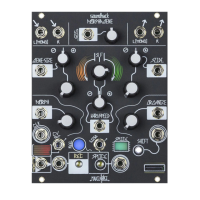
The MORPH parameter controls the amount of overlap from one Gene to the next. At full counter clockwise, there is a small gap
between Genes for a pointillist eect. At around 9:00, MORPH is set as a seamless loop, i.e. “1/1” (the opposing Vari-Speed Activity
Window lights Amber when Morph is set to an integer). Turning Morph further clockwise overlaps multiple instances of the Gene
beyond 1/1, up to as many as 3/1. Turning the Morph control beyond 3/1 causes additional upward pitch randomization of Genes
and Panning. The Morph control works the same regardless of the size of the Gene, all the way up to a full Splice of any length
including the full Reel, up to 2.9 minutes in length. The Morphagene uses Dynamic Enveloping to achieve smoothing of the
audible glitches that result from performing these particle physics experiments with audio signals.
Traversing Sound on a Genetic Level in a Nonlinear Way
As interesting as the single Gene may sound while modulated, you may nd that exploring the many possible Gene windows in a
given Splice via modulation of the Slide parameter is even more thrilling. The sonic contrast of the dierent Genes and the order in
which they are heard generates a wealth of new sounds from your source material. Slide immediately moves the playback
window, so modulating with Stepped Voltages often results in fast, hard, timbral changes as you move from one cluster of
samples to another. Continuous signals, such as CV from MATHS or the Morphagene’s own CV Output, are very good modulators
for Slide.
Chronological Inspection of the Sound DNA
With Morph set to be counterclockwise from 12:00 and Gene-Size set to be smaller than the whole Splice, you may use the CLK IN
to play through Genes in Chronological order. This is called Synchronous Granulation. At the rising edge of each Clock or Gate,
the Morphagene jumps to the next Gene and plays that Gene at the rate and direction determined by Vari-Speed until the next
Clock or Gate arrives at the CLK Input. Modulating Vari-Speed and Gene-Size while clocking through the Genes is very pleasing.
This is also useful for syncing timbral shifts or for performing crude Time Stretching (see Page 24).
Gene Identity
The Gene-Size parameter is continuous with the Gene shrinking gradually and smoothly as the parameter increases. The
designated Gene Size is a function of time-- not of sample length. This behavior allows Genes that have loose relation or no
relation at all to the rhythm of captured sound and therefore, the creation of new rhythms. Additionally, it means that a change in
Vari-Speed (unless stopped entirely) does not change the temporal length of the Gene, allowing EOSG to be used as a steady clock
even if Vari-Speed is being modulated.


 To Next Page