EasyManua.ls Logo

Marine Air Systems vector compact - Seawater Pump and Plumbing

Marine Air Systems vector compact
30 pages
Print Icon
To Next Page IconTo Next Page
To Previous Page IconTo Previous Page
Loading...
SEAWATER
PUMP
AND
PLUMBING
Seawater
temperature
will
directly
affect
the
a/c unit's
efficiency.
This
a/c
unit
can
effectively
cool
your
boat
in
water
temperatures
up
to
90°F
and
heat
(if
reverse
cycle
option
is
installed)
in
water
as
low
as
40°F.
Several
guidelines
should
be
followed
during
the
installation
of
the
seawater
system.
Since
the
circulation
pump
is
centrifugal
and
not
self-priming,
it
must
be
mounted
so
that
it
is
always
at
least
one
foot
below
the
water
line
regardless
of
which
tack
the
vessel
is
on.
The
pump
may
be
mounted
horizontally
or
vertically,
however
the
discharge
must
always
be
above
the
inlet.
If
possible,
the
pump
head
should
be
rotated
toward
the
direction
of
water
flow.
Install
the
seawater
speed
scoop
intake
as
far
below
the
water
line
and
as
close
to
the
keel
as possible
in
any
application,
but
especially
on
a
sailboat,
to
keep
the
intake
in
the
water
so
that
air
does
not
get
into
the
system
when
the
boat
heels
over.
The
speed
scoop
intake
must
face
forward
and
not
be
shared
with
any
other
pump.
A
seacock
(shut
off
valve)
must
be
installed
directly
on
the
speed
scoop
outlet.
A
seawater
strainer
is
mandatory
between
the
seacock
and
pump.
Failure
to
install
a
seawater
strainer
will
void
the
pump
warranty.
The
seawater
system
should
be
installed
with
an
upward
incline
from
the
speed
scoop
&
sea
cock,
through
the
strainer,
to
the
inlet
of
the
pump
and
then
up
to
the
inlet
of
the
a/c
unit's
condenser
coil.
The
discharge
from
the
a/c
unit
should
then
run
to
the
seawater
outlet
through
hull
fitting
which
should
be
located
where
it
can
be
visually
checked
for
water
flow
and
as
close
as
practicable
to
the
waterline
to
reduce
noise.
Use
only
reinforced
marine
grade
hose.
All
hose
connections
shall
use
double/reversed
stainless
steel
hose
clamps.
Below
is
an
installation
summary:
1.
Install
the
speed
scoop
thru-hull
inlet
as
close
to
the
keel
and
as
far
below
the
water
line
as
possible,
facing
forward.
Bed
the
scoop
with
a
marine
sealant
designed
for
underwater
use.
2.
Install
a
bronze,
full
flow
seacock
on
the
speed
scoop
thru-hull
inlet.
3.
Install
a
seawater
strainer
below
the
level
of
the
pump
with
access
to
filter.
4.
Mount
the
pump
at
least
one
foot
below
the
waterline
and
above
the
strainer.
5.
Connect
the
seacock,
strainer
and
pump
with
an
uphill
run
of
reinforced
marine
hose.
6.
Connect
the
discharge
from
the
pump
uphill
to
the
bottom
inlet
of
the
a/c
unit's
condenser
coil.
7.
Avoid
loops,
vertical
bends
(high
spots)
or
the
use
of
90°
elbows
with
seawater
hose
(each
90°
elbow
is
equivalent
to
2.5'
of
hose
and
a
90°
elbow
on
the
pump
is
equivalent
to
20'
of
hose).
8.
Double
clamp
all
hose
connections
with
stainless
steel
clamps,
reversing
the
clamps.
9.
Use
teflon
tape
on
all
threaded
connections.
10.
Connect
all
metallic
parts
in
contact
with
seawater
to
the
vesseVs
bonding
system
including
the
speed
scoop
inlet,
strainer,
pump
and
the
air
conditioner.
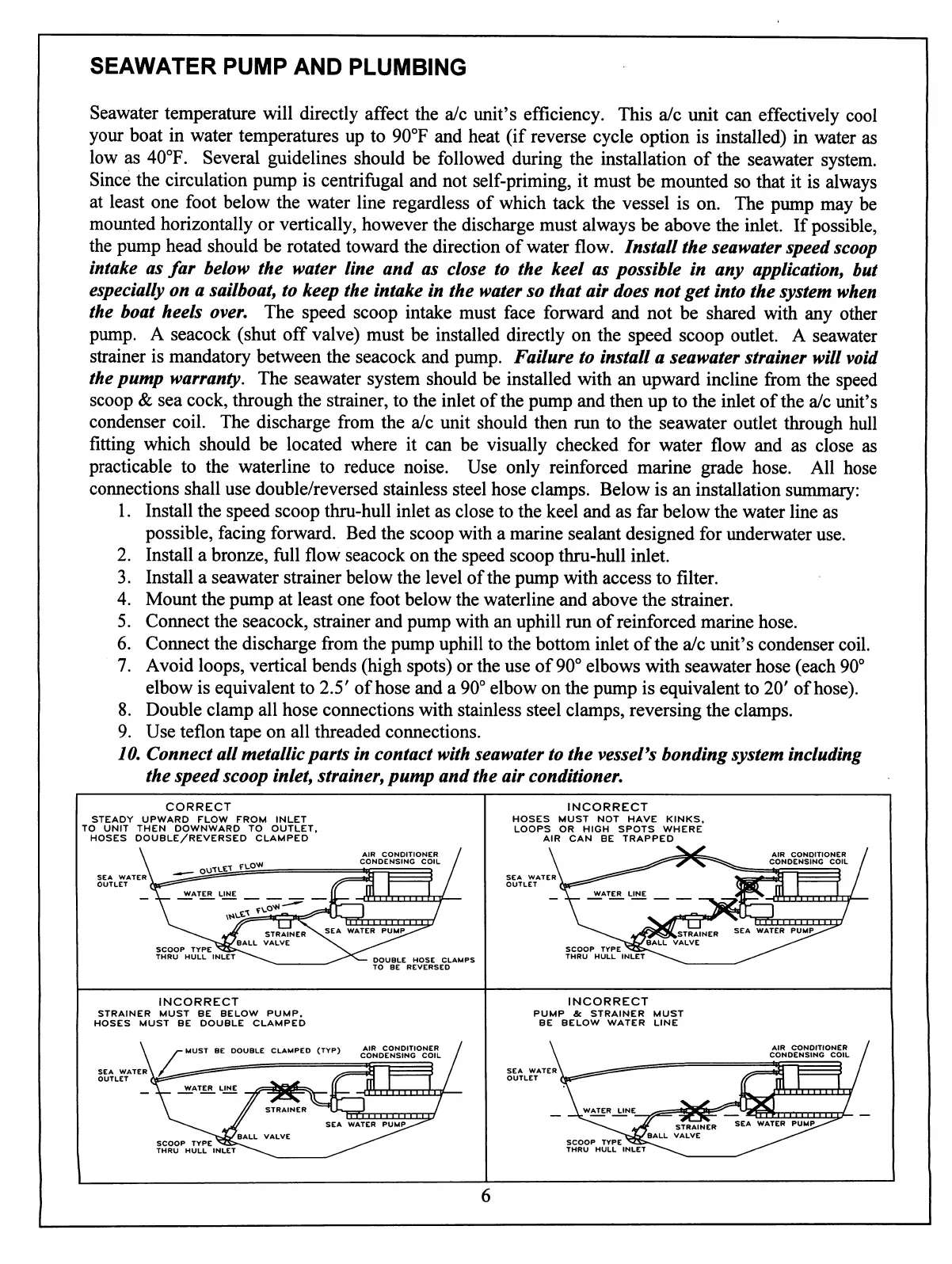
CORRECT
STEADY
UPWARD
FLOW FROM
INLET
TO
UNIT
THEN
DOWNWARD
TO
OUTLET,
HOSES
DOUBLE/REVERSED
CLAMPED
DOUBLE HOSE
CLAMPS
TO
BE
REVERSED
INCORRECT
HOSES
MUST
NOT
HAVE
KINKS,
LOOPS
OR
HIGH
SPOTS
WHERE
AIR
CAN
BE
TRAPPED
INCORRECT
STRAINER
MUST
BE
BELOW
PUMP,
HOSES
MUST
BE
DOUBLE
CLAMPED
INCORRECT
PUMP
&
STRAINER
MUST
BE
BELOW
WATER
LINE