EasyManua.ls Logo

Marine Air Systems vector compact - Page 3

Marine Air Systems vector compact
30 pages
Print Icon
To Next Page IconTo Next Page
To Previous Page IconTo Previous Page
Loading...
CLEAN
AIR
ACT
AMENDMENTS
OF
1990
[TITLE
VI
-
SECTION
608(C-1)]
"Effective
July
1,
1992,
it
shall
be
unlawful
for
any
person,
in
the
course
of
maintaining,
servicing,
repairing,
or
disposing
of an
appliance
or
industrial
process
refrigeration,
to
knowingly
vent
or
otherwise
knowingly
release
or
dispose
of
any
Class
I*
or
Class
II**
substance
used
as
a
refrigerant
in
such
appliance
(or
industrial
process
refrigeration)
in
a
manner
which
permits
such
substance
to
enter
the
environment.
De
minimis
releases
associated
with
good
faith
attempts
to
recapture
and
recycle
or
safely
dispose
of
any
such
substances
shall
not
be
subject
to
the
prohibition
set
forth
in
the
proceeding
sentence."
*Class
I
substances
include
CFC-12
**Class
II
substances
include
HCFC-22
MARINE
AIR
SYSTEMS
Marine
Air
Systems,
Inc.
(MAS)
is
a
manufacturer
of
air
conditioning
and
refrigeration
equipment
for
the
marine
industry.
MAS
is
committed
to
innovative
technology,
competitively
priced
products
and
market
leadership.
The
MAS
team
has
many
years
of
experience
in
the
design,
manufacture,
application
and
support
of
marine
air
conditioning
and
refrigeration.
Our
practical
experience
and
design
capability
allows
our
application
engineers
and
customer
support
team
to
offer
optimum
solutions
for
your
environmental
control
requirements.
Marine
Air
Systems,
Inc.
is
A
Member
of
the
Taylor
Made
GroupT
'TM*
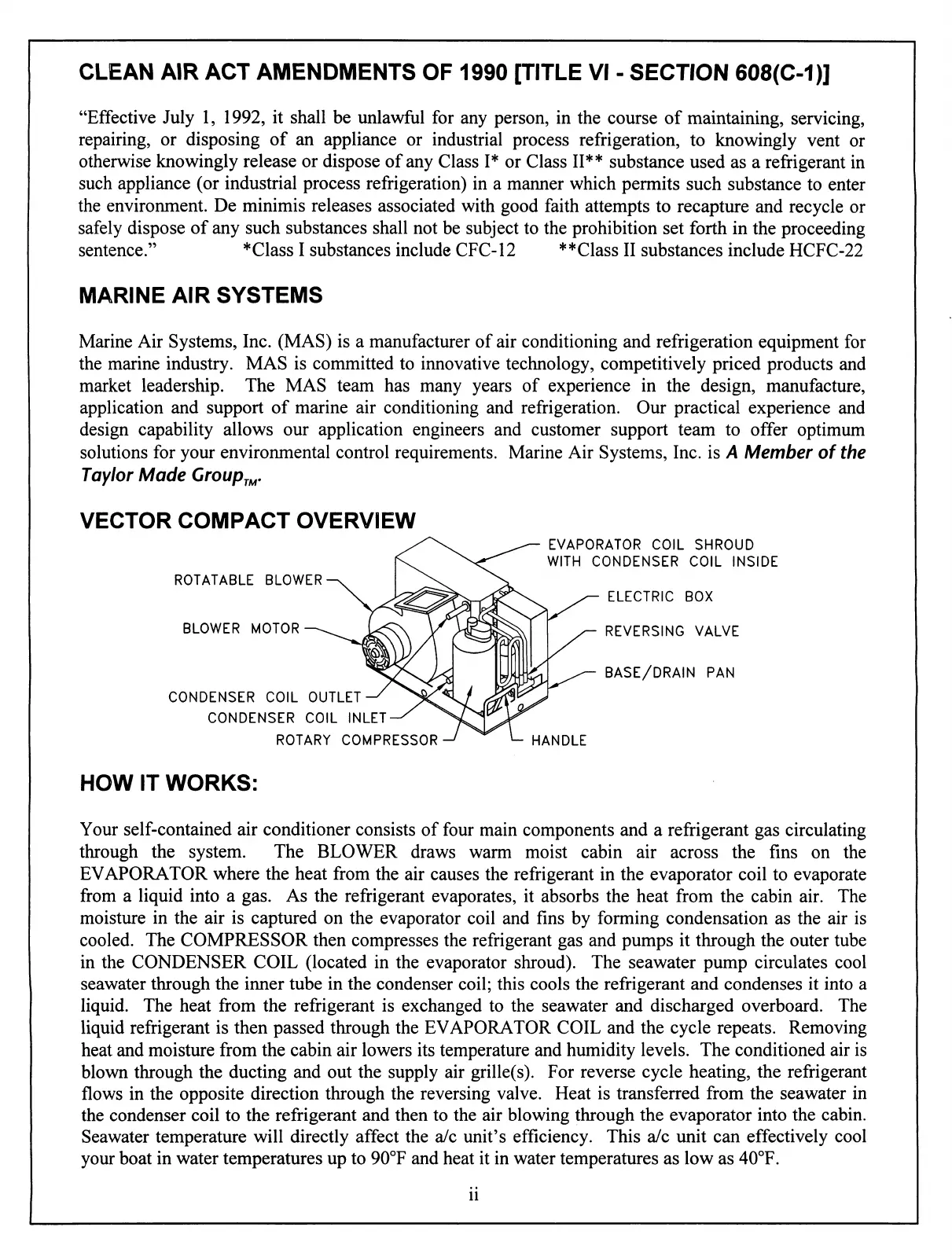
VECTOR
COMPACT
OVERVIEW
ROTATABLE
BLOWER
BLOWER
MOTOR
CONDENSER
COIL
OUTLET
CONDENSER
COIL
INLET
ROTARY
COMPRESSOR
EVAPORATOR
COIL
SHROUD
WITH
CONDENSER
COIL
INSIDE
ELECTRIC
BOX
REVERSING
VALVE
BASE/DRAIN PAN
HANDLE
HOW
IT
WORKS:
Your
self-contained
air
conditioner
consists
of
four
main
components
and
a
refrigerant
gas
circulating
through
the
system.
The
BLOWER
draws
warm
moist
cabin
air
across
the
fins
on
the
EVAPORATOR
where
the
heat
from
the
air
causes
the
refrigerant
in
the
evaporator
coil
to
evaporate
from
a
liquid
into
a
gas.
As
the
refrigerant
evaporates,
it
absorbs
the
heat
from
the
cabin
air.
The
moisture
in
the
air
is
captured
on
the
evaporator
coil
and
fins
by
forming
condensation
as
the
air
is
cooled.
The
COMPRESSOR
then
compresses
the
refrigerant
gas
and
pumps
it
through
the
outer
tube
in
the
CONDENSER
COIL
(located
in
the
evaporator
shroud).
The
seawater
pump
circulates
cool
seawater
through
the
inner
tube
in
the
condenser
coil;
this
cools
the
refrigerant
and
condenses
it
into
a
liquid.
The
heat
from
the
refrigerant
is
exchanged
to
the
seawater
and
discharged
overboard.
The
liquid
refrigerant
is
then
passed
through
the
EVAPORATOR
COIL
and
the
cycle
repeats.
Removing
heat
and
moisture
from
the
cabin
air
lowers
its
temperature
and
humidity
levels.
The
conditioned
air
is
blown
through
the
ducting
and
out
the
supply
air
grille(s).
For
reverse
cycle
heating,
the
refrigerant
flows
in
the
opposite
direction
through
the
reversing
valve.
Heat
is
transferred
from
the
seawater
in
the
condenser
coil
to
the
refrigerant
and
then
to
the
air
blowing
through
the
evaporator
into
the
cabin.
Seawater
temperature
will
directly
affect
the
a/c unit's
efficiency.
This
a/c
unit
can
effectively
cool
your
boat
in
water
temperatures
up
to
90°F
and
heat
it
in
water
temperatures
as
low
as
40°F.
n