5
The maximum vertical elevation between the air conditioner
andindoorcoilis50ft.Systemsthatrequiremoreelevation
will need to have an oil trap installed in the vapor line. Refer to
theApplicationGuidelineforRefrigerantLinesOver75Feet
(document 044B-0600) for piping details.
A filter drier is supplied with the air conditioner. It is required
and recommended that it be installed near the indoor coil.
It is recommended to replace existing refrigerant lines that
were previously used for an R-22 system. If the lines are not
replaced, they must be properly flushed by a licensed EPA
certied technician in accordance with the manufacturer’s
instructions and established procedures.
ofvacuum.Lossofvacuumindicatesthatthereisaleakin
thesystem.Repeattheleaktestifrequired.
3.Evacuatethe system to at least 500microns to remove
non-condensables and water vapor. Close the manifold
valves and remove the vacuum pump.
4.Connecttherefrigeranttanktothecentermanifoldportof
thegaugeset.Pressurizethesystemenoughtobreakthe
vacuum.
5.Openbothservicevalvesbyturningthevalvestems¼turn
counterclockwise.Thestemwillbeinlinewiththetubes.
Replace the stem caps and tighten. Proceed with Refrigerant
Charging section.
WARNING:
The air conditioning system contains liquid and
gaseous refrigerant under pressure. Adjustment of
refrigerant charge should only be done by a qualified,
EPA certified technician thoroughly familiar with this
type of equipment. Under no circumstances should
the homeowner attempt to install and/or service this
equipment. Failure to comply with this warning could
result in equipment damage, personal injury, or death.
Refrigerant Charging
NOTES:
• Theunitmustbechargedataxedspeedsetting.Forthis
purpose the thermostat needs to be wired and powered
prior to charging.
• The air conditioner is factory charged for eld installed
lines15ft.inlengthwiththematchingindoorequipment.
Adjustments to the refrigerant charge will be required for
otherlengthandtubesizes.Forlineslongerthan15ftwith
a3/8”ODliquidline,add0.52oz.perft.SeeTable 4 (page
5).
• Smallvariationsinthe temperaturesand pressuresare
normal due to differences in the installation.
• Large variations in the temperatures and pressures
could indicate incorrect charge or another problem with a
component in the system.
The preferred method of charging is by weighing in the
additional refrigerant required. If a charging scale is not
available, the next preferred charging method would be to
use the sub-cooling method. After weighing in extra charge,
the subcooling values should be measured to confirm proper
charge.
Brazing
Use the appropriate safety equipment while brazing. Items
such as gloves, safety glasses, proper ventilation, and a fire
extinguisher should be used.
1. Route the refrigerant lines from the indoor coil to the service
valves on the air conditioner. Avoid sharp radius bends and
turns. See Figure5(page12)
2.Makesurethatthevaporlineisproperlyinsulatedforthe
entire length of the run for maximum system efficiency.
Improper insulation may also create condensation and result
in water damage to the equipment and building structure.
3. Remove the valve cores from the air conditioner service
valves. Wrap the valves completely with wet rags to protect
them from overheating during the brazing operation.
4. Connect both the vapor and liquid lines. Tubes should be
round, de-burred and free of debris. Use a phosphorous
and copper or silver brazing alloy for the joints. Do not use
soft solder with a low melting point.
5.Connect the indoor lines according to the indoor unit
instructions. The indoor coil will require the same alloys and
wet rags to protect the sensors from excessive heat on the
refrigerant lines.
6. Allow the service valves to cool and replace the valve cores.
7.Leaktesttheconnectionsusinglowpressuredrynitrogen.
System Evacuation
1. Connect the refrigerant gauge manifold to both the vapor
and liquid service valves. Figure5. Connect the center port
to the vacuum pump.
2. Open both manifold valves and start the vacuum pump.
After a short time, it is recommended to close the manifold
valvesandstopthevacuumpumptolookforarapidloss
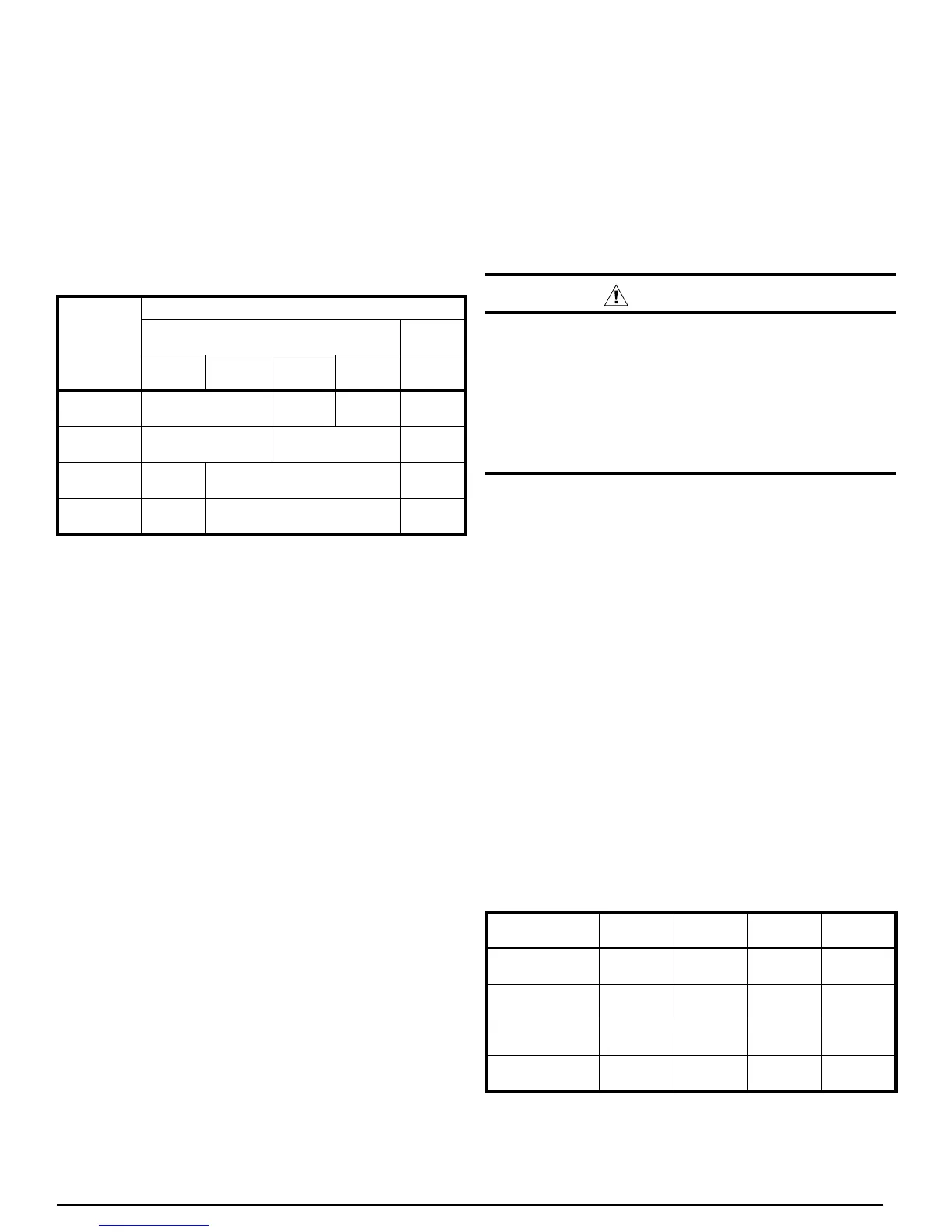
MODEL
LINE SET LENGTHS
LIQUID
LINE
UP TO
24 FT.
25 TO
39 FT.
40 TO
75 FT.
75 TO
100 FT.
UP TO
100 FT.
-024K Units
3/4 in.
(19 mm)
7/8in.
(22 mm)
1 1/8 in.
(29 mm)
3/8 in.
(10 mm)
-036K Units
7/8in.
(22 mm)
1 1/8 in.
(29 mm)
3/8 in.
(10 mm)
-048K Units
7/8in.
(22 mm)
1 1/8 in.
(29 mm)
3/8 in.
(10 mm)
-060K Units
7/8in.
(22 mm)
1 1/8 in.
(29 mm)
3/8 in.
(10 mm)
Table 3. Permissible Refrigerant Line Sizes
MODEL
2 TON
3 TON
4 TON
5 TON
FactoryCharge
for15ft.lineset
78oz 93 oz 110 oz 123 oz
Additional Charge
for 40 ft. line set
16 oz 16 oz 18 oz 18 oz
Additional Charge
for75ft.lineset
39 oz 43 oz 44 oz 44 oz
Additional Charge
for 100 ft. line set
57oz 62 oz 63 oz 63 oz
Table 4. Refrigerant Charge Quantities



 To Next Page