6
S Keep a good, firm gripon thesaw withboth
hands when the engine is running and
don’t let go. A firmgrip willhelp youreduce
kickback and maintain control of the saw.
Keep the fingers of your left hand encir-
cling and your left thumb under the front
handlebar. Keepyourright handcomplete-
ly around the rear handle whether your are
right handed or left handed. Keep your left
arm straight with the elbow locked.
S Position your left hand on the front handle-
bar so it is in a straight line with your right
hand on the rear handle when making
bucking cuts. Never reverse right and left
hand positions for any type of cutting.
S Standwithyourweightevenly balancedon
both feet.
S Stand slightly to the left side of the saw to
keep your body from being in a direct line
with the cutting chain.
S Do not overreach. You could be drawn or
thrown off balance and lose control of the
saw.
S Do not cut above shoulderheight. It is diffi-
cult to maintain control of saw above
shoulder height.
KICKBACK SAFETY FEATURES
WARNING: Thefollowing features are
includedon your saw to helpreduce the hazard
of kickback; however, such features will not to-
tally eliminate this dangerous reaction. As a
chain saw user, do not rely only on safety de-
vices. You must follow all safety precautions,
instructions, and maintenance inthis manualto
help avoid kickback and other forces which
can result in serious injury.
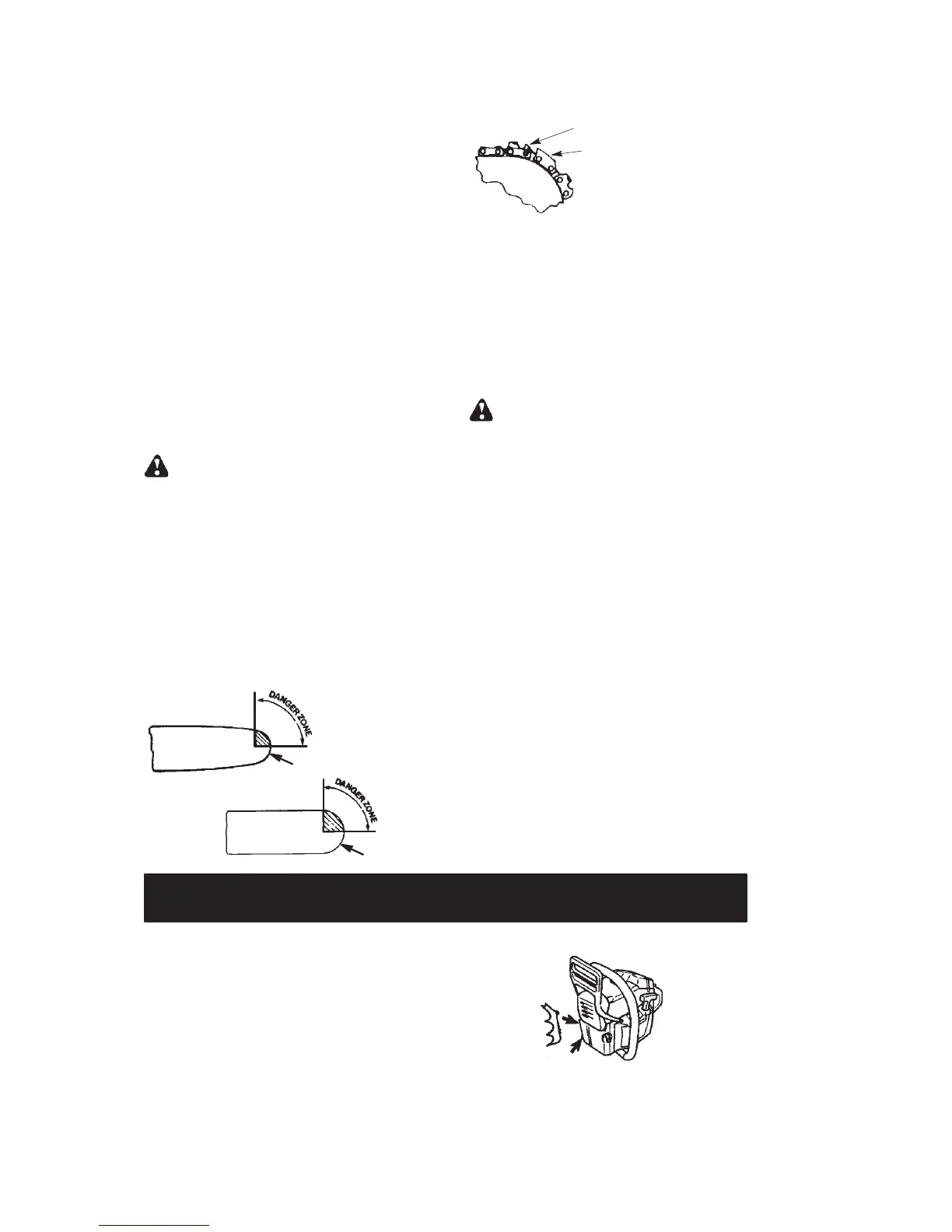
S Reduced--Kickback Guide Bar, designed
with a small radius tip which reduces the
size of the kickback danger zone on the
bar tip. A Reduced--Kickback GuideBarhas
been demonstrated to significantly reduce
the number and seriousness of kickbacks.
Small Radius Tip
Reduced Kickback
Symmetrical Guide
Bar
Symmetrical Guide Bar
Large Radius Tip
S Low--Kickback Chain, designed with a
contoured depth gauge and guard link
which deflect kickback force and allow
wood to gradually ride into the cutter.
ickback Chain
Contoured Depth Gauge
Elongated Guard Link
Deflects Kickback
Force And Allows
Wood To Gradually
Ride Into Cutter
S Handguard, designed to reduce the
chance of your left hand contacting the
chain if your hand slips offthe fronthandle-
bar.
S Position of front and rear handlebars, de-
signed with distance betweenhandles and
“in-line” with each other. The spread and
“in-line” position of the hands provided by
this design work together to give balance
and resistance in controlling the pivot of
the saw back toward the operator if kick-
back occurs.
WARNING: DO NOT RELY UPON
ANY OF THE DEVICES BUILT INTO YOUR
SAW. YOU SHOULD USE THE SAW
PROPERLY AND CAREFULLY TO AVOID
KICKBACK. Reduced--kickback guide bars
and low--kickback saw chains reduce the
chance and magnitude of kickback and are
recommended. Your saw has a low kick-
back chain and bar as original equipment.
Repairs on a chain brake should be made by
an authorized servicing dealer. Take your
unit to the place of purchase if purchased
from a servicing dealer, or to the nearest au-
thorized master service dealer.
S Tip contactin some cases may cause a light-
ning fast reverse REACTION, kicking the
guide bar up and back toward the operator.
S Pinching the saw chain along the top ofthe
guide bar may push the guide bar rapidly
back toward the operator.
S Either of these reactions may cause youto
lose control of the saw which could result
in serious injury. Do not rely exclusively
uponthesafety devices builtinto your saw.
ASSEMBLY
Protective gloves (not provided) should be
worn during assembly.
ATTACHING THE BUMPER
SPIKE
The bumper spike may be used as a pivot
when making a cut.
1. Lift adjustment knob handle and turn coun-
terclockwise to loosen chain brake.
2. Align arrows by pressing tensioning le-
ver down to install position (see illustra-
tion). Remove chain brake from saw.
3. Attach the bumper spike with the two
screws as illustrated.


 To Next Page