12
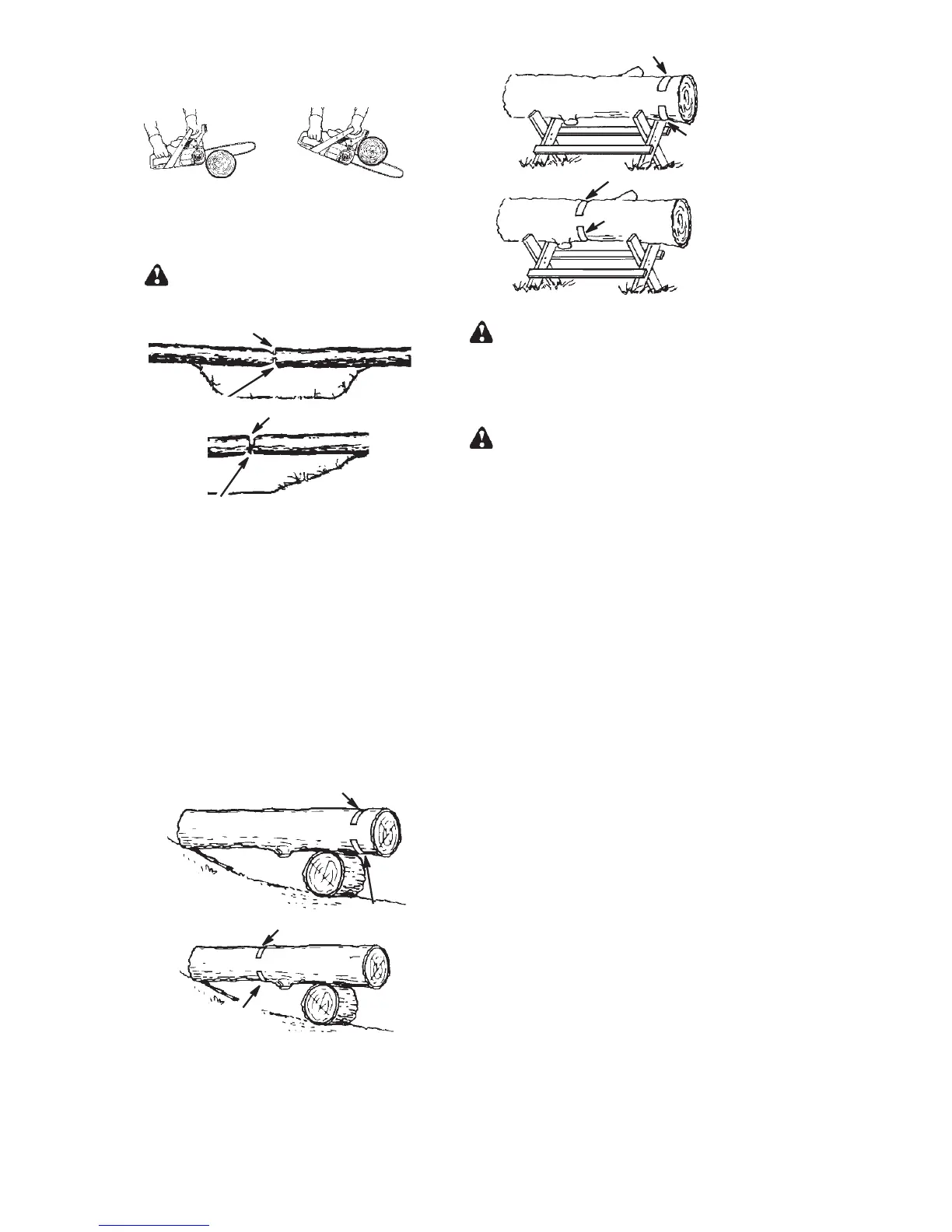
Overcutting begins on thetop sideof thelog
with the saw against the log. When overcut-
ting use light downward pressure.
Overcutting Undercutting
Undercutting involves cutting on the under-
side of the log with top of saw against the log.
When undercutting use light upward pres-
sure. Hold saw firmly and maintain control.
The saw will tend to push back toward you.
WARNING: Never turn saw upside
down to undercut. The saw cannot be con-
trolled in this position.
First cut on pressure side of log
Second cut
First cut on pressure side of log
Second cut
BUCKING WITHOUT A
SUPPORT
S Overcut through 1/3 of the diameter of the
log.
S Roll the log over and finish with a second
overcut.
S Give special attention to logs under strain
to prevent the saw from pinching. Make
the first cut on the pressure side to relieve
the stress on the log.
BUCKING USING A LOG OR SUP-
PORT STAND
S Remember your first cut is always on the
pressure side of the log.
S Your first cut should extend 1/3 of the
diameter of the log.
S Finish with your second cut.
1
st
Cut
2
nd
Cut
Using a log for support
2
nd
Cut
1
st
Cut
1
st
Cut
2
nd
CutUsing a support stand
1
st
Cut
2
nd
Cut
LIMBING AND PRUNING
WARNING: Be alert for and guard
against kickback. Do not allow the moving
chain to contact any other branched or objects
at the nose of the guide bar when limbing or
pruning. Allowing such contact can result in
serious injury.
WARNING: Never climb into a tree to
limb or prune. Do not stand on ladders, plat-
forms,a log,or in any positionwhich can cause
you to lose your balance or control of the saw.
IMPORTANT POINTS
S Watch out for springpoles. Use extreme
caution when cutting small size limbs. Slen-
der material may catch the saw chain and be
whipped toward you or pull you off balance.
S Be alert for springback. Watch out for
branches that are bent or under pressure.
Avoid being struck by the branch or the
saw when the tension in the wood fibers is
released.
S Keep a clear work area. Frequently clear
branches out of the way to avoid tripping
over them.
LIMBING
S Always limbatree after itis cut down. Only
then can limbing be done safely and prop-
erly.
S Leave the larger limbs underneath the
felled tree to support the tree as you work.
S Start at base of the felled treeand work to-
ward the top, cutting branches and limbs.
Remove small limbs with one cut.
S Keep the tree between you and the chain
as much as possible.
S Remove larger, supporting branches with
thecuttingtechniques described inBUCK-
ING WITHOUT A SUPPORT.
S Always use an overcut to cut small and
freely hanging limbs. Undercutting could
cause limbs to fall and pinch saw.


 To Next Page