EasyManua.ls Logo

Megger MIT520/2 - User Manual

Megger MIT520/2
21 pages
Print Icon
To Next Page IconTo Next Page
Loading...
M
MIT520/2
5kV Digital Insulation Tester
USER MANUAL
99 Washington Street
Melrose, MA 02176
Phone 781-665-1400
Toll Free 1-800-517-8431
Visit us at www.TestEquipmentDepot.com
Question and Answer IconNeed help?

Do you have a question about the Megger MIT520/2 and is the answer not in the manual?

Summary

Safety Warnings

General Safety Precautions

Mandatory safety precautions to be observed during the use of the insulation tester.

User Competency Requirement

Emphasizes that the instrument must only be used by suitably trained and competent persons.

Introduction

General Description of MIT520;2

Overview of the microprocessor-controlled 5 kV insulation tester and its capabilities.

Instrument Features and Capabilities

Details the various features, test modes, and measurement capabilities of the instrument.

Cleaning and Maintenance

Instructions for cleaning the instrument using a damp cloth and mild cleaning agents.

Power Lead and Battery Charging

Battery Charging and Mains Power

Explains how the instrument is powered and how the internal battery is charged.

Instrument Controls and Indicators

Front Panel Controls and Display Overview

Visual guide to the instrument's buttons, terminals, and LCD display elements.

Power On;Off and Test Voltage Controls

Operation of the power button and selection of test voltages using ▲ and ▼.

Test Start;Stop and Ω;I Button Functionality

Initiating/terminating tests and toggling between resistance and current displays.

Fn and Mode Button Operations

Using Fn for secondary functions and Mode for selecting test types.

Data Handling and Timers

Timer Control and Data Recording

Setting test timers and initiating/stopping data recording to internal memory.

Downloading and Deleting Test Results

Procedures for transferring results to a PC and clearing stored data.

Terminals and Connections

PC Connectivity and Indicator LEDs

Connecting to PC via RS232/USB and understanding indicator lights.

Test Terminals and Guard Terminal Usage

Description of main test terminals and the function of the guard terminal for leakage reduction.

Display and Interface

RS232;USB Connection and Battery Status

Details for PC connection and interpretation of the battery level indicator.

Voltage, Timer, and Digital Displays

Explanation of voltage, timer indicators, and digital display functions.

Analogue and Secondary Display Functions

Functionality of the analogue meter simulation and secondary display for time-based tests.

Pre-Test;During Test Key Action Table

Table detailing key functions and their actions during pre-test and test phases.

Test Mode Summary

Insulation Resistance (IR) Test Modes

Details on IR test operation, including breakdown, burn, and alarm limit modes.

Step Voltage (SV) Test Procedure

Explanation of the SV test principle, voltage stepping, and measurement process.

Polarisation Index (PI) and DAR Test Methods

How PI and DAR are calculated and displayed, related to time-resistance measurements.

Dielectric Discharge (DD) Test Procedure

Description of the DD test for assessing insulation ageing, deterioration, and voids.

High Resistance Measurements (Above 100 GΩ)

Precautions for measuring very high resistances and the role of the guard lead.

Circuit Block Diagram Explanation

Diagram illustrating the internal circuitry and components of the insulation tester.

Specifications

Instrument Technical Specifications

Comprehensive list of technical specifications including voltage, accuracy, battery life, and ranges.

Accessories

Available Lead Sets and Accessories

List of included and optional lead sets, cables, and other accessories for the instrument.

Repair and Warranty Information

Product Return and Repair Process

Instructions for returning the instrument for recalibration or repair, including RA number.

Approved Service Centre Information

Guidance on locating authorized service centres for repairs and maintenance.

Summary

Safety Warnings

General Safety Precautions

Mandatory safety precautions to be observed during the use of the insulation tester.

User Competency Requirement

Emphasizes that the instrument must only be used by suitably trained and competent persons.

Introduction

General Description of MIT520;2

Overview of the microprocessor-controlled 5 kV insulation tester and its capabilities.

Instrument Features and Capabilities

Details the various features, test modes, and measurement capabilities of the instrument.

Cleaning and Maintenance

Instructions for cleaning the instrument using a damp cloth and mild cleaning agents.

Power Lead and Battery Charging

Battery Charging and Mains Power

Explains how the instrument is powered and how the internal battery is charged.

Instrument Controls and Indicators

Front Panel Controls and Display Overview

Visual guide to the instrument's buttons, terminals, and LCD display elements.

Power On;Off and Test Voltage Controls

Operation of the power button and selection of test voltages using ▲ and ▼.

Test Start;Stop and Ω;I Button Functionality

Initiating/terminating tests and toggling between resistance and current displays.

Fn and Mode Button Operations

Using Fn for secondary functions and Mode for selecting test types.

Data Handling and Timers

Timer Control and Data Recording

Setting test timers and initiating/stopping data recording to internal memory.

Downloading and Deleting Test Results

Procedures for transferring results to a PC and clearing stored data.

Terminals and Connections

PC Connectivity and Indicator LEDs

Connecting to PC via RS232/USB and understanding indicator lights.

Test Terminals and Guard Terminal Usage

Description of main test terminals and the function of the guard terminal for leakage reduction.

Display and Interface

RS232;USB Connection and Battery Status

Details for PC connection and interpretation of the battery level indicator.

Voltage, Timer, and Digital Displays

Explanation of voltage, timer indicators, and digital display functions.

Analogue and Secondary Display Functions

Functionality of the analogue meter simulation and secondary display for time-based tests.

Pre-Test;During Test Key Action Table

Table detailing key functions and their actions during pre-test and test phases.

Test Mode Summary

Insulation Resistance (IR) Test Modes

Details on IR test operation, including breakdown, burn, and alarm limit modes.

Step Voltage (SV) Test Procedure

Explanation of the SV test principle, voltage stepping, and measurement process.

Polarisation Index (PI) and DAR Test Methods

How PI and DAR are calculated and displayed, related to time-resistance measurements.

Dielectric Discharge (DD) Test Procedure

Description of the DD test for assessing insulation ageing, deterioration, and voids.

High Resistance Measurements (Above 100 GΩ)

Precautions for measuring very high resistances and the role of the guard lead.

Circuit Block Diagram Explanation

Diagram illustrating the internal circuitry and components of the insulation tester.

Specifications

Instrument Technical Specifications

Comprehensive list of technical specifications including voltage, accuracy, battery life, and ranges.

Accessories

Available Lead Sets and Accessories

List of included and optional lead sets, cables, and other accessories for the instrument.

Repair and Warranty Information

Product Return and Repair Process

Instructions for returning the instrument for recalibration or repair, including RA number.

Approved Service Centre Information

Guidance on locating authorized service centres for repairs and maintenance.

Overview

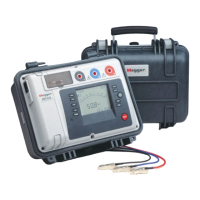
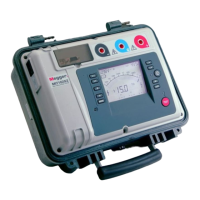
The Megger MIT520/2 is a microprocessor-controlled 5 kV digital insulation tester designed for comprehensive insulation resistance measurements and diagnostic tests. It offers a wide range of features for both continuous resistance/current measurement and specialized test modes, with data storage and retrieval capabilities.

Function Description

The MIT520/2 measures insulation resistance up to 15 TΩ. It can be powered from a mains supply (85-265 Vrms a.c. at 50/60 Hz) or its internal rechargeable battery, which provides at least 6 hours of continuous testing with a 100 MΩ load. The battery level is indicated on the LCD display, and the battery charges automatically when connected to mains, except during testing. An internal battery management system turns the instrument off after ten minutes of inactivity to conserve power. If the battery charge is very low, the instrument will turn off, requiring mains power for use. Recorded test results and settings are retained when the instrument powers off.

The device supports various test modes:

  • Insulation Resistance (IR) Test: This is the default mode, continuously measuring insulation resistance at the selected voltage. The test voltage can be adjusted during the test, and the duration can be set using the main timer. Upon completion, insulation capacitance and time constant are calculated and displayed.
  • Polarisation Index (PI) Test: A specific time/resistance method that calculates the ratio of insulation resistance measured at 1 minute and 10 minutes. Good insulation typically shows an increase in resistance over this period.
  • Dielectric Absorption Ratio (DAR) Test: Automatically calculated if timers T1 and T2 are set. This ratio uses insulation resistance measurements at different time intervals (T1 and T2).
  • Step Voltage (SV) Test: This test applies incrementally stepping voltages (one-fifth of the final value each minute for 5 minutes) to assess insulation. An ideal insulator should show identical readings at all voltages, while an over-stressed insulator will show lower values at higher voltages. The default settings are 5 minutes and 1 kV, but these can be adjusted.
  • Dielectric Discharge (DD) Test: A diagnostic test for assessing aging, deterioration, and voids in insulation. It measures the discharge current 1 minute after the removal of the test voltage. The default settings are 30 minutes and 500 V.

The MIT520/2 offers both 'burn' and 'breakdown' modes for IR tests. In breakdown mode, the test terminates automatically upon insulation breakdown to prevent damage. In burn mode, breakdown detection is disabled, allowing the test voltage to continue, which can help locate the failure point. The instrument emits two long beeps when starting a test in burn mode due to potential damage. An 'Alarm Limit' mode is also available for IR tests, where the instrument beeps if the resistance reading exceeds a user-selectable threshold (10 kΩ to 15 TΩ).

Important Technical Specifications

  • Measurement Capability: Up to 15 TΩ.
  • Test Voltages: Standard options include 250 V, 500 V, 1 kV, 2.5 kV, and 5 kV. Non-standard voltages are selectable in 10 V steps between 50 V and 1 kV, and in 25 V steps between 1 kV and 5 kV.
  • Voltage Output Accuracy (0°C to 30°C): +4%, -0% ±10 V of nominal test voltage at 1 GΩ load.
  • Current Measurement Range: 0.01 nA to 5 mA.
  • Current Measurement Accuracy (23°C): ±5% ±0.2 nA at all voltages.
  • Insulation Resistance Accuracy (23°C, 5 kV): ±5% @ 1 TΩ, ±20% @ 10 TΩ.
  • Guard Terminal: 2% error guarding 500 kΩ leakage with 100 MΩ load.
  • Display Range: Digital: 10 kΩ to 15 TΩ (3 digits); Analogue: 100 kΩ to 1 TΩ.
  • Short Circuit/Charge Current: 3 mA @ 5 kV.
  • Capacitor Charge Time: <3 seconds per µF at 3 mA to 5 kV.
  • Capacitor Discharge Time: <120 ms per µF to discharge from 5 kV to 50 V.
  • Capacitance Measurement (500 V minimum test voltage): 10 nF to 50 µF (dependent on test voltage).
  • Capacitance Measurement Accuracy (23°C): ±5% ±5 nF.
  • Timer Range: Counts up to 99 minutes and 59 seconds. Minimum setting is 15 seconds for test voltages ≥1000 V, and 30 seconds for <1000 V.
  • Interference Rejection: 1 mA per 250 V up to a maximum of 2 mA.
  • Operating Temperature: -20°C to 50°C.
  • Storage Temperature: -25°C to 65°C.
  • Humidity: 90% RH non-condensing at 40°C.
  • Ingress Protection (lid closed): IP65.
  • Dimensions: 305 x 194 x 360 mm (12 x 7.6 x 14.2 inches).
  • Weight: 7.1 kg (16 lb) approx.
  • Safety: Meets IEC61010-1 CAT IV 600 V.
  • EMC: Meets IEC61326-1.

Usage Features

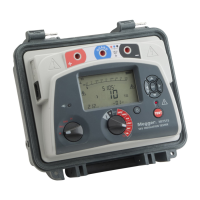
The instrument features an LCD display that shows continuous resistance or current measurements on the main display, with optional resistance, current, or figure of merit measurements (like PI, DAR) on a secondary display. The display also includes a battery bar graph, voltage at terminals, and a timer indicator. An analogue display simulates a meter movement, providing a "feel" for measurement progress.

  • Controls:

    • Power On/Off Button: Requires a press, hold, and release sequence for activation to prevent accidental power-on.
    • Test Voltage ▲ and ▼ Buttons: Selects standard test voltages or allows adjustment of non-standard voltages (50 V to 5 kV).
    • Test Start/Stop Button: Initiates a test with a press, hold, and release sequence when the high voltage warning LED lights. Stops a test when pressed again, or automatically when the preset time is reached or insulation breakdown is detected (in breakdown mode).
    • Ω/I Button: Toggles the digital and secondary displays between insulation resistance and current, and cycles through various results and units after a test.
    • Backlight Button: Toggles the display backlight on and off.
    • Fn Button: Used in combination with other buttons to access secondary functions, such as adjusting non-standard voltages, cycling through timers (Tmain, T1, T2), selecting IR modes (burn/breakdown/alarm limit), downloading data, or clearing stored data.
    • Mode Button: Cycles through and selects test modes (IR, PI, SV, DD).
    • Timer ▲ and ▼ Buttons: Adjusts the main timer and T1/T2 timers.
    • Record Button: Starts and stops data recording to the on-board memory.
  • Safety Warnings:

    • The circuit under test must be switched off, de-energized, and isolated before connecting the instrument.
    • Circuit connections must not be touched during an insulation test.
    • Capacitive circuits must be completely discharged after a test before disconnecting leads.
    • Tested items should be shorted out after discharge to prevent dielectric absorption charge release.
    • The instrument should not be used if damaged, or in wet weather conditions unless necessary precautions are taken.
    • It is not intrinsically safe and must not be used in hazardous atmospheres.
    • High voltage warning LED flashes and a beeper sounds if external voltage > 50 V is detected on test leads, disabling testing.
  • Data Storage and Output:

    • On-board Memory: Stores results at 15, 30, 45, and 60 seconds, then at minute intervals up to 10 minutes, and 5-minute intervals thereafter. Recorded data includes selected voltage, test time elapsed, applied voltage, leakage current, and insulation resistance. PI, DAR, capacitance, time constant, and DD values are also stored.
    • Downloading Results: Connects to a PC via RS232 (null modem cable, 38400 Baud, 8 data bits, 0 parity, 1 stop bit, no flow control) or USB (requires driver installation). Megger Download Manager software can be used.
    • Real-time Data Output: Outputs test voltage, current, and resistance once per second during a test via serial connection.
  • Guard Terminal: The guard terminal (G) is at the same potential as the negative terminal. It diverts surface leakage currents from the measuring circuit, improving accuracy, especially in cable testing or when moisture/dirt is present. This is particularly useful for measurements above 100 GΩ. The display will show 'FUS' if the internal guard terminal fuse blows.

Maintenance Features

  • Cleaning: Disconnect the instrument and wipe it with a clean cloth slightly damped with soapy water or Isopropyl alcohol (IPA).
  • Test Leads: Test leads, including crocodile clips, must be in good order, clean, and free of broken or cracked insulation.
  • Fuse Replacement: If the guard terminal fuse blows, it must be replaced by an authorized repairer.
  • Warranty: New instruments are guaranteed for 1 year from the date of purchase. Unauthorized repairs or adjustments invalidate the warranty.
  • Service and Calibration: For recalibration or repair, a Returns Authorisation (RA) number must be obtained from Megger service centers. The instrument should be carefully packed to prevent transit damage.

Megger MIT520/2 Specifications

General IconGeneral
BrandMegger
ModelMIT520/2
CategoryTest Equipment
LanguageEnglish

Related product manuals