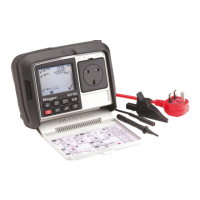
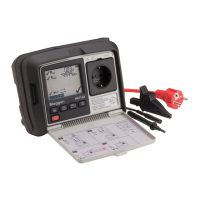
The Megger PAT120 Series Portable Appliance Tester is a handheld instrument designed for simple, fast, and safe testing of electrical appliances in various environments, including offices, shops, and business units. It is particularly well-suited for training organizations due to its user-friendly design and reliable functionality. The instrument is built to be exceptionally tough, featuring rubber-armored cases and a hardened, scratch-proof display window, making it suitable for demanding conditions such as building sites and warehouses.
Function Description
The PAT120 performs essential electrical safety tests to ensure appliances comply with UK and European requirements. Its primary function is to provide a clear pass or fail indication, supplemented by measurement readings. The device is battery-powered, offering portability and the ability to conduct tests in locations without an electrical supply or where it might be inconvenient or unsafe.
The PAT120 offers specific test groups for different types of appliances:
- Class I Test: This test is for appliances that rely on an earth connection for safety. It involves continuity (bond) testing, insulation testing, and substitute leakage testing. The continuity test measures the proper bonding of all metal parts of a Class I device to the protective conductor, performed at 200 mA DC in both polarities to comply with international and UK regulations. This low current ensures safety for equipment that might be damaged by higher test currents. Insulation testing measures the resistance between live/neutral conductors and earth, typically performed at 500 V DC. The PAT120 maintains the necessary test voltage down to 0.5 MΩ.
- Class II Test: This test is for double-insulated appliances that do not have an earth return conductor. It primarily involves insulation testing and substitute leakage testing.
- Extension Lead Test: This test checks the integrity of extension leads and multi-way extension leads, including insulation and bond tests.
- Power Cord Test: This test is for standard power cords, also including insulation and bond tests.
A key feature of the PAT120 is its "Substitute Leakage" or "Alternative" method for leakage testing. This method allows for AC leakage current measurements without requiring a mains supply during the test, which is beneficial when the operation of the equipment under test is undesirable or when testing IT equipment and surge-protected devices. The substitute leakage test is performed at less than 40 V AC.
The instrument also includes a 250 V DC insulation test option, which can be selected at the start of a test. This is useful for IT equipment, devices with surge protection, or in situations where a 500 V test is deemed undesirable.
Usage Features
The PAT120 is designed for ease of use, employing test groups that automate the sequence of tests, minimizing user intervention and reducing the potential for errors. This approach simplifies testing and speeds up the process.
- Switching ON/OFF: The device is switched on by holding down the power button for more than 0.5 seconds. It can be manually switched off by holding the power button for more than 2 seconds. An auto-off feature turns the unit off after 3 minutes of inactivity (not adjustable) to conserve battery life.
- Test Initiation: Tests are initiated by pressing the appropriate class button (Class I, Class II, or Extension Lead).
- Display Information: The display clearly shows test results, including continuity resistance (RCONT), protective earth resistance (RPE), insulation resistance (RINS), insulation resistance to earth (RISO), and substitute leakage current (It (sub) / ILEAK). It also provides information and warnings, such as "Test in progress," "Measurement locked ON," "Notice: Refer to user guide," "Resistance in ohms," "Insulation resistance in Meg Ohms," and "Leakage current in milliamps."
- PASS/FAIL Indication: The instrument provides a clear overall PASS/FAIL indication, with individual test failures marked by a small cross and overall failures by a large cross. If a test fails, further testing in the sequence is prevented for safety reasons, except for extension lead testing.
- Backlight: A backlight button is available for improved visibility in low-light conditions.
- Aborting a Test: A test can be aborted at any time by pressing the Power (ESC) button.
- Probe Connection: The P1 test lead is used for continuity (bond), insulation, and touch leakage probe connections. It is crucial to connect the probe to exposed metalwork and ensure it is NOT connected to a 230V source. The P3 socket is for IEC power cords and extension lead adaptor connections. Users are warned NOT to connect P1 and P3 sockets to hazardous live voltages.
- Appliance State: During testing, it is important to ensure the equipment under test is switched ON. If the contact symbol appears, it indicates an open circuit load, and the appliance needs to be switched on before proceeding.
- Pre-checks: The PAT120 performs various pre-checks before testing to ensure the asset is not short-circuited and is switched on.
- International Model Variations: For PAT120-DE and PAT120-CH models, if a continuity test fails to meet the pre-set continuity resistance pass limit of 0.3 Ω, the test can be re-run within 5 seconds at a higher 1.0 Ω limit.
Maintenance Features
The PAT120 is designed for durability and includes features for user maintenance to ensure its longevity and reliable operation.
- Battery Replacement: The instrument uses 8 x 1.5 V AA Alkaline LR6 batteries or NiMH HR6 rechargeable batteries. Battery condition is indicated by display symbols (100%, 75%, 50%, 25%, <25% exhausted/flashing). To replace batteries, the instrument must be switched off, and all test leads disconnected. The battery cover is removed from the base using a cross-head screwdriver. Old cells are removed, and new batteries are refitted following the correct polarity marked on the battery holder. It is crucial to avoid incorrect battery cell polarity, mixing battery technologies, or using batteries with different charge states, as these can cause damage.
- Fuse Replacement: A possible fuse failure is indicated by a specific symbol on the display. To replace the fuse, the battery cover is removed, the fuse is withdrawn and checked for failure. The replacement fuse must be of the correct rating and type: 1 x 100 mA (F) 250 V 1.5 KA HBC 4 x 20 mm.
- Preventive Maintenance:
- Test leads should be checked for damage before each use.
- Batteries should be removed if the instrument is left unused for an extended period.
- The instrument can be cleaned with a damp cloth when necessary. Alcohol-based cleaners should not be used as they may leave a residue.
- Battery Disposal: Spent batteries are classified as portable batteries and must be disposed of according to local authority requirements. The crossed-out wheeled bin symbol on the batteries serves as a reminder not to dispose of them with general waste. Megger is registered as a producer of batteries in the UK.
- WEE Directive Compliance: The instrument itself is marked with the crossed-out wheeled bin symbol, indicating that it should not be disposed of with general waste at the end of its life. Megger is registered as a producer of Electrical and Electronic Equipment in the UK.

 Need help?
 General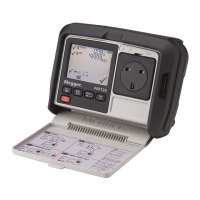


 To Next Page