14
ii. Calculating Corrosion Rate
As explained previously, ER probes and instruments report Metal Loss. However, the value that is of
ultimate interest is Corrosion Rate. The Corrosion Rate is essentially Metal Loss over time, so the
Corrosion Rate can be calculated using the following formula:
Corrosion Rate(mpy) =
Loop Current(mA)
16
×
365
Time(days)
× Probe Life(mils)
where:
∆
Loop Current(mA) is the difference between two readings
∆
Time(days) is the time difference between those two readings
It is a common practice to program this formula into the control (DCS/SCADA) system and have it
calculate Corrosion Rate on a continual basis from the Metal Loss data. The challenge in doing this is
selecting an appropriate time interval. Using an interval that is too short may give erratic results,
while selecting an interval that is too long may give results that are insensitive to system upsets. The
ideal time period depends on many factors, and will vary from system to system. It may take some
trial and error to settle on the best time period for your installation.
In some cases it may be necessary to review the raw Metal Loss data and manually apply the
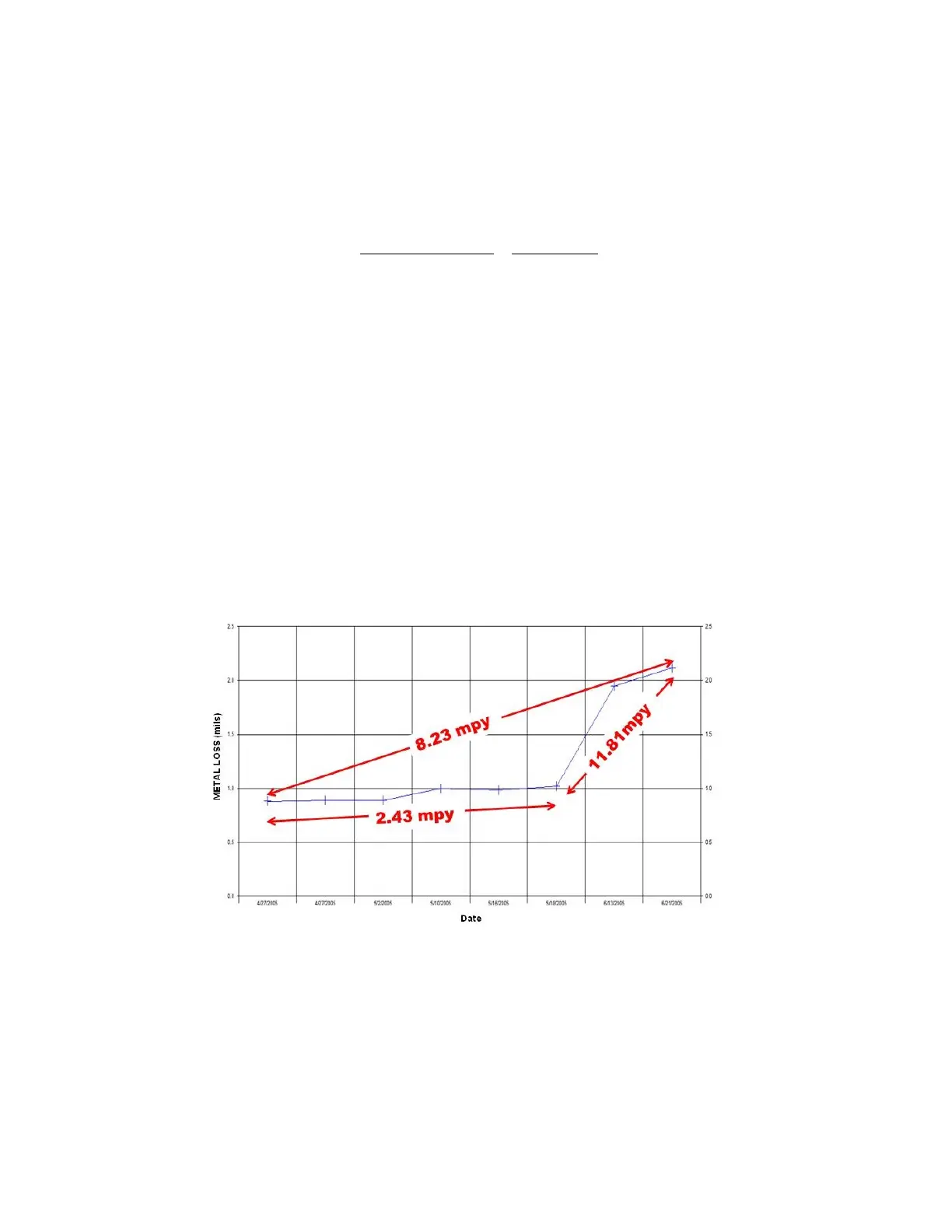
Corrosion Rate formula to periods of interest. For example, look at the graph below and see how
much the calculated Corrosion Rate can vary depending on the time period used.
Figure 8. Corrosion Rates calculated from Metal Loss data
While each of the results is valid for the selected time period, the one of most interest is the value of
11.81 mpy which represents some type of system upset. When the Corrosion Rate is calculated
automatically on a pre-selected time period, there is no guarantee that the selected time period will
always coincide with system upsets such as this. That is why manual review and interpretation of
Metal Loss data is also helpful.


 To Next Page