II. Installation and Operation
A. Receiving the MS2601E Transmitter
Check the MS2601E Transmitter for any shipping damage when it is first received. When the MS2601E
is unpacked, verify that the following items are included:
• MS2601E Transmitter
• Meter Prover
• User’s Manual
• Probe Cable & Mounting Hardware (optional, for remote-mount only)
In the event of shipping damage, quantity shortage, or missing items, it is recommended that the event
is documented immediately and that digital photographs are taken. Any shortages or missing items
should be reported to Metal Samples immediately. In the event of shipping damage, a claim should be
opened with the responsible carrier.
B. Installation
Warning: Do not open when an explosive atmosphere is present. Potential electrostatic charging hazard.
See instructions. Refer use manual for installation instructions and maximum electrical input & output
parameters.
Attention: ne pas ouvrir en présence d'une atmosphère explosive. Risque potentiel de charge
électrostatique. Voir les instructions. Consultez le manuel d'utilisation pour les instructions d'installation
et les paramètres d'entrée et de sortie électriques maximum.
Installation of the MS2601E Transmitter involves the following steps:
1. Physical Mounting
2. Electrical Connection
3. Setup and Programming
1. Physical Mounting and Probe Connection
When selecting a location to mount the MS2601E it is important to consider the surrounding
environment. To ensure proper operation:
• Do not mount the MS2601E in a location that exceeds its operating temperature.
• Avoid mounting the MS2601E near sources of strong electrical noise.
• Ensure that there is sufficient clearance for installation and to open the transmitter cover
afterwards.
a. Direct-Probe Mounting
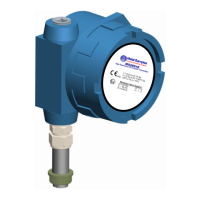
The MS2601E is designed for direct-probe mounting which eliminates the need for additional hardware
and transmitter-to-probe cabling. This greatly simplifies installation, reduces costs, and minimizes
electrical noise that can be coupled onto probe cabling from nearby electrical equipment.
Before mounting the MS2601E, first ensure that the probe is installed properly and securely. During
installation it is important that you do not apply excessive force on the probe or seals, as doing so could
break the seal and result in system leakage.


 To Next Page