3
I. Introduction
A. General Description
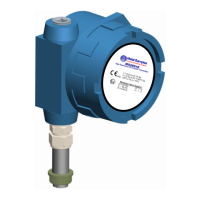
The MS2601E is a high-resolution meter designed to transmit corrosion (metal loss) data from an Electrical
Resistance (ER) probe to a plant control system or other recording device. The MS2601E utilizes traditional
4-20mA current loop communication and is loop-powered with built-in isolator, so it requires only a two-
wire interface. This results in a simple and low-cost installation. The use of the 4-20mA protocol also
allows the MS2601E to be placed great distances from the control system or recorder while maintainin
g
g
ood noise rejection. Practical current loop distances can be many thousands of feet (see pages 6 and 7
for exact specifications.)
The MS2601E is compatible with all types of Metal Samples ER probes, as well as any standard ER probe
from other manufacturers. Unlike competitors’ products, the MS2601E Transmitter does not require
factory modification to accommodate different probe types. The probe type can be easily changed at any
time using the on-board probe selection switches (see page 9.)
The MS2601E is available as direct-mount (standard) or remote-mount. In the direct-mount version the
MS2601E is mounted directly to the ER probe. This option offers the simplest installation and minimizes
noise problems. The remote-mount option allows the MS2601E to be mounted independently from (but in
close proximity to) the ER probe. It is then connected to the probe via a short probe cable. (See page 5 for
mounting diagrams and specifications.)
B. Principles of Operation
The MS2601E operates on the Electrical Resistance (ER) technique and is used in conjunction with an ER
probe. The ER probe utilizes a resistive sensing element manufactured from the material of interest (or a
close approximation) which is exposed to a corroding environment. This is called the Exposed or Corroding
Element. The resistance of the Exposed Element is directly related to its thickness, so as the element
corrodes the resulting loss of metal causes a proportional increase in the element’s resistance. The probe
also contains an internal Reference Element which is used to compensate for the influences of
temperature on the Exposed Element.
The MS2601E is designed to work with any standard ER probe, but it is recommended that Cylindrical and
Large Flush type probes be used to ensure optimum performance. Their physical design places the
Reference Element in closer proximity to the Exposed Element compared to other probe types, providing
more effective temperature compensation and thus reducing the effects of thermal noise.
Because they are designed to corrode, ER probes are sacrificial in nature. Each ER probe will have a finite
life that is based on the element thickness. ER probes are available in a number of geometries and
thicknesses designed to suit a wide variety of applications. Table 1 lists the common ER element options
available from Metal Samples and the effective life of each.


 To Next Page