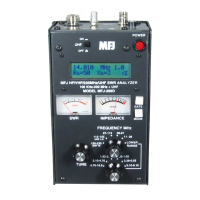
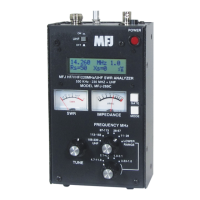
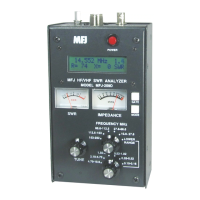
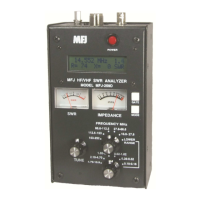
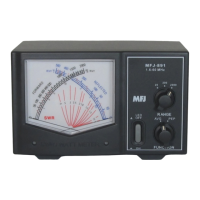
MFJ-266B HF/VHF/UHF Antenna Analyzer Instruction Manual
2012 MFJ Enterprises, Inc. Version 1D 10
(2.) Select the desired Range, Band, and Frequency (Section-4).
(3.) Connect the antenna to the analyzer (Antenna connector)*.
(4.) Rotate the Tune knob to find the lowest SWR reading and write it
down.
(5.) Rotate Tune to either side of minimum SWR and note the 2:1 SWR
points.
*When testing large ungrounded antenna systems such as HF dipoles,
momentarily short the feedline center pin to ground to bleed off static
buildup before connecting to the analyzer.
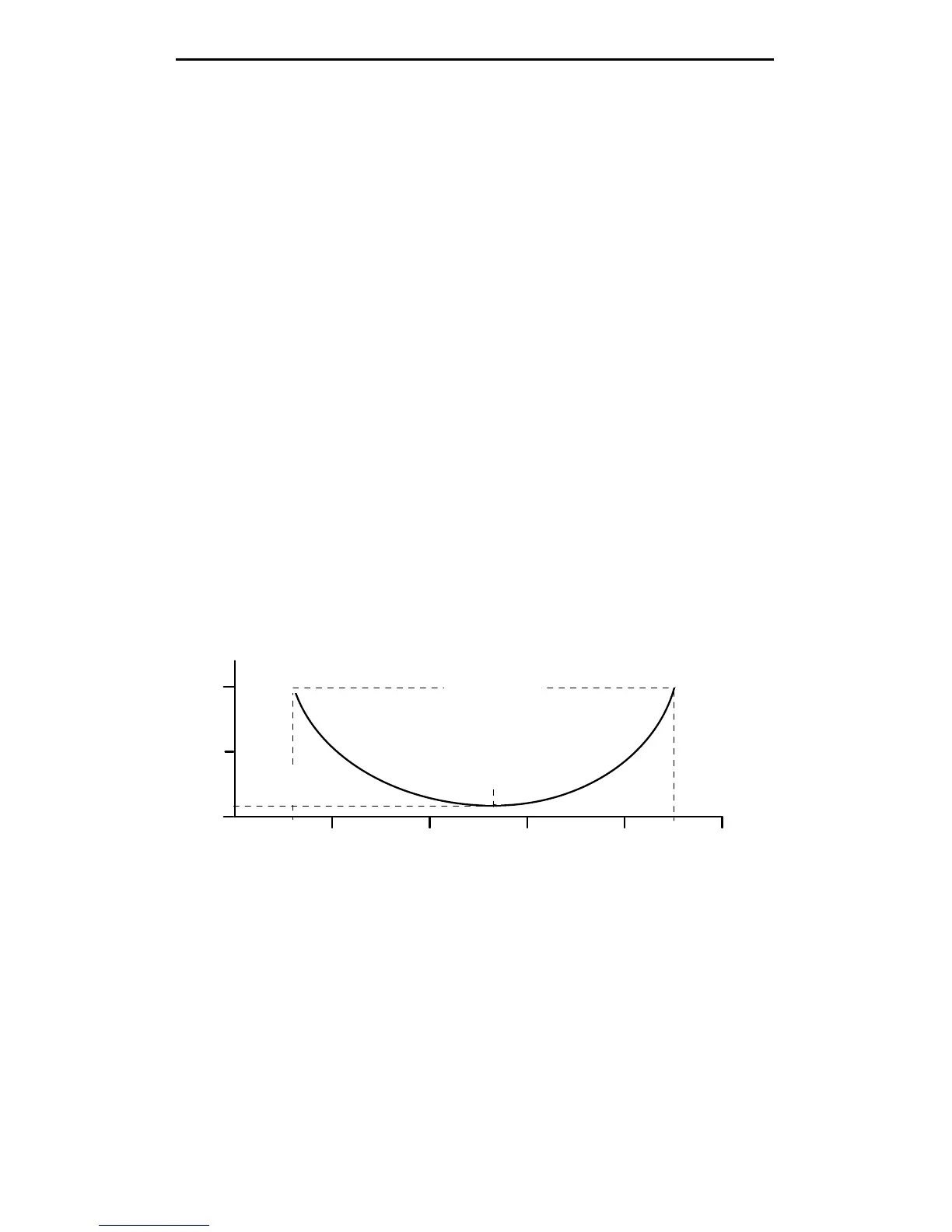
6.4 SWR, Bandwidth, and Resonance
The amateur-radio industry's standard for maximum SWR is 2:1 (1.5:1
for commercial 2-way). Most modern transceivers operate safely and
deliver full power within this mismatch range. The antenna bandwidth is
the frequency interval between its two 2:1 SWR points. This
specification, along with minimum SWR and minimum SWR frequency, is
often included on antenna specification sheets. Note that minimum SWR
is sometimes wrongly confused with resonant frequency. The technical
definition for resonance is the frequency where inductive and capacitive
reactance cancels, leaving a purely resistive load (
±
j = 0). The minimum
SWR and resonant frequencies may be close, but they rarely coincide.
13.9 14.0 14.1 14.2 14.3 14.4
1.5
2.0
1.0
Min. SWR Freq.
Bandwidth
Lower 2:1 Freq.
Upper 2:1 Freq.
Min. SWR
6.5 Antenna Tuning
Where possible, make adjustments to your antenna that will yield SWR
readings under 2:1 over the frequency range where you normally operate.
If the minimum-SWR frequency measures low in the band (or below the
band edge), your antenna is probably too long and will need to be
shortened. If the Minimum SWR frequency is too high, it should be
lengthened. To calculate the required change in length:
(1.) Write down the desired minimum SWR frequency (ex: 14.200 MHz)
(2.) Use the analyzer to measure the present minimum SWR frequency
(ex: 14.050 MHz)


 To Next Page