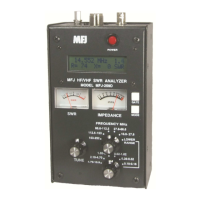
MFJ-266B HF/VHF/UHF Antenna Analyzer Instruction Manual
2012 MFJ Enterprises, Inc. Version 1D 14
the best accuracy is typically obtained on Band C, which may be
selected using the Up/Down switches. Note that any capacitor and lead
combination that approaches self-resonance at the stimulus frequency
will trigger the C = Xc >1.5K
Ω
ΩΩ
Ω
message and will be un-measurable.
Attempt to re-measure at a lower frequency.
7.5 Measuring Unknown Inductance
To measure inductance, connect the unknown component to the Antenna
connector. To enter the Inductance mode, begin with the analyzer turned
off, then press and hold the Down button while pressing the PWR
switch on (see Section 3.6). The screen will display the approximate
value of the unknown inductor in uH along with the stimulus frequency
where the measurement is being made. You will not have full control
over the stimulus-frequency Band selection and the best accuracy is
usually obtained on Band B or C (selected using the Up/Down
switches). Note that any inductor approaching self-resonance at the
stimulus frequency will trigger the L = X
L
>1.5K
Ω
ΩΩ
Ω
message and will be
un-measurable. Try to re-measure at a lower frequency.
7.6 Tuning a ¼-Wave or ½-Wave Coaxial Stub
To accurately tune a coaxial stub, begin by calculating the free-space
length at the stub's intended operating frequency:
For 1/4-λ in inches = 2951
÷
MHz
For 1/4-λ in feet = 246
÷
MHz
For 1/2-λ in inches = 5902
÷
MHz
For 1/2-λ In feet = 492
÷
MHz
Next, multiply the free-space length times your cable's velocity factor.
Finally, add at least 10% to this length for a margin of error (better too
long than too short). Cut the cable to this initial length. Connect one end
of the cable to the analyzer's Antenna connector. For a 1/4-λ stub, leave
the far end open. For a 1/2-λ stub, short the far end. Next:
(1.) Set the MFJ-266B to Analyzer mode (Section-3)
(2.) Initially, set the Range, Band, and Tune for the desired stub
frequency (Section-4)
(3.) *Tune down in frequency to find lowest impedance-magnitude
reading (the load is a short).
(4.) Write your measured frequency down.
(5.) Divide the measured frequency by the desired stub frequency to
obtain a correction factor
(6.) Multiply the present stub length by the correction factor to get the
desired stub length.


 To Next Page