MFJ-266B HF/VHF/UHF Antenna Analyzer Instruction Manual
2012 MFJ Enterprises, Inc. Version 1D 16
At the low and high ends of the transformer's frequency response range,
SWR and reactance will climb to unacceptable levels (< 1.2:1 is ideal).
HF, VHF, and UHF tuned transmission-line transformers may be tested
in similar fashion by connecting one end directly to the analyzer and
terminating the far end. However, only precision RF terminations with
known impedance characteristics should be used above 50 MHz. Set up
the analyzer for the desired range and sweep the band of interest using
the Tune control. Transmission-line transformers are “frequency
specific” and have much more limited frequency response.
7.9 Checking HF Baluns
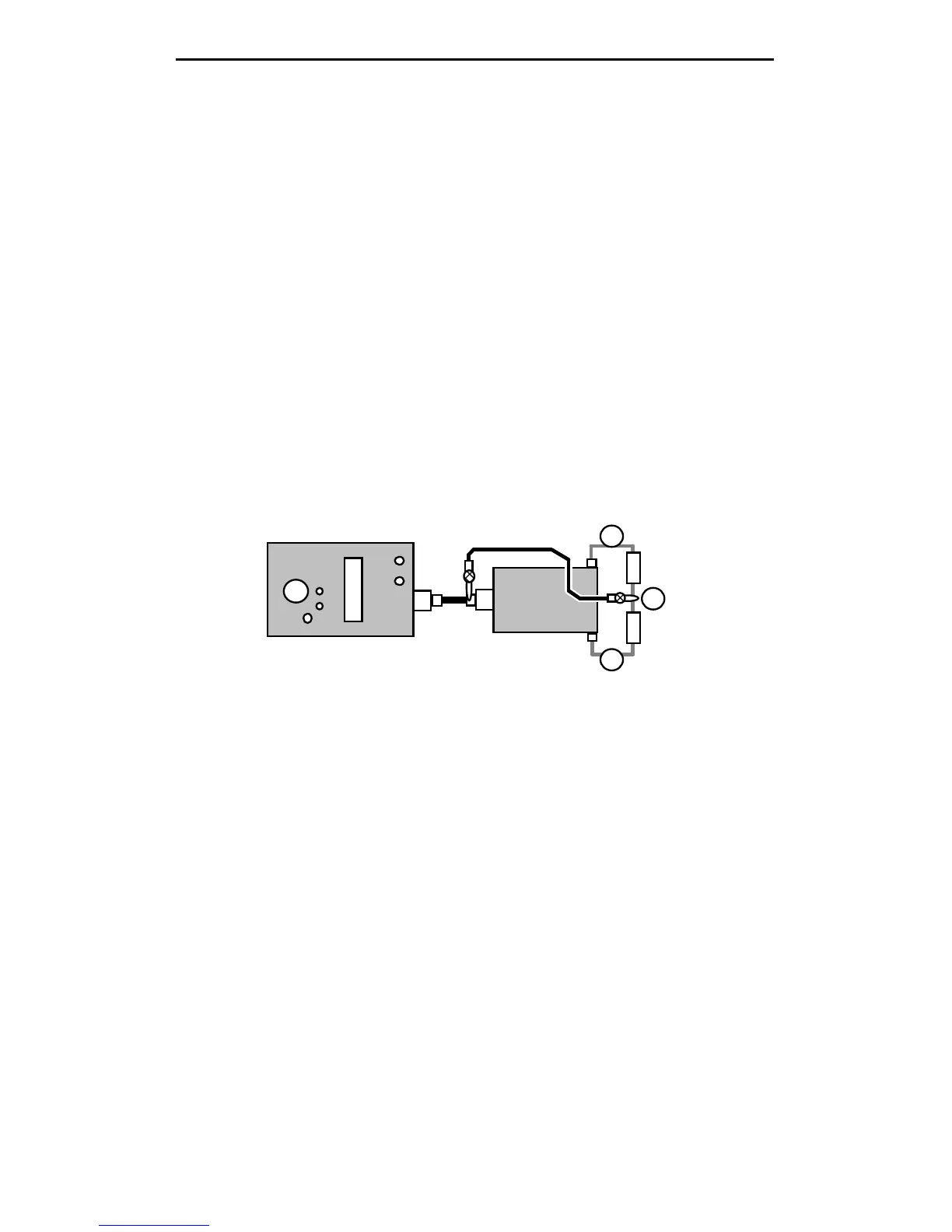
A well-designed balun will have low SWR and good balance over its
operating range. The MFJ-266B can test both of these qualities using the
setup shown below. Configure the unit to operate in Analyzer mode in
the HF range. Connect the input (unbalanced) side of the balun to the
analyzer’s antenna connector. Connect a center-tapped resistive load to
the balanced side (R1,R2 = 25Ω for 1:1 baluns, R1,R2 = 100Ω for 4:1
baluns). Using the Tune and Band controls:
B
C
Balun
MJ-266
A
Short Test Lead
R1
R2
(1.) Sweep the balun for SWR with the test lead disconnected from the
load.
(2.) Connect the test lead to the mid-point (A) and re-sweep. There
should be minimal change.
(3.) Connect it to either side (B) (C). SWR will go up, but should go up
equally on both sides.
7.10 Checking Coax Cable
To check a length of coax cable for impedance error, connect one end to
the analyzer and terminate the far end with a precision (non-inductive)
50-Ohm resistive load. Set the MFJ-266B up for analyzer mode and
select the VHF tuning range. Rotate Tune across the VHF range while
watching the Impedance Magnitude reading. If the cable is 50 Ohms and
in good condition, there should be little change in the impedance
magnitude readings. If there are significant fluctuations, the cable is
either not 50 Ohms or is badly contaminated. If readings cyclically swing
between 25 Ohms and 100 Ohms, the cable is 75-Ohm coax.


 To Next Page