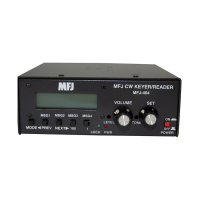
MFJ-464 Instruction Manual CW Keyer/Reader
15
Serial Number
The Serial Number menu allows you to set the current serial number from 0001 to 9999. Press
the “1” button and use the Set dial control to change number in increments of 1; press the “100”
button and use the Set dial control to change number in increments of 100. Only three digits are
sent for numbers below 1000—use leading zeroes when appropriate. The serial number is
automatically post-incremented each time it is sent. Serial number 9999 will wrap-around to
0001, skipping 0000 since it is not used. Use Leading Zeroes, Other Zeroes and Nines menus to
control the way zeroes and nines in the serial number are sent (see below). There are a four-digit
number and three single characters on line two of the display. The four-digit number enclosed
within “[” and “]” is the serial number.
Leading Zeroes
The Leading Zeroes menu is used to set whether the leading zeroes in the serial number are sent
as “0”, “O”, “T” or not at all. There are a four-digit number and three single characters on line
two of the display. The character enclosed within “[” and “]” is the replacement for the leading
zeroes in the serial number.
Other Zeroes
The Other Zeroes menu is used to set whether the non-leading zeroes in the serial number are
sent as “0”, “O” or “T”. There are a four-digit number and three single characters on line two of
the display. The character enclosed within “[” and “]” is the replacement for the other zeroes in
the serial number.
Nines
The Nines menu is used to set whether the nines in the serial number are sent as “9” or “N”.
There are a four-digit number and three single characters on line two of the display. The
character enclosed within “[” and “]” is the replacement for the nines in the serial number.
Iambic
The Iambic menu allows you to enable or disable iambic operation. Iambic operation allows you
to squeeze both paddles and get alternating dots and dashes. There are two different types of
iambic keying, and both are available. The difference in behavior of these two modes occurs
when both paddles are squeezed and then released. In iambic A mode, the keyer will simply
complete the element (dot or dash) in progress, and then stop sending. In iambic B mode, the
keyer will complete the element in progress, and then send an additional opposite element. For
example, a release during the dash produces "dit-dah" (A) in iambic A mode but produces "dit-
dah-dit" (R) in iambic B mode. Non-iambic mode does not alternate between dots and dashes
during a squeeze. It plays whatever side made contact first until it is released. That is, when
iambic mode is disabled there are no dot and dash memories.


 To Next Page