MFJ-464 Instruction Manual CW Keyer/Reader
17
The Reader
Using the MFJ-464 CW Reader
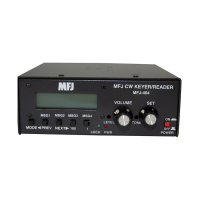
The MFJ-464 comes complete with a CW Reader. The CW Reader on the MFJ-464 is a Morse
code decoder that is displayed on a two-line 32-character LCD (liquid crystal display). It can
auto-track CW up to 99 WPM (words per minute), and has a volatile repeat buffer memory of
140 characters.
The Reader on the MFJ-464 functions in two different ways. It decodes and displays the Morse
code being sent and the Morse code being received. The LCD screen displays on the first
(upper) line the code that is being sent and on the second (lower) line the code that is being
received.
Operation
Connect the proper cables from the MFJ-464 to your radio. If you cannot remember where the
cables properly go, then see the Back Panel section of the manual on page 3. Power on your
receiver and tune it to find a clear, well-sent Morse code signal. When you have found one,
power on the MFJ-464. If necessary, adjust the Input Level control on your radio so that the
Lock LED is blinking. Now tune in the signal again on your radio to adjust its frequency (to
match the PLL frequency) until you get the maximum response from the LED. Next, turn the
Input Level control on your radio until the LED is blinking in sync with the Morse code. Wait
for the LCD screen to start displaying something that makes sense. Once it has tracked the
signal, read the messages as they scroll across the LCD screen. Repeat these steps a few times to
get the best response.
IMPORTANT: You can adjust the Input Level and Tune the signal directly on the MFJ-464.
However, it is recommended that you do these adjustments on your radio and
not on the MFJ-464. Changing the Input Level and the Tuning the signal on
the MFJ-464 can cause problems when trying to listen to another signal.
These adjustments are much easier to do on your radio than on the unit itself.
The Reader automatically locks on and tracks low and high speed Morse code, decoding it up to
99 WPM. When the unit is locked the green LED labeled LOCK will light. Its initial power-on
tracking speed is 20 WPM. It will take some time to track an incoming signal or to re-track an
extremely slow signal after copying a fast one and vice versa. If there is a lot of static, it will
take time to track slow signals. This is because the static appears to the Reader as high speed
Morse code.
There is a lot of sloppy code on the air and most computers cannot read them. Do not expect this
Reader to do the incredible when it comes to copying Morse code. Nothing can clean up and
copy a sloppy fist, especially with a weak signal and lots of QRM/QRN (interferences).
However, you will be quite pleased when copying strong well-sent code, especially those sent
with electronic keyers. Farnsworth code* and extremely negative weighted code will display
with spaces between each character. Finally, invalid characters are displayed as block characters
on the LCD screen and as spaces on the computer monitor. Prosigns (procedural signs) are
enclosed within “<” and “>” such as <AR> and <SN>.


 To Next Page