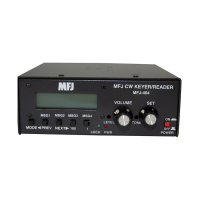
MFJ-464 Instruction Manual CW Keyer/Reader
33
setting the overall speed greater than or equal to the Farnsworth speed will disable
Farnsworth spacing.
Press either the “<” or “>” to decrease or increase speed, or enter up to two digits 05
to 99 to set the code speed. Press ENTER to accept and exit, or press ESC to accept
and exit.
T## Tone – sets the sidetone frequency to approximately ##0 Hz, where ## represents two
digits in the range of 30 to 99. The MFJ-464 features smooth, clean audio, with sine
wave output, instead of the harsh square wave audio used by many other keyers.
Also, the MFJ-464 produces each dit and dah with a rise and decay time of
approximately 5 milliseconds, avoiding the "spikes" that cause distracting key clicks.
The MFJ-464's audio sounds like that of a good CW transceiver.
Notice an alternating series of dots and dashes are sent to the sidetone monitor to
assist in the setting of the desired sidetone frequency. Press either the “<” or “>” to
decrease or increase tone frequency, or enter two digits 30 to 99 to set the tone
frequency. Press ENTER to accept and exit, or press ESC to cancel and exit.
V reVerse – reverses the sense of the dot and dash paddles. When using paddles, the
MFJ-464 normally expects the dot paddle to be connected to the tip of the plug and
the dash paddle to be connected to the plug's ring. If your paddles are wired in the
opposite manner, or you wish to change between right and left-handed operators, you
may reverse the paddles.
W## Weight – sets the code weighting to ## percent, where ## represents two digits in the
range of 25 to 75. Weight is the duty cycle of a continuous string of dots, where 50%
for perfect code. A higher weight produces a heavier sound and a lower weight
causes characters to sound lighter.
An alternating dot/dash is produced to aid in changing the weight. Press either the
“<” or “>” key to change the weight, or enter two digits 25 to 75 to set the weight.
Press ENTER to accept and exit, or press ESC to cancel and exit.
X Xmit (carrier tune) – gives continuous key-down for adjusting transmitter or antenna
tuner. Press any key to exit and release the key line.
Y Pulse tune – gives continuous adjustable pulses for adjusting transmitter or antenna
tuner. Press MSG1 and MSG2 buttons to change the speed in the range of 50 to 99
WPM. Press MSG3 and MSG4 buttons to change the weight (duty cycle) in the
range of 1% to 35%. Press ESC to exit and release the key line.
Z### Zeros and nines – sets the way zeros and nines in the serial number are sent. The first
# sets whether to send the leading zeros as "0", "O", "T" or not at all (# = "N"). The
second # sets whether the other zeros are sent as "0", "O" or "T". The last # sets
whether the nines are sent as "9" or "N". For example, "ZO09" will send the leading
zeros as "O" (dah-dah-dah), the other zeros as "0" (dah-dah-dah-dah-dah), and the
nines as "9" (dah-dah-dah-dah-dit).
# Play message – play message #, where # is the message number 1 to 4.
># Save message – save message into the keyer memory #, where # is the message
number 1 to 4.
<# View message – view message #, where # is the message number 1 to 4.


 To Next Page