MGL Avionics Stratomaster Ultra “L” Owner’s manual
Page 67
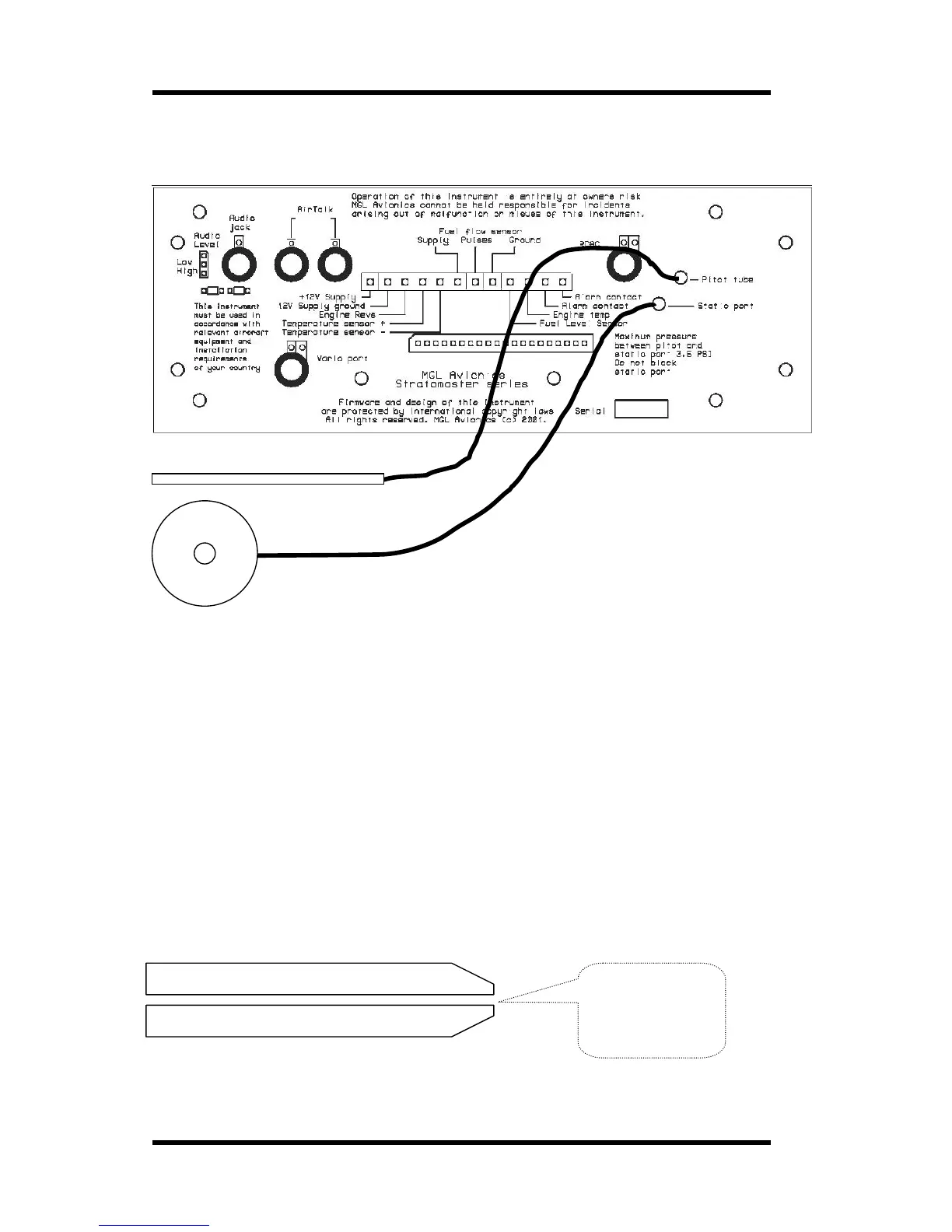
Pitot tube and static port
Pitot tube
Static port
Pitot tubes are found in a large variety in at your aircraft parts shop, in mail order catalogs or you
can make your own.
Contrary to popular belief, Pitot tubes are not carefully designed and calibrated but are simple
orifices or tubes that get pointed in the direction that you are flying. The forward movement of the
aircraft causes air to dam inside the pitot tube. This increases the pressure inside the tube. The
Stratomaster Flight contains a sensitive silicon diaphragm sensor that measures the pressure
difference between the pitot pressure port and the static port. This measurement is used to
calculate the airspeed.
In addition, the static port is connected to the altimeter sensor.
Most small aircraft such as ultralights or microlights do not require a connection to a static port. In
these cases, simply leave the static port open. Ensure however that the static port does not
receive pressurized air due to the forward movement of the aircraft.
Static ports are usually mounted at a strategic position on the rear side of the aircraft fuselage for
faster, pressurized aircraft.
Suitable pitot tubes can be made from a short piece of hollow aluminium or copper piping. Length
and diameter are not important. Ensure that the front of the pitot tube has a suitable chamfer if
you use thick walled tubing or you may introduce a speed reading error if you have a faster
aircraft.
Example cross-section of thick walled pitot tube.
Chamfer leading
edge if you use
thick walled pipe
as a pitot tube


 To Next Page