EasyManua.ls Logo

Micronta 22-195A - VOLTAGE MEASUREMENT SPECIFICS; Reading Decimal Points; 3-Phase AC Voltage Measurement

Default Icon
36 pages
Print Icon
To Next Page IconTo Next Page
To Previous Page IconTo Previous Page
Loading...
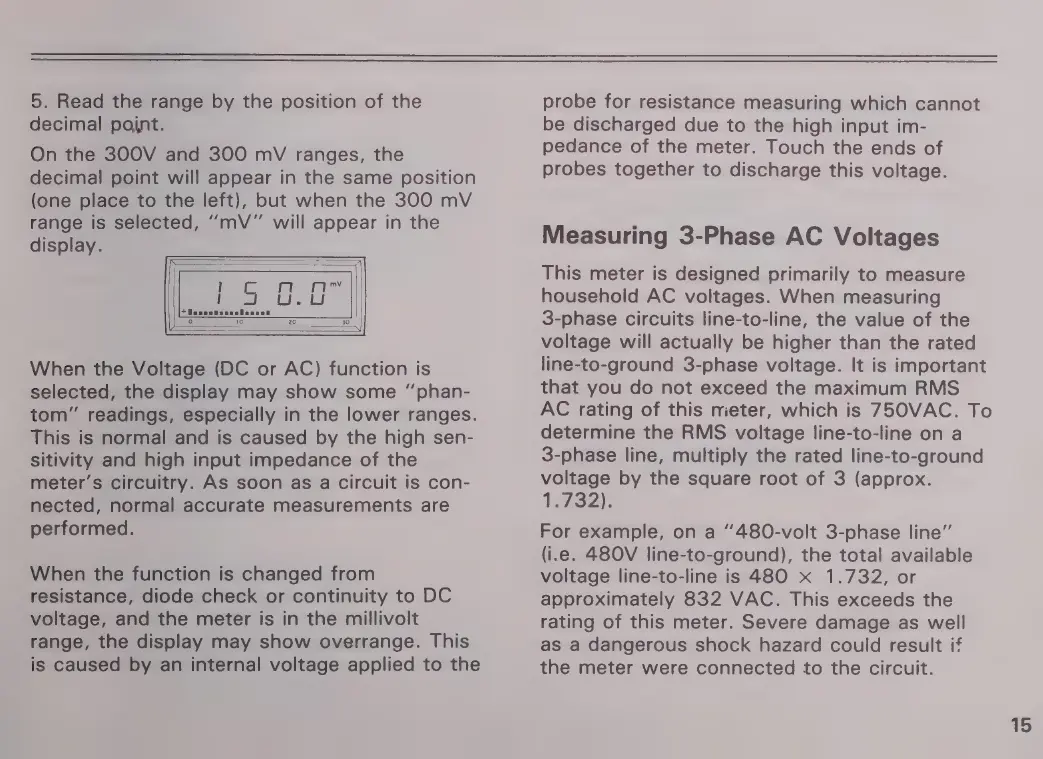
5.
Read
the
range
by
the
position
of
the
decimal
point.
On
the
300V
and
300
mV
ranges,
the
decimal
point
will
appear
in
the
same
position
(one
place
to
the
left),
but
when
the
300
mV
range
is
selected,
"mV"
will
appear
in
the
display.
When
the
Voltage
(DC
or
AC)
function
is
selected,
the
display
may
show
some
"phan-
tom"
readings,
especially
in
the
lower
ranges.
This
is
normal
and
is
caused
by
the
high
sen-
sitivity
and
high
input
impedance
of
the
meter's
circuitry.
As
soon
as
a
circuit
is
con-
nected,
normal
accurate
measurements
are
performed.
When
the
function
is
changed
from
resistance,
diode
check
or
continuity
to
DC
voltage,
and
the
meter
is
in
the
millivolt
range,
the
display
may
show
overrange.
This
is
caused
by
an
internal
voltage
applied
to
the
probe
for
resistance
measuring
which
cannot
be
discharged
due
to
the
high
input
im-
pedance
of
the
meter.
Touch
the
ends
of
probes
together
to
discharge
this
voltage.
Measuring
3-Phase
AC
Voltages
This
meter
is
designed
primarily
to
measure
household
AC
voltages.
When
measuring
3-phase
circuits
line-to-line,
the
value
of
the
voltage
will
actually
be
higher
than
the
rated
line-to-ground
3-phase
voltage.
It
is
important
that
you
do
not
exceed
the
maximum
RMS
AC
rating
of
this
mieter,
which
is
750VAC.
To
determine
the
RMS
voltage
line-to-line
on
a
3-phase
line,
multiply
the
rated
line-to-ground
voltage
by
the
square
root
of
3
(approx.
1.732).
For
example,
on
a
"480-volt
3-phase
line"
(i.e.
480V
line-to-ground),
the
total
available
voltage
line-to-line
is
480
x
1.732,
or
approximately
832
VAC.
This
exceeds
the
rating
of
this
meter.
Severe
damage
as
well
as
a
dangerous
shock
hazard
could
result
if
the
meter
were
connected
to
the
circuit.
15

Related product manuals