4.3 Theory of Operation
The SA.22c controls the frequency of a quartz crystal oscillator through a frequency-locked loop (FLL)
using the atomic resonance property of rubidium ( Rb).
87
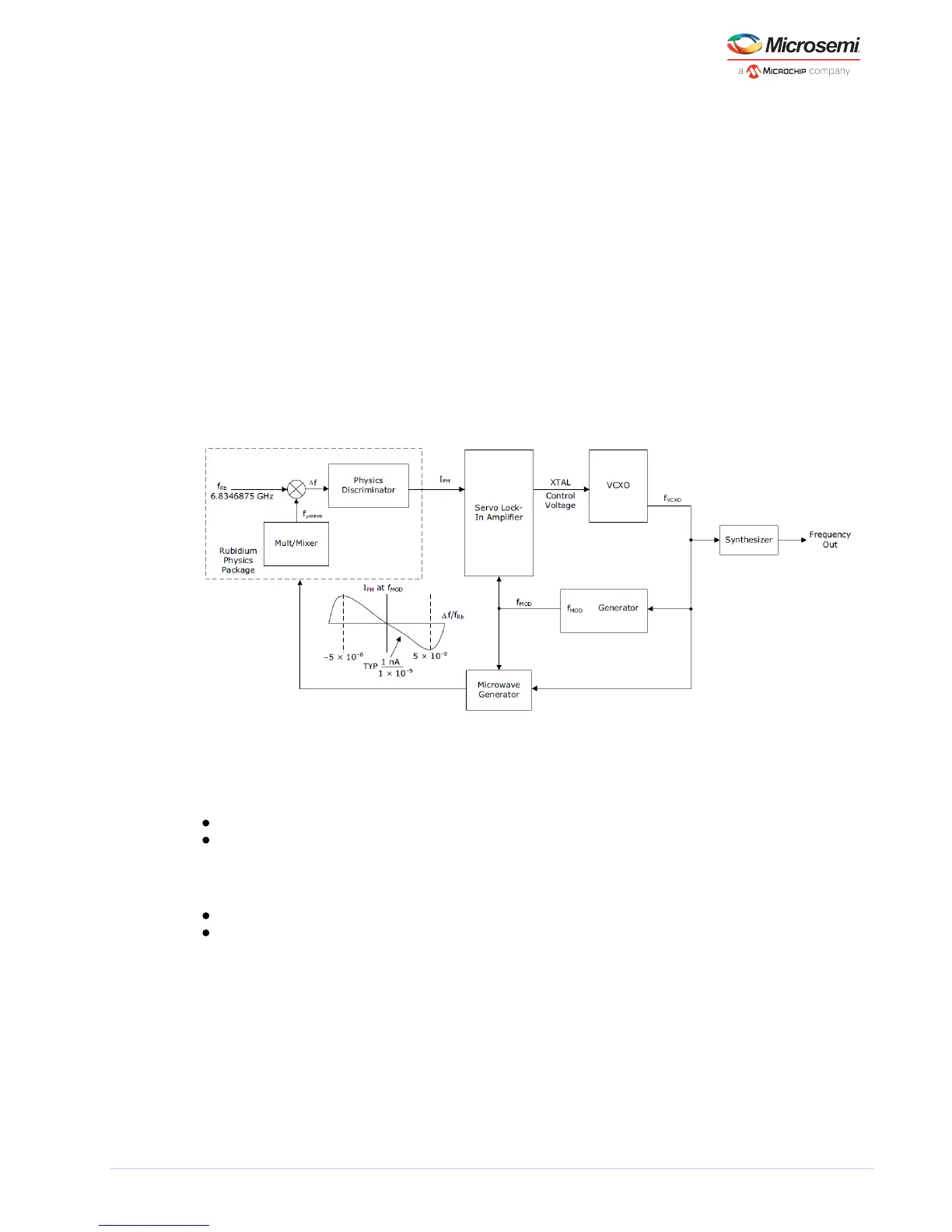
The FLL function block is shown in the following illustration. A microwave signal is derived from a
voltage controlled crystal oscillator (VCXO) and is applied to the Rb vapor within a glass cell. The light
87
of a rubidium lamp passes through this cell and illuminates a photo detector. When the frequency of the
applied RF signal corresponds to the frequency of the ground-state hyperfine transition of the Rb atom
87
(an ultra-stable high-Q rubidium atomic resonance), the light is absorbed causing a change (decrease) in
photo detector current (IPH).
As the change in current is small, modulation techniques are required to extract the desired signal from
the noise background.
The photo detector current generates a control signal with phase and amplitude information, which
permits continuous regulation of the VCXO frequency. The servo section converts the photo detector
current into a voltage, then amplifies, demodulates, and integrates it for high DC servo loop gain.
Figure 9 • Rb Control Loop Block Diagram
4.4 Troubleshooting
After installation, if the SA.22c unit fails to provide outputs, or the rubidium oscillator fails to achieve
lock, check for the following faults:
External power supply is providing incorrect power
I/O connector is defective—perform a continuity check
Note: All pins must have a connection in the I/O connector. This is important for the power and ground
pins.
Operating area has excess humidity or moisture
Ambient temperature is below –10 °C or above 75 °C (the unit may not startup in excessively cold or
hot temperatures)
4.5 Repairs and Support
The SA.22c is not field repairable, but some firmware upgrades can be done in the field, as mentioned in
. If the unit fails, do not remove the cover of the unit and attempt to Start-Up Sequence (see page 13)
make repairs.
Note: Unit warranty is void if the cover is removed or if the protective seals covering the two tuning and
adjustment holes are torn or removed.



 To Next Page