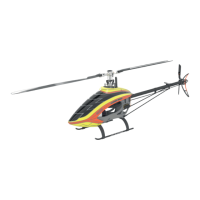
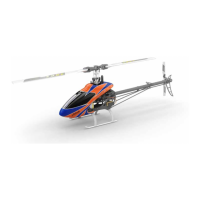
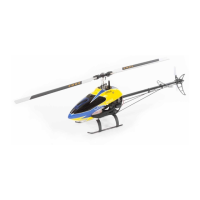
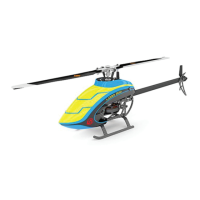
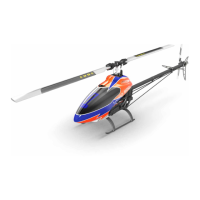
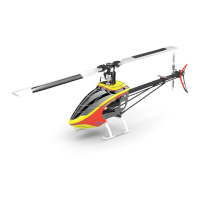
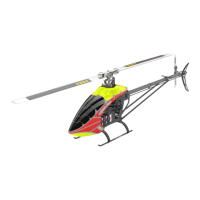
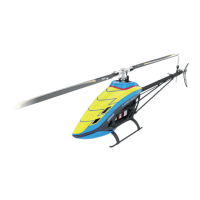
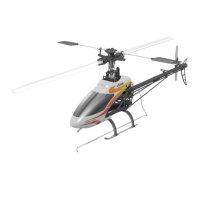
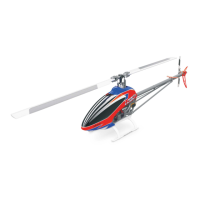
The provided document is a manual for the Mikado LOGO 550 SE model helicopter.
This device is a high-performance, flybarless radio-controlled (RC) helicopter designed for experienced pilots. Its primary function is to provide an advanced and robust platform for aerobatic and precision flying. The "SE" in its name likely denotes "Special Edition," suggesting enhanced features or components compared to a standard model.
Function Description:
The LOGO 550 SE is a complex electromechanical system controlled remotely via a radio transmitter. It utilizes a V-Bar flybarless system, which is a sophisticated electronic stabilization unit that replaces the traditional mechanical flybar, offering precise control, stability, and agility. The helicopter is powered by an electric motor, typically a brushless type, which drives the main rotor and tail rotor through a series of gears and belts. A speed controller (ESC) regulates the motor's RPM based on commands from the V-Bar unit and the pilot's input. Servos translate control inputs into mechanical movements of the swashplate and tail rotor, altering the pitch of the main rotor blades and the tail rotor blades, respectively, to achieve flight maneuvers. The design emphasizes a lightweight yet rigid chassis, ensuring optimal performance and durability during flight.
Important Technical Specifications:
- Max. rotorhead rpm: 2100 RPM. This indicates the maximum rotational speed of the main rotor, a critical parameter for flight performance and safety.
- Max. collective range: +/- 12°. This refers to the maximum angle of attack the main rotor blades can achieve, directly impacting the helicopter's lift and maneuverability. A wider collective range allows for more aggressive maneuvers.
- Max. Rotor blade size: 600mm. This specifies the maximum length of the main rotor blades that can be used with this model, influencing its overall size, lift characteristics, and flight envelope.
- Max. LiPo Akku size: 6S 5000mAh. This indicates the recommended maximum Lithium Polymer battery configuration, specifying a 6-cell (6S) battery with a capacity of 5000 milliampere-hours (mAh). This directly affects flight time and power output.
- Flybarless System: V-Bar (V-Stabi). This is a key feature, highlighting the use of an electronic stabilization system for enhanced flight characteristics.
Usage Features:
The LOGO 550 SE is explicitly not recommended for novices. It is a complex system requiring basic knowledge of model helicopter functions to build and operate safely.
- Assembly: The manual provides detailed, step-by-step instructions for assembly, including the mainframe, tail rotor, tail boom, main gear, V-Bar rotor head, servo installation, motor mounting, and canopy mounting. It emphasizes the use of specific tools like hex wrenches, screwdrivers, ball link pliers, circlips pliers, and a pitch gauge.
- Component Integration: The helicopter integrates various components, including:
- Mainframe: The structural backbone, designed for rigidity and component mounting.
- Tail Rotor: Belt-driven for precise yaw control.
- V-Bar Rotor Head: The core of the flybarless system, allowing for precise blade pitch control.
- Servos: Crucial for translating control inputs to mechanical movements. The manual provides guidance on servo arm positioning for optimal control.
- Motor and Speed Controller: The propulsion system, with recommendations to check Mikado webpages for suitable motors.
- Radio and Battery: The remote control system and power source. The manual shows the placement of the V-Bar gyro, mini V-Bar, speed controller, and LiPo battery.
- Pre-flight Checks: The manual stresses the importance of ensuring all screws are tightened, replacing damaged parts, and performing necessary maintenance before each flight.
- Safety Guidelines: Extensive safety instructions are provided, including:
- Operating in spacious areas with no people nearby.
- Avoiding operation in residential areas, parks, indoors, or in adverse weather conditions (wind, rain, snow, fog).
- Maintaining a safe distance (at least 10 meters/yards) from the spinning rotor.
- Checking the R/C system prior to operation, especially battery strength.
- Never using a frequency already in use by another R/C model.
- Immediately halting operation and investigating if the model shows irregular behavior.
- Novice pilots are strongly advised to seek advice from experienced pilots and never fly alone.
- Motor Pinion Installation: Specific instructions are given for mounting the motor pinion, emphasizing correct alignment with the main gear and proper gear backlash adjustment to prevent damage and ensure smooth operation.
- Ball Link Attachment: Instructions specify attaching ball links so that the engraved number faces outwards.
Maintenance Features:
- Greasing and Lubrication: The manual instructs applying grease to bearings (e.g., tail rotor assembly) and silicon oil or grease to O-rings and the spindle shaft in the V-Bar rotor head.
- Threadlock Application: The use of threadlock is indicated for specific threaded sections, particularly in the tail rotor hub, to prevent screws from loosening due to vibrations.
- Epoxy Usage: Five-minute epoxy is used for securing ball bearings in certain assemblies, such as the tail rotor.
- Regular Inspections: The safety instructions implicitly highlight the need for regular maintenance by advising pilots to ensure all screws are tightened and to replace broken or defective parts.
- Gear Backlash Adjustment: Detailed instructions are provided for adjusting the gear backlash between the motor pinion and the main gear, which is crucial for the longevity and efficiency of the drivetrain. This involves ensuring no backlash while also avoiding excessive pressure on the running surface of the main gear.
In summary, the Mikado LOGO 550 SE is a sophisticated RC helicopter designed for experienced enthusiasts, offering high performance and precision through its V-Bar flybarless system. Its manual emphasizes meticulous assembly, rigorous safety protocols, and diligent maintenance to ensure a safe and optimal flying experience.

 Need help?

 To Next Page
 General