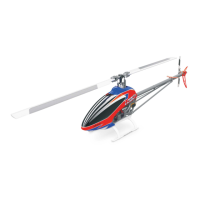
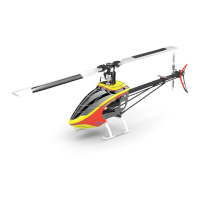
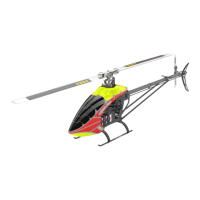
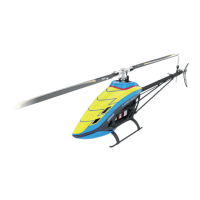
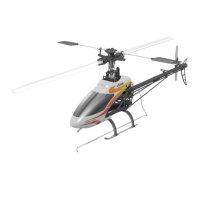
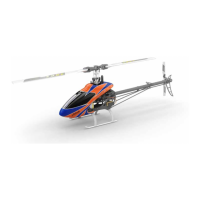
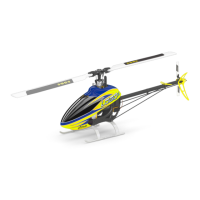
The Mikado LOGO 600 is a high-performance model helicopter designed for experienced pilots. It is a complex system requiring basic knowledge of model helicopter function for both assembly and operation. The manual emphasizes safety, warning against operation in crowded areas, residential zones, indoors, or during adverse weather conditions. It also stresses the importance of pre-flight checks, ensuring all screws are tightened, and replacing damaged parts to prevent accidents. Novice pilots are strongly advised to seek assistance from experienced individuals for assembly, pre-flight adjustments, and initial flights due to the inherent safety hazards of a poorly assembled or adjusted helicopter.
Function Description:
The Mikado LOGO 600 is a remote-controlled model helicopter, specifically a flybarless design, as indicated by the "V-Stabi, flybarless head" section. This design typically offers improved agility, precision, and a simpler mechanical setup compared to traditional flybar systems. The helicopter is designed for various flight styles, including 3D flying, which is hinted at by the recommendation for a counterbearing for "very hard 3D flying." The manual details the assembly of the mainframe, tail rotor, tail boom, main gear, tail boom assembly, V-Bar rotor head, servo installation, motor mounting, canopy mounting, and radio/battery setup. The V-Bar system, a common electronic flybarless controller, is integral to its operation, managing the helicopter's stability and control.
Important Technical Specifications:
- Max. rotorhead rpm: 2000 RPM
- Max. collective range: +/- 12°
- Max. Rotor blade size: 600 mm – 620 mm
- Max. LiPo Akku size: 10S 5000 mAh
- Tail Boom dimensions: Ø4x705 mm
- Motor Pinion options (module 1, diameter 6 mm): 10, 11, 12, 13, 14, 15 teeth (10 teeth pinion has a 5 mm diameter)
- Rotor Head dimensions (V-Stabi, flybarless head): 16 mm (aileron left, aileron right, elevator), 14 mm (rudder)
- Ball link distance for rotor head: 18 mm
Usage Features:
- Flybarless Design (V-Stabi): Offers enhanced flight performance, precision, and a cleaner mechanical setup. The V-Bar system is a key component for electronic stabilization.
- Modular Assembly: The manual breaks down the assembly into distinct sections (Mainframe, Tail Rotor, Tail Boom, etc.), each with specific parts and instructions, making the build process manageable.
- Servo Installation Guidance: Provides specific instructions for servo arm positioning for tail rotor and aileron servos when sticks are centered, ensuring correct control throws. It also notes the need for distance plates when installing Futaba servos for ailerons.
- Motor Mounting and Gear Backlash Adjustment: Detailed instructions are provided for mounting the motor pinion and adjusting gear backlash to prevent wear and ensure smooth operation. This involves aligning the pinion with the main gear and tightening screws without exerting pressure on the running surface of the main gear.
- Battery Mounting: Recommends securing the LiPo battery with three Velcro straps for stability during flight.
- Canopy Mounting: Simple instructions for attaching the canopy, which is essential for protecting internal components and contributing to the helicopter's aerodynamics.
- Radio and Battery Setup: Includes diagrams for the optimal positioning of the V-Bar gyro, receiver, speed controller, V-Bar main board, and LiPo battery for the receiver's power supply.
Maintenance Features:
- Regular Screw Tightening: Emphasized as a critical safety measure, as loose screws can lead to major accidents.
- Part Replacement: Instructions to replace all broken or defective parts with new ones to prevent crashes.
- Bearing Lubrication: Specific instructions to apply grease to bearings in the tail rotor and V-Bar rotor head assemblies, and a small amount of oil to the rotor shaft, to ensure smooth operation and longevity.
- Axial Play Check: For the blade holder in the V-Bar rotor head, instructions are given to check for axial play and use shims (10x16x0.5) if detected, indicating a focus on precise mechanical tolerances.
- Swashplate Driver Adjustment: Guidance to adjust the swashplate driver so that the balls on the inner and outer ring are aligned along the longitudinal axis of the heli, which is crucial for accurate control.
- Motor Heat Warning: Advises against touching the motor immediately after use due to potential high temperatures.
- General Maintenance: A general instruction to "Perform all necessary maintenance" underscores the ongoing need for care to ensure optimal performance and safety.
- Troubleshooting: If the model exhibits irregular behavior, the manual instructs the user to immediately stop operation, turn off power, disconnect batteries, investigate the cause, and fix the problem before flying again.

 Need help?

 To Next Page
 General