EasyManua.ls Logo

Mikado LOGO 800 - User Manual

Mikado LOGO 800
25 pages
Print Icon
To Next Page IconTo Next Page
Loading...
LOGO 800
Manual
Mikado Model Helicopters GmbH • Graf-von-Schwerin-Str.40 • 14469 Potsdam • Germany
phone +49 (0)331 23749-0 • fax +49 (0)331 23749-11 • www.mikado-heli.de
© Mikado Model Helicopters GmbH 2019, V1.0
Question and Answer IconNeed help?

Do you have a question about the Mikado LOGO 800 and is the answer not in the manual?

Summary

Safety and Operational Guidelines

Pre-Flight Safety Checks

Crucial safety measures and operational restrictions before powering on the helicopter.

Technical Specifications

Key operational specifications for the LOGO 800 helicopter.

Safe Flying Tips

Recommendations for safe and optimal flying maneuvers to ensure model longevity.

Injury and Damage Prevention

Essential precautions for preventing injuries and damage during operation and maintenance.

1 Chassis

Chassis Assembly: Servo Mounting

Instructions for mounting servos onto the helicopter chassis.

1 Chassis

Chassis Assembly: Frame Connections

Steps for connecting chassis frame components and installing adapters.

1 Chassis and Landing Struts

Landing Struts Assembly

Instructions for attaching the landing struts and related components.

1 Chassis

Chassis Final Assembly

Final steps for chassis assembly, including tail boom support installation.

2 Servo Mounting

Servo Mounting Procedure

Detailed instructions for mounting the servos onto the helicopter.

3 Main Gear

Main Gear Installation

Step-by-step guide for installing the main gear and checking its mesh.

4 Motor Installation

Motor Installation and Pinion Setting

Procedure for installing the motor and setting the pinion gear mesh.

5 Tail Rotor

Tail Rotor Assembly

Detailed guide for assembling the tail rotor components.

6 Torque Tube

Torque Tube Assembly

Instructions for assembling and installing the torque tube system.

7 Tail Boom Mounting

Tail Boom Mounting

Steps for securely mounting the tail boom onto the helicopter chassis.

8 Tail Boom Brace

Tail Boom Brace Installation

Instructions for installing the tail boom brace and control rod guide.

9 Swashplate

Swashplate Assembly

Guide to assembling the swashplate and mounting ball links.

10 Rotor Head

Rotor Head Assembly

Instructions for assembling the rotor head and configuring dampeners.

11 Rotor Head Linkage

Rotor Head Linkage Connection

Procedure for connecting the rotor head linkages to the swashplate and servos.

12 Wiring RC Components

RC Component Wiring

Diagram illustrating the correct wiring of RC components like ESC, receiver, and servos.

13 Mounting ESC; Battery

ESC and Battery Mounting

Steps for securely mounting the ESC and battery pack onto the helicopter.

14 Canopy and Overview

Canopy Mounting

Instructions for mounting, removing, and securing the helicopter canopy.

15 Overview Spare Parts Mainframe

Mainframe Spare Parts Identification

Visual identification of spare parts for the helicopter's mainframe.

15 Overview Spare Parts Mainframe

Mainframe Assembly Components

Overview of components and spare parts for the mainframe assembly.

15 Overview Spare Parts Mainframe

Mainframe Structure Overview

Identification of different structural components of the helicopter mainframe.

16 Overview Spare Parts Tail Boom

Tail Boom Spare Parts

Visual identification of spare parts for the helicopter's tail boom.

17 Overview Spare Parts Tail Rotor

Tail Rotor Spare Parts

Visual identification of spare parts for the helicopter's tail rotor assembly.

18 Overview Spare Parts Rotor Head

Rotor Head Spare Parts

Visual identification of spare parts for the helicopter's rotor head assembly.

Overview

The Mikado LOGO 800 is a high-performance RC helicopter designed for experienced users, not beginners. It requires a certain level of expertise in assembling and operating RC helicopters, with prior experience with models like the LOGO 400 to LOGO 600 being recommended. The manual emphasizes strict adherence to safety instructions and proper assembly techniques to prevent injury or damage.

Function Description

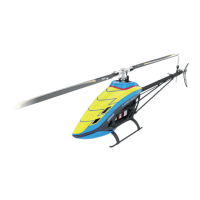
The LOGO 800 is an RC helicopter intended for outdoor operation. It is designed for various flight styles, from smooth sport flying to aggressive 3D maneuvers, depending on the chosen damper configuration. The helicopter's design incorporates features that contribute to its stability and performance, such as a robust chassis, a precise servo mounting system, and a well-engineered main gear and tail rotor drive. The VBar NEO system is integrated for flight control, and the model is powered by a high-performance motor and ESC, requiring specific battery configurations.
Important Technical Specifications

  • Maximum Rotor Head RPM: 1800 U/min. Exceeding this can lead to electronic component overload, damage, or a crash.
  • Maximum Pitch Travel: +/- 12°.
  • Rotor Blade Length: 750 to 810mm.
  • LiPo Battery: 12-14S LiPo Batteries are required.
  • Admissible Temperature: 5° - 35° Celsius.
  • Dampers: The kit comes standard with 6 x 80 shore dampers ("Medium Dampener Configuration") suitable for smoother flying at all RPMs and gentle 3D. For aggressive 3D maneuvers, 2 x 90 shore dampers ("Hard Damper Configuration") are included and must be installed to prevent boom strikes. Installing more than 2 x 90 dampers is not recommended as it can over-compress the head and damage thrust bearings.
  • Tail Rotor Blades: For low RPM flying (below 1400rpm), longer tail rotor blades (120-130mm) can be used for better tail authority. However, flying at higher RPMs with larger tail blades is not advised.
  • Canopy: The LOGO 800 features a large, wrap-around canopy with four mounting points for secure attachment. It is 100% handmade, and minor irregularities are normal.

Usage Features

  • Flight Control: The VBar NEO system is central to the helicopter's flight control. Users should refer to its manual for proper setup and functioning.
  • Aggressive 3D Maneuvers: While capable, the manual advises caution for aggressive 3D maneuvers due to the model's size. Specific recommendations include:
    • Installing 2 x 90 shore dampers for aggressive 3D.
    • Avoiding maneuvers with large amounts of backward elevator and negative collective pitch simultaneously, especially in a quick or aggressive manner, to prevent catastrophic boom strikes.
    • Practicing good pitch management: large collective pitch with low cyclic, or high cyclic with low collective, but not both simultaneously.
    • Maintaining at least 1800rpm head speed for aggressive maneuvers. Lower RPMs require smoother flying.
    • Avoiding high collective pitch with rapid right rudder inputs to prevent excessive stress on the tail rotor drive train.
  • Battery Plate: The battery plate may initially be stiff to insert; applying a small amount of silicone oil to the edges can help. It must be secured with both quick-release mechanisms before each flight.
  • Canopy Handling: Taking the canopy on and off requires a specific procedure, and users are directed to an informational video for guidance to avoid damage.
  • Safety Distance: Always maintain a minimum of 10 yards from the spinning rotor head and during trimming. Never operate the helicopter alone.
  • Operating Environment: The helicopter is strictly for outdoor use in permitted areas, away from children, crowds, houses, parks, confined spaces, adverse weather (rain, snow, hail, strong winds), trees, or high-tension wires.

Maintenance Features

  • Screw Security: All screws must be secured, with Loctite 243 (blue) recommended for all screwed connections. Proper curing time for Loctite should be observed before flying.
  • Frequent Inspections: Regular checks for deterioration or wear on all parts are crucial. Any worn parts must be exchanged. Failure to do so increases the risk of an unsafe model, damage, or injury.
  • Gear Mesh Adjustment:
    • Main Gear: The main gear should have approximately 1 mm of axial play when properly mounted.
    • Tail Gear: The tail gear position is factory-set for a good starting mesh. After 10-20 flights, the gear mesh will wear in and likely require readjustment. This is done by shifting 0.1 or 0.2mm shims from the right to the left side of the bevel gear. Only shift one shim at a time. The mesh should have a slight amount of play, with only 1 or 2 positions having no play. If gears are hard to rotate or noisy, it's too tight; if there's play all around, it's too loose. Periodic checks are recommended.
  • Torque Tube: Ensure the tail boom is dirt-free inside before inserting the torque tube. Apply grease to the rubber o-rings and the inside of the tail boom.
  • Ball Link Adapters: Sand the carbon tube before gluing the ball link adapters in place.
  • Swashplate Ball: Apply a few drops of oil to the swashplate ball to aid in breaking it in during flight.
  • Rotor Head Dampers: For aggressive 3D flying, the outer dampers on each side must be changed from 80 shore to 90 shore.
  • Rotor Head Linkage: Tighten and secure specific screws (M4x25 in main rotor head, M3x30 in blade holders, M3x25 in swashplate driver) after mounting and adjusting the rotor head and linkages.
  • Wiring Protection: All wires must be placed to avoid damage from sharp edges. Fabric tubes and edge guards are provided and recommended.
  • Component Cooling: Components like the ESC and motor can run hot; avoid touching them until they have cooled down sufficiently.
  • Original Parts: Only original Mikado parts and recommended electronic components should be used.

Mikado LOGO 800 Specifications

General IconGeneral
BrandMikado
ModelLOGO 800
CategoryToy
LanguageEnglish

Related product manuals