The cables must be in sized proportion with the electrical power of the milk cooling tank. See table 1 of the appendix in order
to choose the type of the cable.
The cable must be straight, without coils (twisted extensions of electrical cable, etc.).
The milk cooling tank power must be supplied from a separate electrical line that is protected with a fuse or circuit breaker for
electric motors at the electrical panel.
Powering two milk cooling tanks from one fuse is forbidden.
The electrical connections of the milk cooling tanks of over or equal to 500 liters capacity must be inside the electrical
panel, and the electrical line must be connected to an industrial type socket.
ATTENTION! For your protection, the milk cooling tank must be provided with a grounded protective conductor of
suitable capacity to ensure the proper grounding of the tank.
After you have performed the electrical connection, measure the voltage loss in the cable by using a voltmeter. While the milk
cooling tank is operating, the voltage loss must not be greater than 3% of the electrical circuit. This measurement should be
performed while the compressor is operating.
Excessive voltage loss at the feeding cable can cause serious damage to the refrigerating mechanism, and is not
covered by the guarantee.
NOTE: Wrong connections at the terminal blocks or the socket plugging can also cause excessive voltage loss.
6. OPERATION PRINCIPLE
The milk cooling tank is especially designed and constructed for the refrigeration and conservation of milk, and to maintain
high product quality. Refrigeration must occur immediately after collection to minimize the possibility of spoilage of the milk.
The tank cools the milk by using a refrigeration unit. Homogenous refrigeration is achieved by an agitation paddle, which is
rotated by an electrical motor and mechanical reducer. The insulated walls of the milk cooling tank help keep the temperature
stable by reducing thermal loss.
7. DESCRIPTION
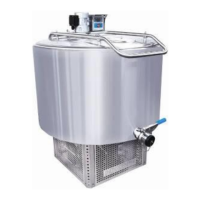
The milk tank vessel is made of stainless steel 18/10 AISI 304. The vessel consists of two walls. Between them there is environ-
mentally friendly polyurethane foam insulation, which is inserted under controlled infusion. The agitation motor mechanism
is mounted to the tank lid and directly connected with the stirring paddle. The paddle is constructed of stainless steel and has
two shaped ribs at both its diametrical sides. This shape has been chosen for better and more equalized stirring of the product.
A dipstick and a calibration chart are located inside the tank.
The agitator motor and the control panel/controller are located on the milk cooling tank lid. This controller is used as a ther-
mostat, thermometer and a stirring state controller. The milk inlet of a Ø175 diameter is placed on the lid, too. A handle is
placed on the front of the cover, and is used for opening the lid.
The milk outlet valve (DN50, Ø52) is located at the bottom of the tank (models IC 100-300LT). The tank base is made of stainless
steel and can be completely dismantled. It consists of the upper and the bottom cover, four adjustable legs, four footing-bases
and lateral covers. This has been designed for safe operation, easy maintenance, and full protection from various weather
conditions and the entrance of small animals and rodents in the refrigerating unit. This protection is achieved by four stainless
steel covers placed at the four sides of the base. These covers are perforated so that the heat produced by the condenser and
the compressor can be easily emitted. The perforation holes have dimensions that prevent the entrance of small animals and
rodents into the refrigerating unit. In models IC 400-2000LT the refrigerating unit is placed adjacent to the tank, also protected
by perforated stainless steel covers.
The stainless steel tank cover has an adjustable, gravity-activated safety switch to interrupt the agitator motor operation when
the cover is opened. When the cover is closed, the stirring operation is re-enabled.


 To Next Page