NAVIGATING PARALLEL PATHS
With a basic understanding of Labyrinth’s sequencers under our belts it is finally time to turn our
attention to its sound engine. Labyrinth is, of course, far more than a sine wave synthesizer!
Return your panel settings to the same initialized panel state we started with back in the beginning of
the “Exploring Labyrinth” section. Keep whatever sequence you have playing around—it will be easier
to explore the sound network of Labyrinth with a repeating sequence playing.
EXPLORING LABYRINTH (Continued)
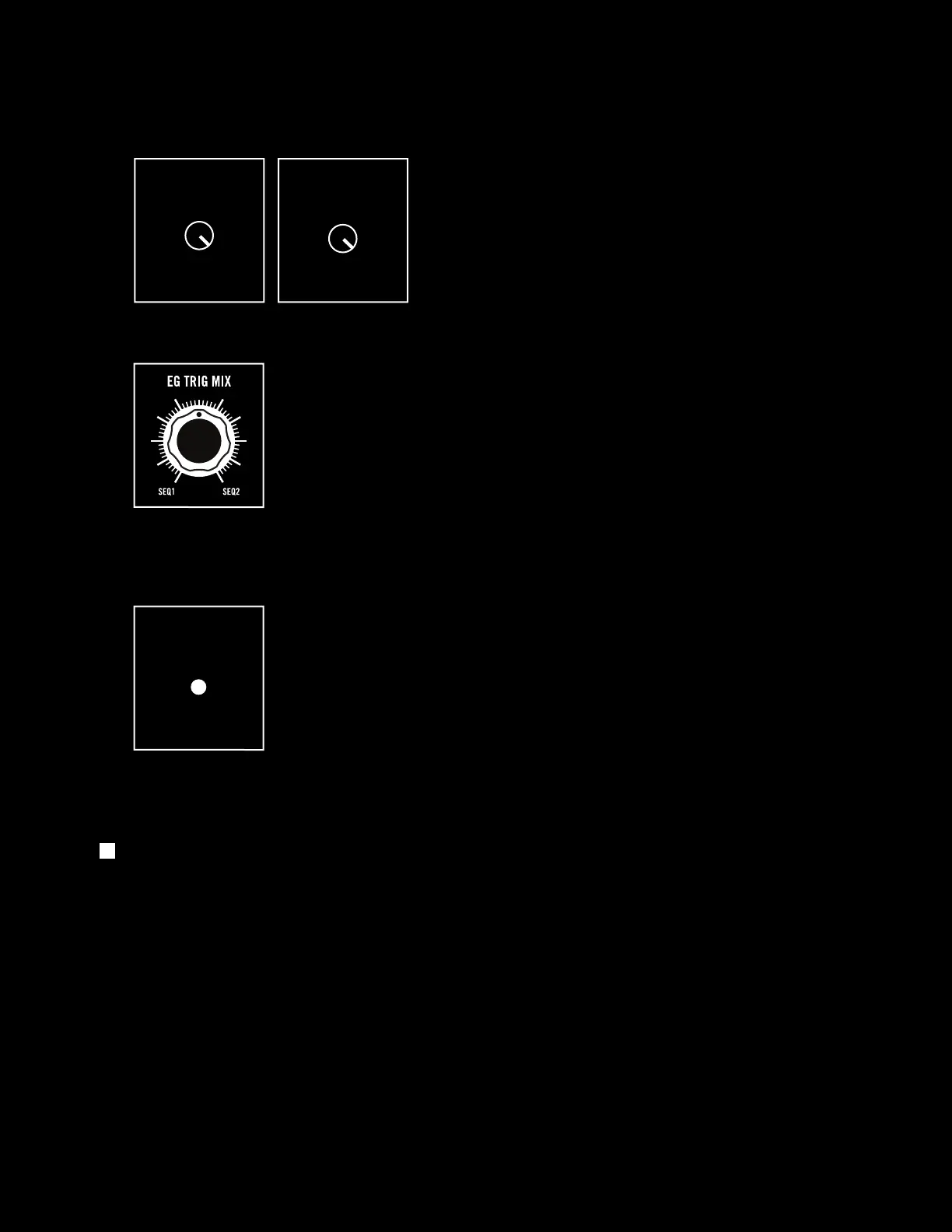
Build a sequence in SEQ2 just like you did in SEQ1 and
route it to the MOD VCO by moving the SEQ2 AMT knob
next to the MOD VCO FREQUENCY fully clockwise. Move
the VCO SEQ1 AMT knob next to VCO FREQUENCY fully
clockwise again, and experiment with listening to both
sequencers sequencing the two oscillators at the
same time.
EG TRIG MIX is a rhythmic balance control, determining which stream of
triggers is sent to the envelope generators. Fully counterclockwise only SEQ1’s
triggers will trigger the envelope generators, and fully clockwise only SEQ2’s
will. In between you will get a nice rhythmic balance, with the triggers from one
sequencer at a higher velocity than the other (unless set to 12 o’clock, where
each trigger stream will be at the same velocity). EG TRIG MIX therefore allows
you to create dynamic patterns with dierent accents.
NOTE: The EG TRIG MIX control really shines when SEQ1 and SEQ2 have dierent
rhythms at dierent lengths. Play with EG TRIG MIX while the sequencers are running to
hear all of the dierent dynamic permutations of the two SEQs against each other.
Finally, pressing CHAIN SEQ links SEQ1 and SEQ2 together for a single
sequence of up to 16 steps. The SEQ1 and SEQ2 play heads will be set in
phase, traversing these 16 steps jointly for immediate parallel dual oscillator
sequencing. These play heads can be oset from each other for round robin
eects (see the “Sequencer Button Combos” on page 37) and can also be
clocked dierently via their independent CLOCK inputs. Combined with their
individual CV RANGE attenuators, you actually have two 16-step sequencers
that share steps but can be clocked, scaled, and oset
completely independently!
CHAIN SEQ
SEQ2 AMT
QTZ
SEQ1 AMT
QTZ
18


 To Next Page