EXPLORING LABYRINTH (Continued)
THE WAVEFOLDER PATH
From the mixer, Labyrinth splits into two paths: the Voltage-Controlled Wavefolder (VCW) path and
the Voltage-Controlled Filter (VCF) path. Labyrinth contains the first Voltage-Controlled Wavefolder
in a Moog instrument, so let’s take a moment to explore the wavefolder in depth. Return your panel
settings back to the initialized state back at the beginning of the “Explore Labyrinth” section so that we
only hear the sine wave VCO (set to 12 o’clock in the mixer so that it remains clean and undistorted).
You can think of a wavefolder as something like the opposite of a filter. Whereas a filter subtracts
harmonics, a wavefolder adds them. Many Moog synthesizers begin with a waveform containing many
harmonics (such as a sawtooth or pulse wave) and use a filter to sculpt tones out of that rich base.
Since a wavefolder adds tones, it is best to begin with the simplest waveform—a sine wave, which
contains no harmonics—and build from there.
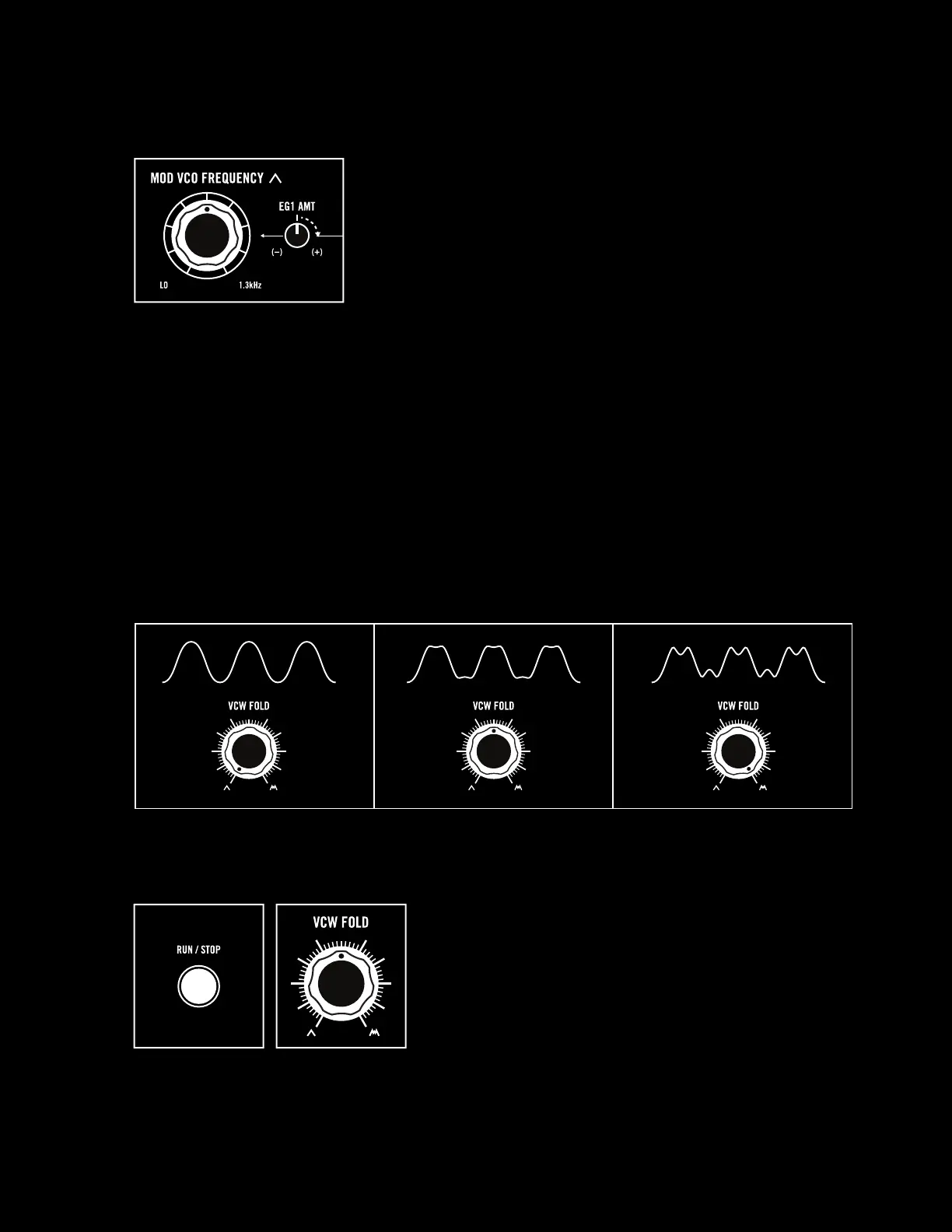
Press RUN/STOP to start the sequencer again and listen to
the clean sine wave VCO. Begin to slowly increase the VCW
FOLD knob and listen as the wavefolder adds harmonics.
As you increase VCW FOLD, the sine wave approaches the
point of distortion, but instead of clipping the tops and
bottoms of the waveform o, the wavefolder folds the wave
back on itself, creating a range of new harmonics.
WAVE FOLDING
Finally, each oscillator contains a bipolar EG1 AMT control to
add envelope modulation, which is especially useful in creating
percussive sounds. Raise the EG1 AMT control next to the MOD VCO
to add some bite, simulating a kick drum around 1 o’clock and laser
zaps fully clockwise.
20


 To Next Page