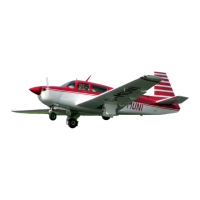
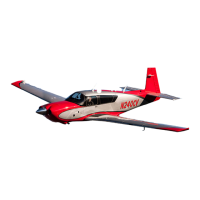
MOONEY
MODEL
M20J
SECTION
X
SAFETY INFORMATION
Ailerons
, , , ,
. .
,
.
.
, ,
. .
.NEUTRAL
Throttle
,
. . .
,
.
, , , , ,
.
RETARD to IDLE
Flaps If extended,
.
.
.
. . . .
RETRACT as soon as possible
Rudder
,
. . .
.
.
,
.
.
. .
.
.
NEUTRALIZE
Controlwheel
. . .
. . .
Smoothly MOVE AFT to bring the
nose up to a level flight attitude after spin has stopped.
VORTICES
-
WAKE TURBULENCE
Every airplane generates wakes of turbulence while in flight. Part of this is
from the propeller or jet engine and part from the wing tip vortices. The
larger and heavier the airplane the more pronounced wake turbulence will be.
Wing tip vortices from large heavy airplanes are very severe at close range,
degenerating with time, wind and space. These are rolling in nature from
each wing tip. In test, vortex velocities of 133 knots have been recorded. Ex-
haust velocities from large airplanes at takeoff have been measured at 25
mph, 2100 feet behind medium large airplanes.
Encountering the rolling effect of wing tip vortices within two minutes or less
after passage of large airplanes is hazardous to light airplanes. This roll ef-
fect can exceed the maximum counter roll obtainable in an airplane.
The turbulent areas may remain for as long as three minutes or more,
depending on wind conditions, and
may extend several miles behind the
airplane. Plan to fly slightly above or to the upwind side of the other
airplane's flight path.
Because of the wide variety of conditions that can be encountered, there is
no set rule to follow to avoid wake turbulence in all situations, However, the
Airman's lnformation Manual goes into considerable detail for a number of
wake turbulence avoidance procedures. Use prudent judgment and allow
ample clearance time and space following or crossing the wake turbulence of
other airplanes in all takeoff, climb out, approach and landing operations. Be
observant of wake turbulence from all aircraft, regardless of size.
The Airman's lnformation Manual contains a section on wake turbulence.
FAA
Advisory Circular AC 90-230 is also recommended reading.
TAKE-OFF AND
UNDiNG CONDITIONS
When taking off on runways covered with water or freezing slush, the landing
gear should remain extended for approximately ten seconds longer than nor-
mal, allowing the wheels to spin and dissipate the freezing moisture. The
landing gear should then be cycled up, then down, wait approximately five
seconds and then retract again Caution must be exercised to insure that the
entire operation is performed below Maximum Landing Gear Operating
Airspeed.
REV. B 6-12-87
ISSUED 6-2-86




 To Next Page