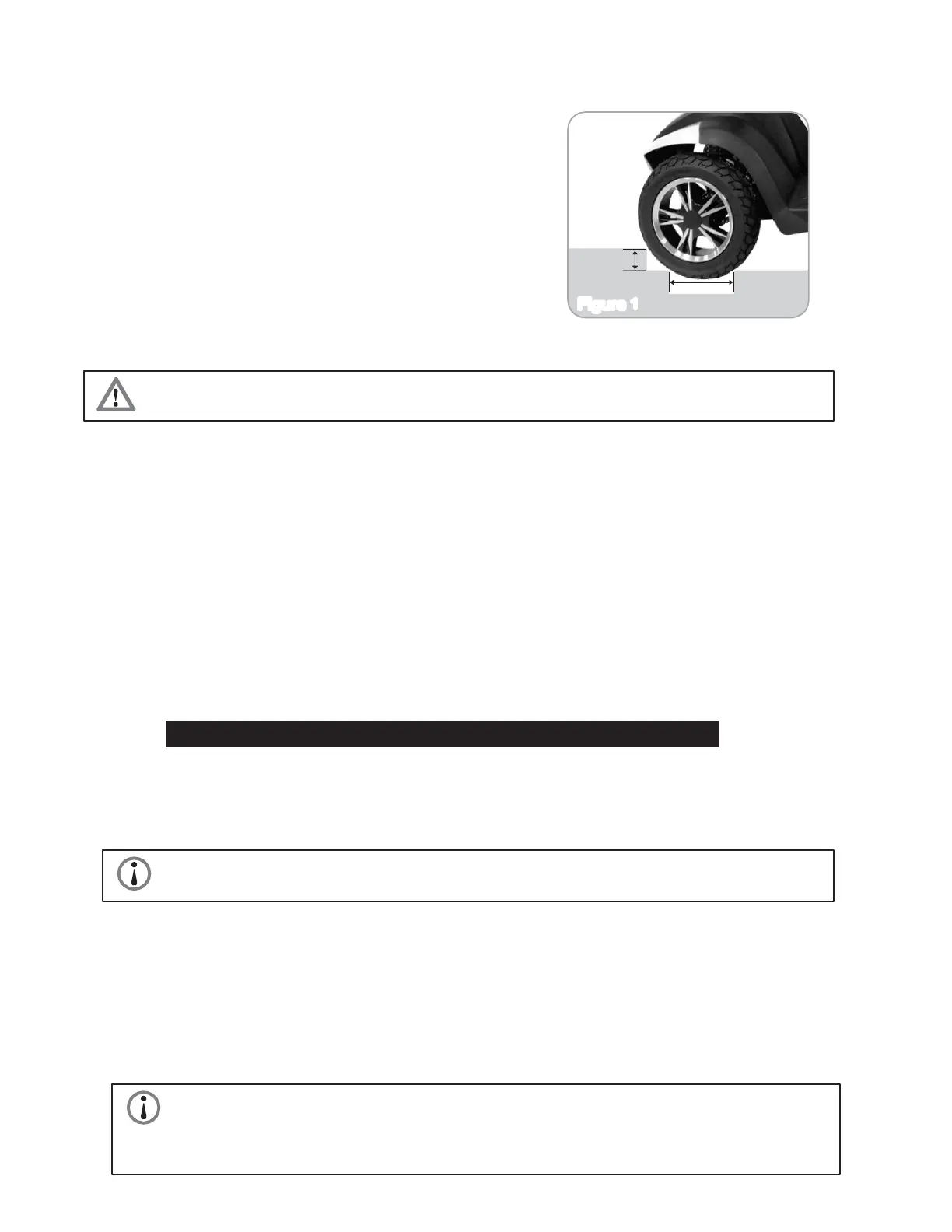
5. CAUTIONS WHEN CLIMBING
• The maximum height of obstacle and curb
that scooter can climb is up to 10 cm (A).
•
The maximum gap that scooter can drive over is
15-20 cm (B).
•
When driving scooter on ramp, adjust body
center of gravity for scooter stability.
6. ELECTROMAGNETIC INTERFERENCE AND WARNINGS
Mobility scooters may be susceptible to electromagnetic interference (EMI), which is interfering
electromagnetic energy (EM) emitted from sources such a radio stations, TV stations, amateur radio
(HAM) transmitters, two-way radios, and mobile phones. The interference (from radio wave sources)
can cause the mobility scooter to release its brakes, move by itself, or move in unintended
directions. It can also permanently damage the mobility scooter control system. The intensity of the
interfering EM energy can be measured in volts per meter (V/m). Each mobility scooter can resist EMI
up to certain intensity. This is called its "immunity level." The higher the immunity level, the greater
the protection. At this time, current technology is capable of achieving at least a 20 V/m immunity
level, which would provide useful protection from the more common sources of radiated EMI. The
immunity level of this mobility scooter model is not known.
There are a number of sources of relatively intense electromagnetic fields in the
everyday environment. Some of these sources are obvious and easy to avoid. Others
are not apparent and exposure is unavoidable. However, we believe that by following
the warnings listed below, your risk to EMI will be minimized.
The sources of radiated EMI can be broadly classified into three types :
1. Hand-held portable transceivers (transmitters-receivers) with the antenna
mounted directly on the transmitting unit. Examples include: citizens band (CB)
radios, "walkie talkie," security, fire, and police transceivers, mobile phones, and
other personal communication devices.
2. Medium-range mobile transceivers, such as those used in police cars, fire trucks,
ambulances, and taxis. These usually have the antenna mounted on the
outside of the vehicle; and
3. Long-range transmitters and transceivers such as commercial broadcast
transmitters (radio and TV broadcast antenna towers) and amateur (HAM) radios.
diffusion commerciale (pylônes d'antenne de diffusion radio et TV) et les radios
amateurs.
Other types of hand-held devices, such as cordless phones, laptop computers, AM/FM
radios, TV sets, CD players, and cassette players, and small appliances, such as electric
shavers and hair dryers, so far as we know, are not likely to cause EMI problems to your
mobility scooter.


 To Next Page