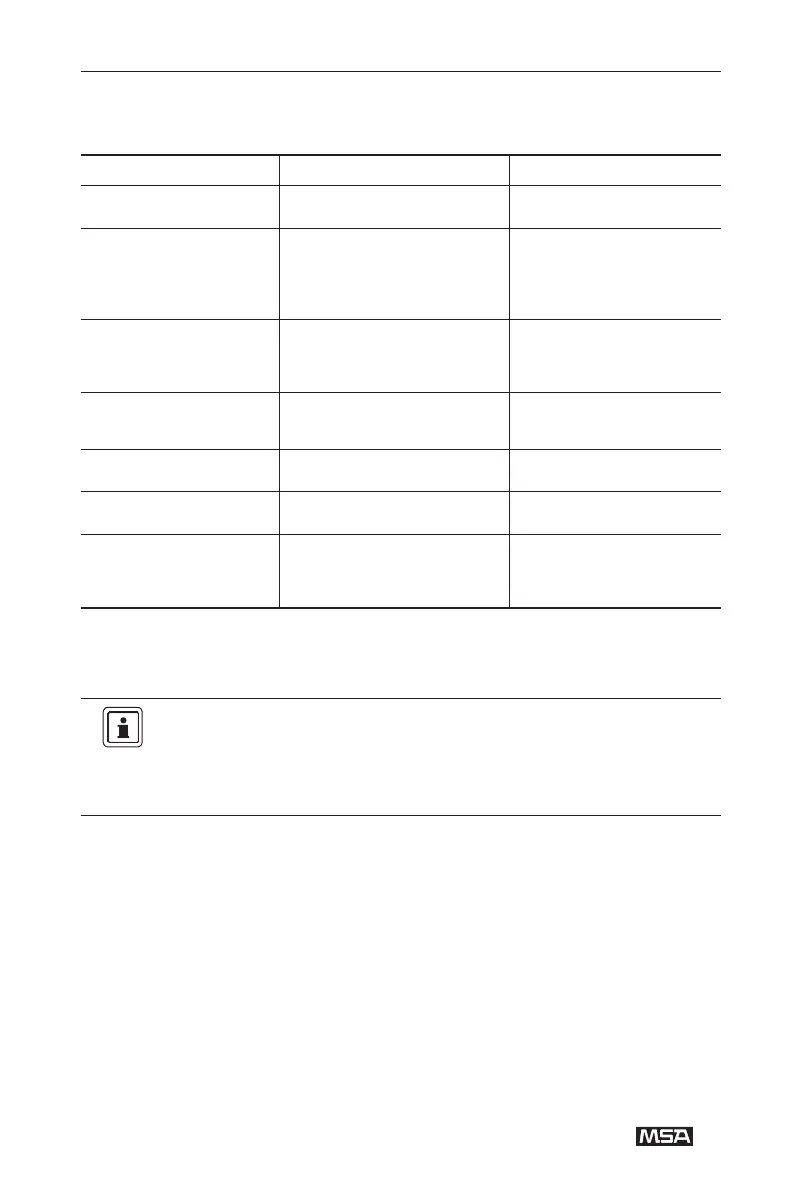
List of Detectable Gases and Measuring Ranges
:
6.5 Sensor Response to Interferants
The interference factors vary with sensor type and life time.
MSA does not recommend the customers to use interference gases for
calibration.
This table may be incomplete. The sensors may be sensitive to other
Precautions for using DF-8500 oxygen sensor:
Note: Acidic gases such as carbon dioxide and sulfur dioxide will be absorbed by the
electrolyte oxygen sensors and can help to increase the oxygen that flows to the
electrodes. This is equivalent to increasing the oxygen content. The display valu
increase approximately 0.3% with 1% increase of the carbon dioxide. The DF-
8500
oxygen sensor is not suitable for use in occasions where the carbon dioxide
concentration exceeds 25% continuously.
Poisoning:
The oxygen, carbon monoxide, and hydrogen sulfide sensors of DF-8500 are
designed
to be used under a wide range of environments and harsh conditions. However, please
Gas Adjustable Range Temperature Range
Oxygen(O
2)
10%Vol/Vol.
25%Vol/Vol.
(-20~50) ℃
Carbon monoxide(CO)
100μmol / mol
200μmol / mol
500μmol / mol
1000μmol / mol
2000μmol / mol
(-40~50) ℃
Hydrogen sulfide(H2S)
20.0μmol / mol
50μmol / mol
100μmol / mol
(-20~50) ℃
Ethylene oxide (ETO)
10.0μmol / mol
30.0μmol / mol
50μmol / mol
(-20~50) ℃
Methanol (CH3OH)
50μmol / mol
100μmol / mol
(-20~50) ℃
Chloroethylene (VCM)
50μmol / mol
100μmol / mol
(-20~50) ℃
Methanal (CH
2O)
20.0μmol / mol
50μmol / mol
100μmol / mol
(-20~50) ℃


 To Next Page