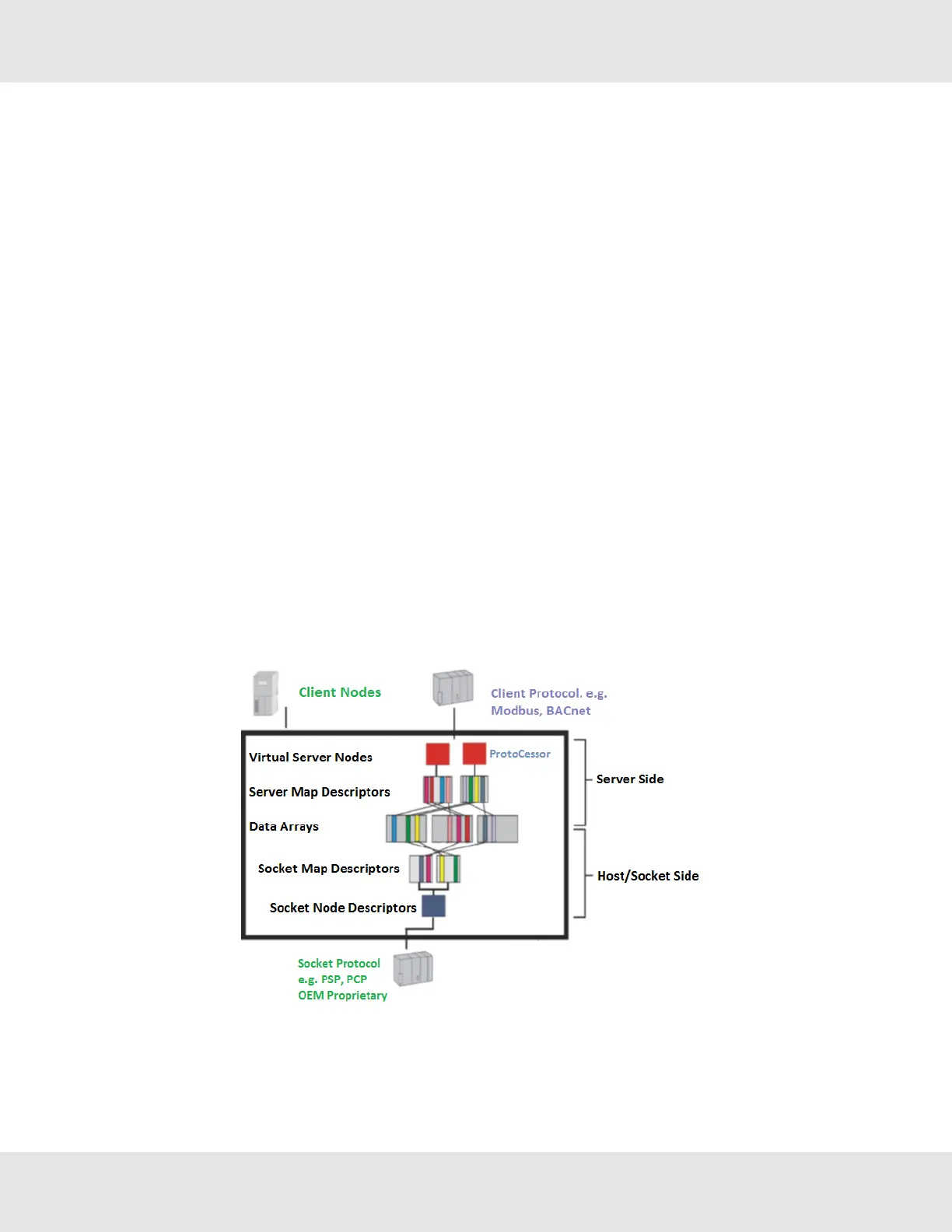
6.2.1 Application Specific ProtoCessor (ASP)
The ASP ProtoCessor has been designed specifically for OEMs with high-volume/cost sensitive products requiring efficient
but affordable protocol support. The ASP has been designed for “Plug and Play” installation – no software is required. This
is to ensure ease of installation and support by the OEM and their customers.
The ASP supports up to 100-150 points mapped to the desired field protocol. The ProtoCessor is programmed at the factory
with a static mapping configuration which cannot be changed in the field. Several different static mappings are supported via
the DIP switch user defined functions. The two banks of DIP switches enable the users to quickly configure the serial
protocol settings without the need for any 3rd party software.
Settings available via the DIP switches include:
• BACnet MS/TP MAC Address
• Baud rate (including auto-baud setting for BACnet MS/TP)
• Node-ID
Four special user defined functions can be selected via the DIP switches. These functions could be protocol or device
related. For example, the same ASP ProtoCessor can be used on four different chiller models. The DIP switches can be
used to select the specific profile used on a specific model of chiller.
ASP’s have an optional 20-pin Expansion I/O Interface that includes:
• Twelve GPIO pins that can support any combination of 12 Digital I/O or Analog Inputs.
• Eight power pins (4 ground and four 3.3V pins) that can be used to power an external device up to 500 mA at 3.3V
(LED’s).
• To access the 20 pins, the 20 socket can be laid directly on OEM hardware or can be connected with the use of a
ribbon cable (needs to be purchased separately). Refer to Section 8 Recommended Connectors, Cables and
Mechanics for connectors and cables.
17 ProtoCessor Design Guide



 To Next Page