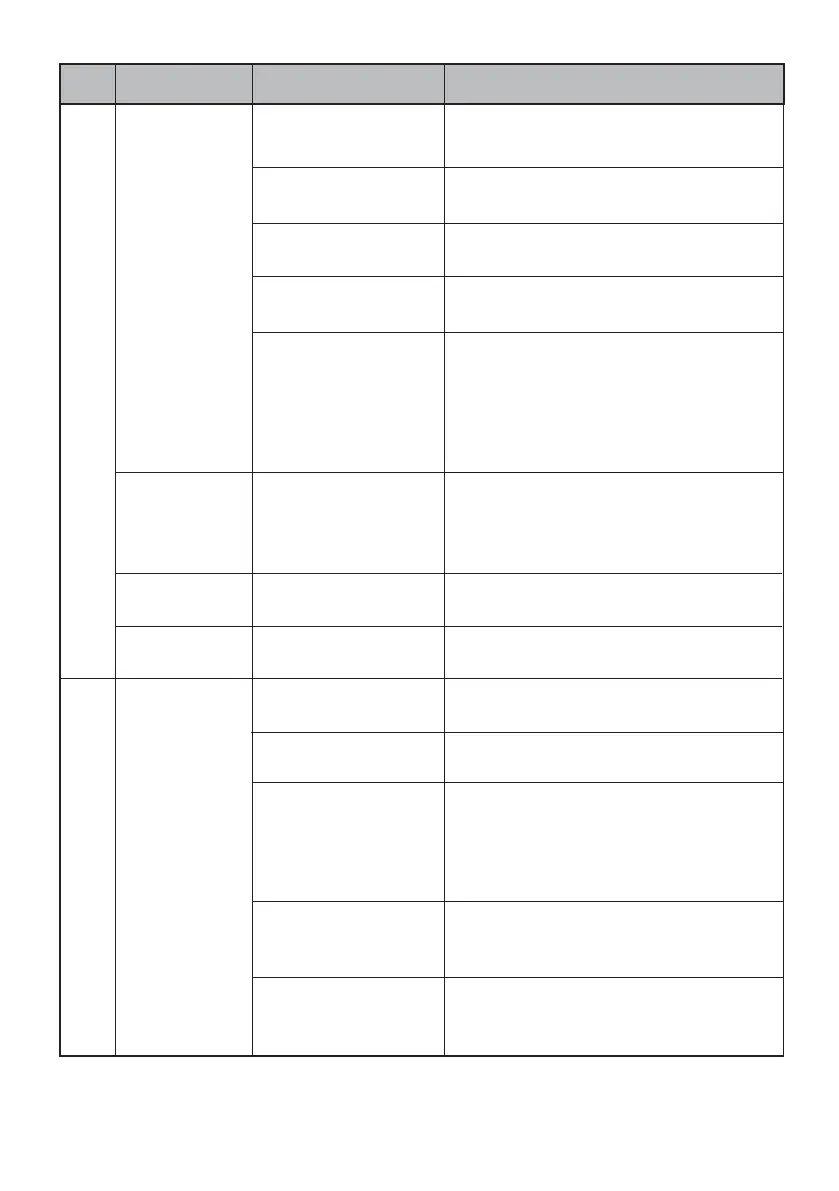
Select a more intensive program. Refer to
“Wash Cycle Table”.
Use more detergent, or change your
detergent.
Rearrange the items so that the spray arms
can rotate freely.
Clean and/or fit the filter correctly. Clean
the spray arm jets. Refer to “Dishwasher
Care” section.
Use less detergent if you have soft water
and select a short cycle to wash the
glassware and to get it clean. See “Wash
Cycle Table”.
Use a mild abrasive cleaner to eliminate the
marks.
Re-load the dishes properly. See the
“Loading the Dishwasher” section.
Load the dishwasher as suggested in the
directions.
Increase the amount of rinse aid or refill the
rinse aid dispenser.
DO NOT empty your dishwasher immediate-
ly after washing. Open the door slightly so
that the steam can escape. Begin unloading
the dishwasher only once the dishes are
cool enough to touch.
Short wash cycles use lower temperatures
which lessen performance. Choose a longer
wash program.
Water drainage is more difficult with these
items. Cutlery or dishes of this type are not
suitable for washing in the dishwasher.
Make sure dishes are loaded correctly per
the “Loading the Dishwasher” section.
Dishes not loaded
correctly.
The dishes are
not clean
Problem SolutionPossible Causes
Unsatisfactory WashingUnsatisfactory Drying
Black or gray
marks on dishes
Detergent left
indispenser cups
Improper wash
program selected.
Not enough detergent
was dispensed.
Items are blocking the
path of spray arms.
The filter system in the
base of wash cabinet is
not clean or is not
correctly fitted. This
may cause the spray
arm jets to get blocked.
Combination of soft
water and too much
detergent.
Aluminum utensils have
rubbed against dishes.
Dishes blocking
detergent cups.
Dishes not loaded
correctly.
Too little rinse aid.
Dishes removed too
soon.
Wrong program
Selection.
The dishes
are not
drying
Glassware is
cloudy
Using cutlery with a
low-quality coating.
20


 To Next Page